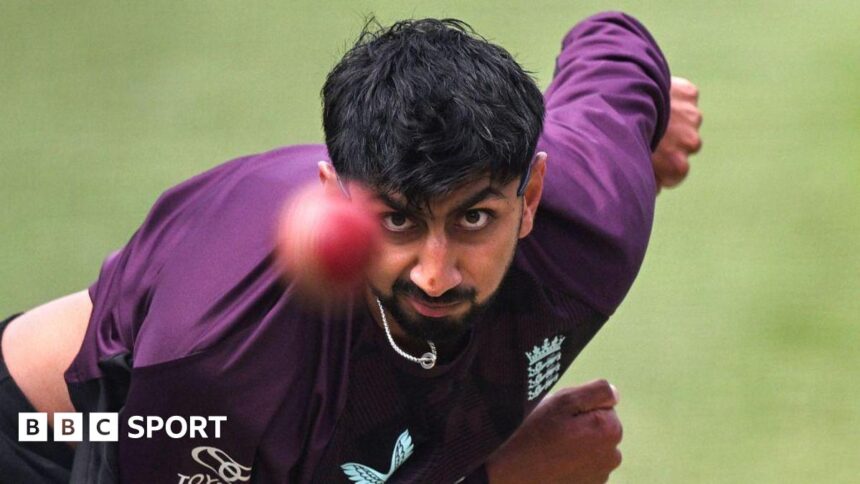
Has Shoaib Bashir Become the Ashes’ Phantom Menace? The ‘Unselectable’ Conundrum Crippling England
The narrative of England’s Ashes tour has been one of stark visibility: the glaring missed chances, the palpable frustration on weary faces, the very public dissection of a campaign teetering on the brink. Yet, one of its most compelling subplots exists in the shadows, in the form of a tall, 22-year-old off-spinner who has become the ghost in the selection room. Shoaib Bashir, present for the battle, discussed in every pre-match conjecture, remains untouched, a theory gathering dust. With his omission for the crucial fourth Test in Melbourne confirmed, a damning question now echoes: has Bashir, through circumstance and strategy, become utterly ‘unselectable’ for England?
The Genesis of a Gambit: From India Debut to Ashes Afterthought
Shoaib Bashir’s ascent was cinematic. Plucked from relative obscurity, his high-action, high-release-point off-spin earned a debut in the crucible of India earlier this year. While the raw numbers were modest, the impression was of a project with serious potential—a specialist tool for specific conditions. Fast-forward to the Ashes, and the context shifted seismically. England arrived with a clear, albeit debated, plan: twin seamers, the ever-present Ben Stokes, and two spinners in Jack Leach and the part-time but threatening Joe Root.
Bashir’s role was ostensibly as the backup spinner, the contingency. But cricket, especially an Ashes series, devours plans. The early injury to Leach was a critical blow, but instead of turning to their designated deputy, England’s think tank pivoted dramatically. They opted to bolster their pace attack, effectively deciding that a part-time spin combination of Root and the occasional trundlers was a lesser risk than unleashing an untested rookie on Australian soil. This was the first step into the selection quagmire.
The “No-Win Situation”: Anatomy of an Unselectable Player
As the series has unfolded, the logic behind Bashir’s continued exclusion has calcified into a paradox, perfectly articulated by former England spinner Phil Tufnell. “They have got themselves into this no-win situation where Bashir’s now become sort of unselectable and that’s not a good thing,” Tufnell noted. This statement cuts to the core of England’s dilemma.
Why is Bashir considered ‘unselectable’ now?
- The Pressure of Perfection: Introducing him at 2-0 or even 2-1 down in the series places an impossible burden. His first Test would be a must-win Ashes match, with the world watching for any sign of weakness. The margin for error is zero.
- The Disruption Argument: Selecting Bashir would necessitate a fundamental rebalancing of the side. It would likely mean dropping a seamer, a move the management seems philosophically opposed to, despite some docile Australian pitches.
- The “Unknown Quantity” Trap: Ironically, his lack of Test experience in Australia, initially a reason for caution, has now become a self-fulfilling prophecy. The longer he doesn’t play, the more alien the prospect of him playing becomes.
- Erosion of Confidence: For the player himself, being on tour but perpetually sidelined is mentally corrosive. Match sharpness fades, and doubt—both in the minds of the selectors and potentially his own—grows.
England have painted themselves into a corner where selecting him feels like a desperate, rather than tactical, move.
The Cost of Conservative Caution: What England is Missing
In making Bashir unselectable, England may be wilfully ignoring a potential solution. Australia’s batting line-up, particularly the left-handers, has historically shown relative comfort against conventional off-spin. However, Bashir is not conventional. His unique selling point is his extreme height and bounce, generating overspin and a steeper trajectory. In a series where England’s seamers have struggled for consistent wicket-taking threat, a point-of-difference spinner could have been a disruptive weapon.
Furthermore, the reliance on Root’s spin has been a double-edged sword. While he has taken vital wickets, it has also placed immense physical and tactical load on the team’s premier batsman and captain. Bashir’s inclusion would have freed Root, allowing him to focus on his batting and captaincy while offering a captain a genuine, attacking spin option to change the pace and rhythm of an innings. By not gambling on Bashir, England may have inadvertently overburdened their most important asset.
The Road Ahead: From Pariah to Protagonist?
So, is Shoaib Bashir’s Ashes tour a complete write-off? Not necessarily. The final Test in Sydney, traditionally the most spin-friendly wicket in Australia, looms as a potential, if belated, redemption arc. Selecting him there would no longer look like panic, but a logical response to conditions. It would be a selection born of design, not desperation.
However, the long-term implications are more profound. This tour has exposed a flaw in England’s much-vaunted ‘Bazball’ ethos, which preaches fearlessness. The selection policy towards Bashir has been anything but. It risks sending a message to young players that the philosophy has limits, and in high-stakes games, conservative instincts prevail.
For Bashir’s career, this strange, static tour could define him in two ways. It could be the tour that stalled his momentum, casting him as a perpetual prospect. Or, if he gets that Sydney chance and excels, it will become the mythic story of patience rewarded, of the weapon kept sheathed until the perfect moment. The latter, however, requires a leap of faith England have so far been unwilling to take.
Conclusion: A Selection Failure Echoes Beyond the Scoreline
England’s Ashes struggles have many fathers: dropped catches, batting collapses, and moments of tactical naivety. But the saga of Shoaib Bashir represents a different kind of failure: a failure of imagination and a failure of roster management. They brought a specialist for conditions they then decided not to exploit, turning a potential tactical weapon into a tourist. In doing so, they have not only potentially harmed their own chances in this series but have also managed the career of a promising young cricketer poorly.
Whether he plays in Sydney or not, the ‘unselectable’ tag now hangs in the air. It is a label created by hesitation, a testament to a selection committee that found itself trapped by its own early decisions. Ultimately, the Bashir paradox is a stark reminder that in Test cricket, sometimes the most damaging moves are the ones you don’t make. England’s treatment of their young spinner may well be remembered as the selection that never was, a silent contributor to the noise of an Ashes defeat.
Source: Based on news from BBC Sport.