Hearts & Celtic Seal Champions League Qualifier Spots: A New Dawn for Scottish Football
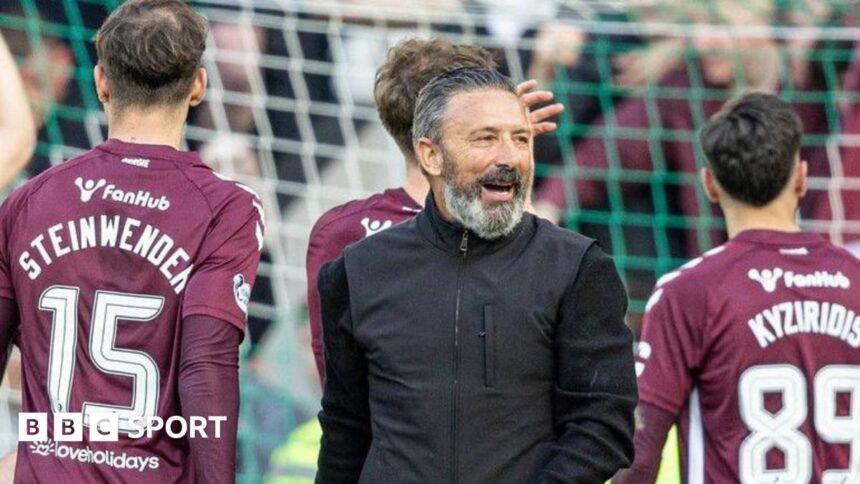
In a seismic shift for the Scottish Premiership landscape, Hearts and Celtic have officially secured their places in next season’s Champions League qualifiers. The confirmation came not from a victory in Gorgie, but from a titanic Old Firm clash at Parkhead. Martin O’Neill’s Celtic did what they do best under pressure, defeating Rangers on Sunday to ensure that Derek McInnes’ Hearts side will finish at least second in the table. This result has cracked the glass ceiling that has suffocated Scottish football for years, splitting the Glasgow duopoly for the first time since McInnes himself achieved the feat with Aberdeen in 2017.
For the maroon half of Edinburgh, this is not just a qualification; it is a resurrection. Hearts will enter the Champions League second qualifying round for the first time in two decades. The last time they graced Europe’s elite stage, the club was a different beast entirely. Now, under the meticulous stewardship of Derek McInnes, they are ready to roar again. But what does this mean for the balance of power in Scotland? And can Hearts navigate the treacherous path to the league phase? Let’s break it down.
The Old Firm Split: Why Celtic’s Win Was Hearts’ Golden Ticket
The mathematics were simple but brutal. If Rangers had won Sunday’s derby, the title race would have been blown wide open, and Hearts would have been left fighting a desperate rear-guard action to cling to second place. Instead, Celtic’s victory did two things: it handed them a commanding lead in the title chase and, crucially, it mathematically eliminated Rangers from the top-two race. Rangers can now only finish third, a position that condemns them to the Europa League qualifiers rather than the Champions League path.
This is a watershed moment. For the first time since Derek McInnes’ Aberdeen did it in consecutive seasons (2016-17 and 2017-18), a club outside of Celtic and Rangers has forced its way into the Champions League conversation. The narrative of Scottish football has been dominated by the “Old Firm duopoly” for so long that many had accepted it as an unbreakable law of nature. McInnes has shattered that law. He has taken a Hearts side that finished third last season and, through shrewd recruitment and tactical discipline, turned them into a genuine top-two force.
The irony is not lost on anyone. McInnes, the former Aberdeen manager who famously broke the duopoly before, has now done it again with a different club. His system—built on defensive solidity, set-piece prowess, and rapid transitions—has proven to be the perfect antidote to the inconsistency of Rangers. While fans in Gorgie might have secretly hoped for a Celtic slip-up to give them a sniff of the title, the pragmatic view is that securing second place with games to spare is a monumental achievement.
Navigating the Champions League Qualifying Minefield
Let’s be clear: qualifying for the Champions League group stage is a different beast entirely. Hearts will not simply waltz into the league phase. They will enter the Champions League second qualifying round, meaning they must win three gruelling two-legged ties to reach the promised land. The path is littered with landmines.
Here is what awaits Derek McInnes and his squad:
- Round 2 (Non-Champions Path): Hearts will be unseeded. They could face clubs from the top leagues in Europe, such as a third-placed team from France, or a powerhouse from the Netherlands or Portugal. Think Monaco, Fenerbahce, or Braga. These are teams with budgets that dwarf Hearts’ entire turnover.
- Round 3 (Non-Champions Path): If they survive the second round, the opposition gets stronger. Clubs like Benfica, PSV Eindhoven, or a Champions League drop-out from the top five leagues could be lying in wait.
- Play-off Round: The final hurdle. A single tie that decides whether Hearts enter the Champions League league phase or drop into the Europa League group stage. The pressure is immense.
Expert Analysis: McInnes is a master of knockout football. He thrives on being the underdog. However, the physical toll of playing European football in July and August, while also managing a Premiership campaign, cannot be overstated. Hearts will need to rotate their squad effectively. The addition of two or three high-quality, European-experienced players in the summer window will be non-negotiable. If they can keep key men like Lawrence Shankland fit and firing, they have a puncher’s chance.
My prediction? Hearts will win their second-round tie. They will be galvanized by the occasion. The third round will be a step too far against a top-tier opponent, but they will fight valiantly. A Europa League group stage berth is a realistic and excellent consolation prize. But do not write off a miracle. Football loves a fairytale, and Tynecastle on a European night is a cauldron that can unsettle any team.
The Derek McInnes Factor: A Masterclass in Pragmatic Management
Let’s give credit where it is due. Derek McInnes has been written off by critics as a “pragmatic” or “defensive” manager. That label is lazy. What he has done at Hearts is build a machine. He inherited a club with a passionate fanbase but a fractured identity. He has instilled a winning mentality and a tactical flexibility that allows his team to grind out results against the Old Firm while also dismantling the league’s lesser lights.
The key to his success has been defensive organization. Hearts have the second-best defensive record in the league, behind only Celtic. They are masters of the low block, but they are also devastating on the counter-attack. The midfield engine room, led by the tireless Cammy Devlin and the creative Beni Baningime, provides the perfect balance. Up front, Lawrence Shankland is a predator who feeds on half-chances.
McInnes has also managed the psychological aspect brilliantly. He has convinced his players that they belong at this level. He has shielded them from the pressure of the “big two” narrative. When Rangers faltered, Hearts were there to pick up the pieces. That is not luck; that is preparation.
Expert Analysis: The question now is whether McInnes will stay. His stock has never been higher. A club from the English Championship—or even a desperate Premier League side—could come calling. Hearts must do everything in their power to tie him down to a long-term contract. Losing him now would be catastrophic. He is the architect of this new era, and without him, the foundations could crumble.
What This Means for Scottish Football: A Broken Duopoly
The implications of this result extend far beyond Edinburgh. For years, the Scottish Premiership has been criticized as a “two-horse race” or, more accurately, a “one-horse race” when Celtic are dominant. The narrative has been that the league is uncompetitive, that the financial gap is insurmountable.
Hearts have just proven that narrative wrong. They have shown that with astute management, strong recruitment, and a unified club culture, you can break the monopoly. This will have a ripple effect. Other clubs—Hibernian, Aberdeen, Dundee United—will look at this and believe it is possible. Scottish football just got more interesting.
For Celtic, the win over Rangers was a double victory. They are now heavy favourites for the league title, and they have secured their own path to the Champions League qualifiers (as champions, they will enter at a later stage). For Rangers, the pain is acute. Missing out on Champions League revenue—a sum that can exceed £30 million—is a devastating financial blow. It will force them to sell players and rebuild.
Prediction for 2024-25: The power dynamic has shifted. Hearts will not just be a “flash in the pan.” They will consolidate their top-two status next season. Rangers will struggle to recover. Celtic will remain dominant, but the gap between them and the rest is shrinking. Derek McInnes is building a dynasty at Tynecastle.
Conclusion: The Maroon Revolution Has Begun
This is more than just a football story. It is a story of belief, resilience, and tactical genius. Hearts have waited 20 years for this moment. They have endured relegation, financial turmoil, and a global pandemic. Now, they stand on the brink of the Champions League.
Derek McInnes has done what few thought possible. He has taken a club with a rich history and given it a modern, ambitious future. The road to the league phase is perilous, but the journey itself is already a victory. The fans in the Wheatfield Stand will sing louder than ever. The players will run until their legs give out. And when the Champions League anthem plays at Tynecastle for the first time in a generation, it will not just be a sound—it will be a statement.
Scottish football is no longer a duopoly. It is a triopoly. And Hearts are here to stay.
Source: Based on news from BBC Sport.