Higgins Recovers to Beat O’Sullivan in Crucible Epic: The Greatest Comeback of the Modern Era?
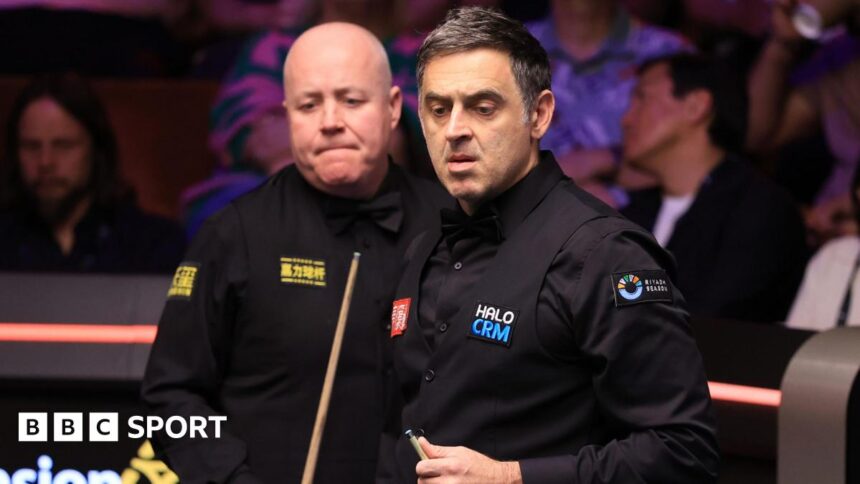
In a contest that will be etched into snooker folklore, John Higgins produced one of the most remarkable comebacks in World Championship history to defeat Ronnie O’Sullivan 13-12 in a pulsating final-frame decider at the Crucible Theatre. The four-time world champion stared into the abyss, trailing 8-3 and 9-4 against the seven-time king of Sheffield, only to summon a level of resilience that left the sport gasping for air. With a combined 11 world titles between them, this was not just a match; it was a heavyweight title fight that delivered drama, tension, and sheer snooker brilliance.
O’Sullivan, chasing an unprecedented eighth world crown to stand alone in the modern era, looked untouchable in the early exchanges. Yet Higgins, the wily Scot from Wishaw, refused to yield. He clawed back frame after frame, winning six in a row at one stage, before holding his nerve in a breathtaking final session. This was more than a victory—it was a testament to the enduring genius of two of the greatest players ever to pick up a cue.
The Rocket’s Early Dominance: A Masterclass in Control
For the first two sessions on Sunday, it appeared that Ronnie O’Sullivan was on course for a routine victory. The “Rocket” surged into a commanding 8-3 lead, playing with the fluidity and precision that has defined his career. He twice held five-frame advantages, leaving Higgins shell-shocked and the Crucible crowd anticipating a swift conclusion. O’Sullivan’s break-building was clinical, his safety play suffocating, and his cue ball control—as always—sublime.
But snooker, as the old adage goes, is a game of fine margins. Higgins, renowned for his tactical nous and never-say-die attitude, began to find a rhythm. He won the last three frames of the Sunday session to reduce the deficit to 9-6, planting a seed of doubt in O’Sullivan’s mind. It was a crucial psychological shift. “When you’re 9-4 down against Ronnie, you’re not just playing the player—you’re playing the history,” said former world champion Ken Doherty in commentary. “Higgins didn’t panic. He just started playing his game.”
- Key Turning Point 1: Higgins winning the final three frames on Sunday to trail 9-6.
- Key Turning Point 2: The Scot taking the first three frames on Monday to level at 9-9.
- Key Turning Point 3: O’Sullivan losing six consecutive frames for only the fifth time in his Crucible career.
The Great Escape: How Higgins Turned the Tide
When play resumed on Monday afternoon, the atmosphere was electric. Higgins carried the momentum from the previous evening like a man possessed. He won the opening frame of the session with a composed break of 67, followed by a gritty 58 to close the gap to 9-8. The Crucible, sensing history, began to roar. Frame 18 was the turning point. O’Sullivan had a chance to stem the tide but missed a routine red to the middle pocket. Higgins pounced, clearing up with a magnificent 71 to level the match at 9-9.
O’Sullivan, visibly rattled, lost his sixth consecutive frame as Higgins edged ahead 10-9. It was the first time the Rocket had lost six frames in a row at the Crucible since his 2014 semi-final defeat to Mark Selby. The match had flipped on its head. Yet, true to his champion’s pedigree, O’Sullivan roared back. He won frames 20 and 21 with breaks of 85 and 63, regaining the lead at 11-10. The pendulum swung again.
“That’s the mark of a true great,” said Higgins after the match. “You think you have him, and then he produces two frames of absolute magic. I just had to keep believing.” The final three frames were a chess match of safety, pressure, and nerve. Higgins levelled at 11-11 with a gritty 52, then edged ahead 12-11 with a stunning long pot that set up a frame-winning 78. O’Sullivan, refusing to surrender, forced a decider with a brilliant 67 clearance to make it 12-12.
Expert Analysis: The Psychology of a Crucible Classic
This match was not won on the practice table; it was won in the mind. John Higgins demonstrated why he is considered one of the greatest match-players of all time. His ability to reset after O’Sullivan’s counter-attack was extraordinary. “Higgins has this incredible capacity to absorb pressure,” noted snooker analyst and former world champion Stephen Hendry. “He doesn’t let the occasion overwhelm him. He just grinds you down.”
O’Sullivan, for all his genius, struggled with the weight of expectation. The quest for a record eighth title seemed to tighten his cue arm at critical moments. His missed red in frame 18 was uncharacteristic, a sign of the mental toll the match was taking. “Ronnie is the most talented player ever, but he’s human,” said Eurosport pundit Jimmy White. “When Higgins got that momentum, it was like a tidal wave. Even Ronnie couldn’t stop it.”
The final frame was a microcosm of the entire match. Both players had chances. O’Sullivan missed a tricky cut-back on a red, and Higgins—with the weight of the Crucible on his shoulders—knocked in a nerveless 40 break before a safety battle ensued. In the end, it was Higgins who potted the final pink, sparking scenes of jubilation from the Scottish contingent in the crowd. The scoreboard read 13-12, but the story was so much richer.
Predictions: What This Means for the Rest of the Tournament
Having dethroned the tournament favorite, John Higgins now becomes a genuine contender for a fifth world title. His quarter-final opponent will be buoyed by Higgins’s epic battle, but the Scot’s resilience could prove decisive. “After a win like this, you either float or you crash,” said Hendry. “Higgins has been here before. He knows how to manage the emotional comedown.”
For Ronnie O’Sullivan, this defeat is a bitter pill. At 49, time is not on his side. The quest for a record eighth title will now go into a 2026 campaign, with questions lingering about his consistency in long matches. “He’ll be back,” predicted White. “He loves the Crucible too much. But this one will hurt. It was his to win.”
The tournament now opens up. With O’Sullivan out, the path to the final becomes more navigable for players like Judd Trump, Neil Robertson, and Mark Allen. But if Higgins can reproduce the form he showed in the final three frames, he has the game to beat anyone. His tactical intelligence, combined with a newfound belief, makes him a dangerous proposition. “I’m not done yet,” Higgins said with a wry smile. “I’ve still got a few more chapters left in me.”
Conclusion: A Night for the Ages
The Higgins vs. O’Sullivan epic will be replayed for decades. It had everything: a dominant start from the favorite, a stunning comeback, a counter-attack, and a nerve-shredding decider. It was a reminder that snooker, at its best, is not just a sport—it is theatre. The Crucible crowd, which has seen everything from Dennis Taylor’s 1985 triumph to O’Sullivan’s own 147 breaks, witnessed something truly special.
John Higgins, the quiet assassin from Scotland, proved once again that heart beats talent when talent doesn’t work hard enough. Ronnie O’Sullivan, the greatest natural talent the game has ever seen, was left to ponder what might have been. For now, the Crucible belongs to Higgins. And if he can bottle the spirit of this comeback, he might just be holding that trophy again in a fortnight. The legend of the “Wizard of Wishaw” grows ever stronger.
Source: Based on news from BBC Sport.