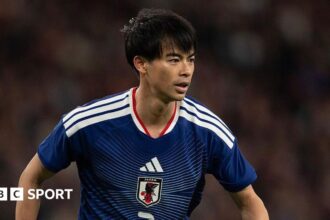
Japan’s World Cup Dream Dealt a Devastating Blow: Injured Kaoru Mitoma Fails to Make the Squad
In a development that has sent shockwaves through the Japanese football landscape, star winger Kaoru Mitoma has been officially omitted from Japan’s 23-man squad for the 2026 FIFA World Cup. The announcement, made by coach Hajime Moriyasu in Tokyo on Friday, confirms the worst fears of the Samurai Blue faithful. The 28-year-old Brighton & Hove Albion dynamo suffered a hamstring injury during a Premier League clash against Wolverhampton Wanderers last weekend, a setback that has proven too severe to overcome in time for the tournament in North America.
Mitoma’s absence is not just a loss; it is a seismic shift in Japan’s tactical identity. For a nation that has consistently failed to break through the Round of 16 ceiling, losing their most potent attacking weapon is a cruel twist of fate. “The medical team assessed that it would be difficult for him to get back to fitness during the tournament,” Moriyasu stated, his voice carrying the weight of a man who knows his best-laid plans have been dismantled.
The Anatomy of a Heartbreak: How Mitoma’s Injury Unfolded
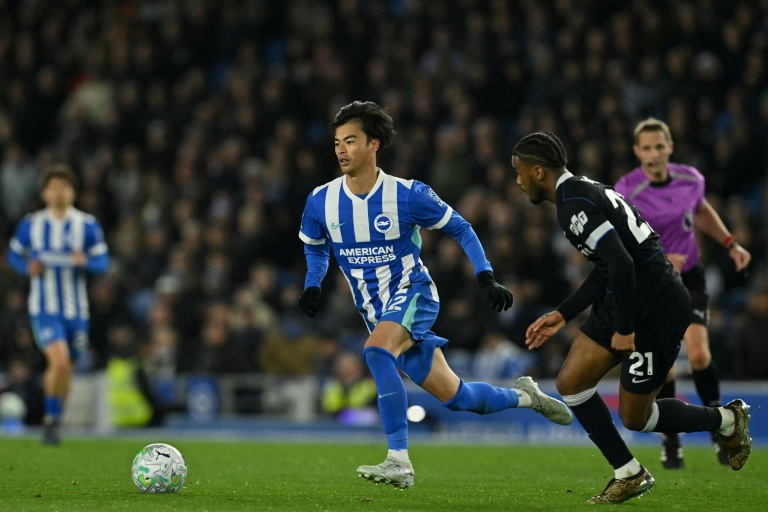
The incident that derailed Japan’s World Cup campaign occurred during a routine Premier League fixture. In the 67th minute of Brighton’s commanding 3-0 victory over Wolves, Mitoma accelerated down the left flank, a move that has become his trademark. As he planted his foot to cut inside, his hamstring gave way. The winger immediately clutched the back of his thigh, signaling the end of his domestic season and, as we now know, his World Cup dream.
The timing could not have been more catastrophic. With the World Cup kicking off in June, Mitoma had been in scintillating form, registering six goals and four assists in his last ten appearances for the Seagulls. His ability to dribble past defenders with explosive pace and deliver pinpoint crosses made him the focal point of Moriyasu’s attacking philosophy.
- Injury Type: High-grade hamstring tear (Grade 2/3).
- Recovery Window: Typically 4-6 weeks for a return to full training.
- Tournament Start: Japan’s first match is on June 14, leaving a razor-thin margin.
Moriyasu and his medical staff conducted a final fitness test on Thursday, but the results were unequivocal. “We had to be realistic,” the coach admitted. “Pushing him would risk a recurrence that could end his career. We cannot do that to a player of his caliber.”
Another Star Falls: The Takumi Minamino Setback
As if losing Mitoma wasn’t enough, Japan’s attacking depth took a second, equally painful hit. Takumi Minamino, the Monaco forward who was expected to provide creativity off the bench or as a false nine, has also been ruled out. The 30-year-old tore his anterior cruciate ligament (ACL) in his left knee in late December, a devastating injury that requires a minimum of six to nine months of rehabilitation.
Minamino’s absence removes a proven goal-scorer who thrived on the biggest stages. Remember his two goals against Germany in the 2022 World Cup? That version of Minamino, the one who could unlock a defense with a single touch, will not be in Arlington, Texas. The double blow of losing both Mitoma and Minamino means Japan has lost over 60% of its international goal contributions from the past two years.
The squad now relies heavily on players like Takefusa Kubo (Real Sociedad) and Daichi Kamada (Crystal Palace) to shoulder the creative burden. While both are talented, neither possesses the sheer electric unpredictability of a fully fit Mitoma. This forces Moriyasu into a tactical pivot—one that may favor a more compact, counter-attacking style rather than the fluid, wing-dominated approach he had spent two years perfecting.
Group F Analysis: Can Japan Survive Without Their Star?
Japan has been drawn into what is arguably one of the most balanced groups of the tournament: Group F. They will face the Netherlands, Sweden, and Tunisia. On paper, this is a group that offers a genuine path to the knockout stages—but only if the team operates at maximum efficiency.
Let’s break down the challenges:
- Netherlands (June 14, Arlington): The Dutch are the group favorites. With a defense anchored by Virgil van Dijk and a midfield led by Frenkie de Jong, they will suffocate possession. Without Mitoma’s direct running, Japan may struggle to stretch the Dutch backline.
- Sweden (June 18): The physicality of Alexander Isak and Viktor Gyökeres is a nightmare for Japan’s smaller defenders. Japan will need to be disciplined and clinical on the break.
- Tunisia (June 22): The must-win game. Tunisia is disciplined and organized, but they lack star power. This is the match where Japan’s depth—or lack thereof—will be tested most severely.
Expert Prediction: Japan’s chances of advancing have dropped from 45% to 25% without Mitoma. The Netherlands will likely top the group. The battle for second place will be a three-way dogfight between Japan, Sweden, and Tunisia. If Kubo can produce moments of magic and the defense stays compact, Japan can still sneak through. But the margin for error is now razor-thin.
Who Steps Up? The New Faces of Japan’s Attack
With Mitoma and Minamino out, the spotlight shifts to the players who must now write their own World Cup stories. Moriyasu has named a squad that leans on experience but also includes fresh legs. Here are the key figures who will define Japan’s fate:
- Takefusa Kubo (Real Sociedad): The 24-year-old is now the primary creative outlet. He has the technical ability to drift inside from the right flank, but he lacks Mitoma’s explosive pace. Kubo must become a goal-scorer, not just a playmaker.
- Daichi Kamada (Crystal Palace): A versatile midfielder who can play as a No. 10 or a winger. His vision and passing will be vital, but he has struggled for consistency in the Premier League.
- Kyogo Furuhashi (Celtic): The poacher. Furuhashi is Japan’s most natural finisher. He thrives on service into the box. If Kubo and Kamada can provide those crosses, Kyogo could be the dark horse.
- Ritsu Doan (Freiburg): The super-sub. Doan scored a stunning equalizer against Germany in 2022. He has the audacity to shoot from distance and the work rate to press high.
The defensive spine remains solid, with Wataru Endo (Liverpool) anchoring the midfield and Ko Itakura (Borussia Mönchengladbach) organizing the backline. But football is won by scoring goals, and without Mitoma, the question is simple: where will the goals come from?
Conclusion: A Cruel Lesson in World Cup Reality
The exclusion of Kaoru Mitoma from Japan’s World Cup squad is a brutal reminder that the beautiful game is often defined by its cruellest twists. For a nation that has invested heavily in technical development and tactical sophistication, losing your best player to a hamstring tear in a routine league match is the kind of misfortune that no amount of planning can prevent.
Hajime Moriyasu now faces the greatest test of his managerial career. He must reshape a team that was built around Mitoma’s genius into a collective that can grind out results. The Samurai Blue will still be dangerous. They will still press with intensity. They will still believe. But the margin for error has vanished.
My prediction? Japan will beat Tunisia, draw with Sweden, and lose narrowly to the Netherlands. That would leave them on four points—a tally that might not be enough to advance. They will exit in the group stage, not because they lacked talent, but because the one player who could turn a half-chance into a goal was watching from the stands.
For Mitoma, the road to recovery begins now. For Japan, the road to redemption starts in Arlington. And for the rest of us, we are left to wonder: what if?
Source: Based on news from Yahoo Sports.