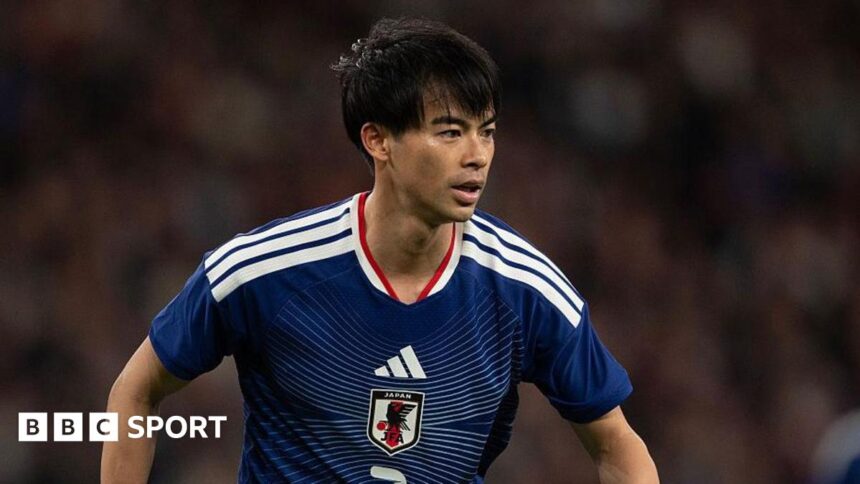
Kaoru Mitoma Omitted from Japan’s World Cup Squad: A Crushing Blow for the Samurai Blue
The football world was rocked on Friday by a devastating piece of news for both Japan and Brighton & Hove Albion supporters. Kaoru Mitoma, the electrifying winger who has dazzled the Premier League with his dribbling and creativity, has been officially left out of Japan’s 26-man squad for the 2025 World Cup. The 28-year-old suffered a significant hamstring injury during Brighton’s 3-0 victory over Wolverhampton Wanderers last weekend, an injury that will not only rule him out of the Seagulls’ final two Premier League fixtures against Leeds United and Manchester United but, more critically, has ended his dream of representing the Samurai Blue on the grandest stage this summer.
Manager Hajime Moriyasu confirmed the news during a press conference in Tokyo, acknowledging the immense disappointment while emphasizing the need for squad cohesion. Mitoma’s absence leaves a gaping hole on the left flank—a position where his unique ability to beat defenders one-on-one and deliver pinpoint crosses has become Japan’s primary attacking weapon. With the tournament set to kick off on 14 June, Japan faces a daunting Group F featuring the Netherlands, Tunisia, and Sweden, and the loss of their talismanic creator could shift the entire dynamic of the group.
The Injury Timeline: A Season-Ending Setback
The sequence of events that led to this heartbreaking omission unfolded rapidly. Mitoma, who has been a consistent performer for Brighton under manager Roberto De Zerbi, started the match against Wolves on the left wing. Early in the second half, with Brighton already leading 2-0, Mitoma attempted a sharp change of direction to accelerate past a defender. He pulled up immediately, clutching the back of his left thigh, and was substituted shortly after. Scans later confirmed a grade two hamstring tear, a diagnosis that typically requires a minimum of four to six weeks of rehabilitation.
Given that Japan’s World Cup opener against the Netherlands is on 14 June, Mitoma would have had less than a month to regain full fitness, match sharpness, and integrate into Moriyasu’s tactical setup. The risk of re-injury was simply too high. Brighton’s medical staff confirmed he would miss the final two league games, and the Japanese federation’s doctors, after consultation, recommended against forcing the issue. The decision, while pragmatic, is a bitter pill for a player who has scored nine goals in 31 international appearances since his debut in 2021.
Key facts of the injury and its impact:
- Mitoma suffered a hamstring injury in Brighton’s 3-0 win over Wolves (May 2025).
- He will miss Brighton’s final two Premier League matches: vs. Leeds United and Manchester United.
- The recovery timeline made him unavailable for Japan’s pre-tournament training camp.
- This is the second major injury blow for Japan in recent months, following the loss of Takehiro Tomiyasu to a knee issue earlier in the season.
Japan’s Group F Challenge: Life Without the X-Factor
Japan’s Group F is arguably one of the most balanced and unpredictable groups in the tournament. The Samurai Blue open against the Netherlands on 14 June, followed by a clash with Tunisia on 21 June, and conclude the group stage against Sweden on 26 June. Without Mitoma, the attacking burden shifts dramatically to other players. The Netherlands, with their deep defensive structure and physical midfield, will be particularly difficult to break down without a dribbler of Mitoma’s caliber. Sweden’s aerial threat and Tunisia’s disciplined counter-attacking style also pose unique challenges.
Manager Moriyasu has opted for a squad built on Premier League and European experience. Liverpool’s Wataru Endo provides steel and leadership in midfield, while Crystal Palace’s Daichi Kamada offers creativity and goal-scoring from the number ten role. Ao Tanaka of Leeds United and Celtic’s Daizen Maeda are also included, with Maeda likely to be tasked with filling the left-wing void. However, Maeda is a different profile of player—more of a direct runner and presser than a technical dribbler. The loss of Mitoma’s unpredictability cannot be understated.
Japan’s World Cup 2025 Group F schedule:
- 14 June: Japan vs. Netherlands (Opening match)
- 21 June: Japan vs. Tunisia
- 26 June: Japan vs. Sweden
From a tactical perspective, Moriyasu may now shift to a more compact 4-4-2 formation, relying on the midfield trio of Endo, Tanaka, and Kamada to control possession and feed the strikers. The full-backs, likely Yukinari Sugawara and Hiroki Ito, will be asked to provide overlapping width in the absence of a natural wide threat. The pressure will be immense on Kamada to drop deep and link play, but without Mitoma stretching defenses, Japan’s attacking patterns become more predictable.
Expert Analysis: The Ripple Effect on Japan’s Tactical Blueprint
As a long-time observer of Asian football and the Premier League, I can say with confidence that Mitoma’s absence is the single most significant injury blow to any Asian nation at this World Cup. Japan’s entire attacking identity under Moriyasu has been built around the concept of “verticality through individual brilliance.” Mitoma was the player who could take the ball in tight spaces, draw two or three defenders, and either win a foul or create a chance out of nothing. In the 2022 World Cup, Japan stunned Germany and Spain with disciplined counter-attacking football. In 2025, they were expected to be more proactive, and Mitoma was the key to that evolution.
The selection of Daizen Maeda is telling. Maeda, who plays for Celtic, is a relentless runner but lacks the close control and final product of Mitoma. He scored 12 goals in the Scottish Premiership this season, but his output in the Champions League was minimal. Another option is Ritsu Doan of SC Freiburg, who is more of a right-sided inverted winger. The left flank is now a major question mark. Expect Moriyasu to experiment with Kamada drifting wide, but that weakens the central attacking midfield area.
Three critical tactical adjustments Japan must make:
- Increased reliance on set pieces: Without Mitoma’s open-play creativity, Japan must maximize corners and free-kicks. Wataru Endo’s aerial presence and center-back Ko Itakura’s timing will be vital.
- Midfield overload: Japan’s best chance is to dominate the midfield battle. Tanaka and Endo must press high and win second balls to supply the forwards quickly, bypassing the need for wide isolation.
- Full-back aggression: Sugawara and Ito must become auxiliary wingers. If they can pin back the opposition full-backs, Japan can create crossing opportunities even without a natural wide dribbler.
Prediction for Japan’s group stage: Without Mitoma, Japan loses its primary game-breaker. I still believe they have enough quality to beat Tunisia, but the Netherlands and Sweden will be extremely difficult. I predict Japan finishes third in Group F with four points (win vs. Tunisia, draw vs. Sweden, loss vs. Netherlands), which would likely be insufficient to advance as one of the best third-placed teams. The dream of a second consecutive Round of 16 appearance now hangs by a thread.
Strong Conclusion: A Nation’s Heartbreak and a Star’s Resilience
Injuries are the cruelest part of football. For Kaoru Mitoma, a player who rose from the J-League to become one of the Premier League’s most exciting wingers, missing a World Cup at the peak of his powers is a tragedy that transcends sport. He will watch from home as his teammates take on the Netherlands, Tunisia, and Sweden, knowing that his unique talent could have been the difference between a heroic campaign and an early exit. Yet, if there is one thing Mitoma has shown throughout his career, it is resilience. He overcame rejection early in his career, worked tirelessly to improve his physicality, and became a star at Brighton. This setback will not define him.
For Hajime Moriyasu and the Samurai Blue, the message is clear: adapt or perish. The squad is still filled with quality—Endo, Kamada, Tanaka, and Maeda are all proven competitors. But the loss of Mitoma removes the element of surprise. Japan must now rely on collective grit, tactical discipline, and a little bit of luck. The World Cup is a tournament where heroes emerge from the shadows. Perhaps a player like Ao Tanaka, who scored the decisive goal against Spain in 2022, will step up again. Perhaps Daichi Kamada will produce the performance of his life.
Whatever happens, the story of Japan’s 2025 World Cup campaign will forever be framed by the absence of its most brilliant star. The road ahead is steeper, the margin for error slimmer. But in football, as in life, the show must go on. For Mitoma, the journey is not over—it is merely postponed. For Japan, the fight begins now, without their magician, but with the heart of a nation behind them.
Source: Based on news from BBC Sport.