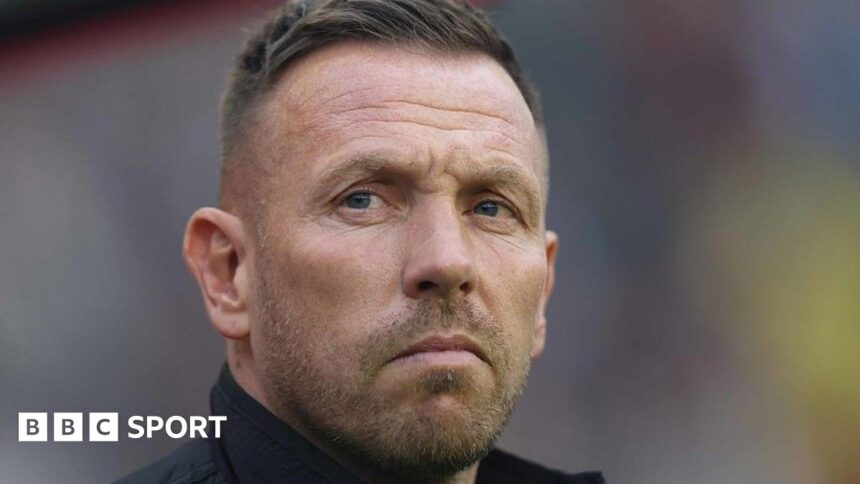
Inside the Complex Mind of Craig Bellamy: The Method Behind the Wales Revolution
The room is silent, save for the faint hum of a projector. Its light cuts through the dimness of a neat, sparse office at Dragon Park, illuminating a wall transformed into a digital mosaic. Files and folders are layered so densely they obscure the laptop’s desktop background. At the centre of this web of data sits Craig Bellamy. The fiery, electric forward who once terrorised Premier League defences is now a picture of concentrated stillness. This is the inner sanctum of the Wales head coach, a place where passion is now processed through pixels, where a legendary intensity has been channelled into a blueprint for a nation’s future.
From Dragon’s Fire to Analytical Focus
To understand Bellamy the manager, one must first reconcile him with Bellamy the player. On the pitch, he was pure, incandescent emotion—a blur of relentless pressing and explosive outbursts. The expectation was for a manager cut from the same cloth: a fiery motivator leaning on passion alone. The reality inside his office at Wales’ national development centre reveals a profound evolution.
Bellamy chooses to work here, on the outskirts of Newport, for a simple, telling reason: “this is a football place.” It is a statement that rejects glamour for purpose. His workspace is a temple to that purpose. Aside from two framed Wales shirts and a single, powerful photograph of his late friend and mentor Gary Speed, there is little decoration. The only personal item is a copy of his own autobiography, perhaps a reminder of the journey. The real story, however, is projected on the wall.
Every single training session Bellamy has ever conducted is catalogued here. With a click, he can whiz through clips, pulling up data, comparing performances, tracking micro-improvements. This is not a hobby; it is the core of his methodology. The man once defined by his heart is now a coach defined by his head, using forensic analysis to build a new Welsh identity.
The Blueprint: Data, Detail, and the Speed Legacy
Bellamy’s approach is a fusion of cutting-edge modern management and deep personal legacy. The framed photo of Gary Speed is not merely a tribute; it is a guiding star. Speed began the cultural shift within the Wales setup, instilling professionalism and belief. Bellamy, his former teammate, is now the inheritor and expander of that mission.
His analytical process is exhaustive. He reels off statistical indicators of Wales’ improvement under his tenure with the ease of a data scientist:
- Pressing triggers and counter-pressing efficiency measured to the percentage.
- Passing networks and patterns of play developed through repetitive, filmed training drills.
- Individual player progression metrics, tracking development across camps.
“The game doesn’t lie,” Bellamy often says. In his office, the game is broken down into a thousand truths, each one a data point on the path to progress. This meticulousness ensures that the famous Welsh spirit—the “hwy!”—is not just raw emotion, but a structured, intelligent force. The Wales head coach has built a system where passion and plan are inseparable.
Dragon Park: The Heartbeat of a Football Nation
Bellamy’s insistence on basing himself at Dragon Park, the FAW’s national development centre, is a strategic masterstroke. It signals a commitment to the ecosystem, not just the elite team. His presence there creates a tangible thread connecting the senior side to the youth pathways.
Young players training on adjacent pitches see the national manager in the corridors. He can pop into a U18 session, his projector likely filled with clips of their games too. This accessibility fosters a unified style and a clear dream. The national development centre becomes more than a facility; it becomes the physical manifestation of a continuous philosophy, from academy to international cap.
This environment keeps Bellamy grounded in development, reminding him that his role is as much about nurturing the next generation as it is about winning the next match. The sparse office, surrounded by training fields, ensures there are no distractions. Only football.
The Road Ahead: Predictions for the Bellamy Era
So, what does this complex, data-driven, yet deeply emotional project yield? The predictions for Bellamy’s Wales are compelling.
First, expect a team that is exceptionally well-prepared and adaptable. Bellamy’s archive of training sessions means no scenario is unforeseen. Teams will face a Welsh side that knows its own patterns intimately and can adjust tactically mid-game based on a library of pre-worked solutions.
Second, the production line will strengthen. Bellamy’s embedded presence in the development structure will accelerate the integration of youth, creating a smoother transition for talents like Jordan James and Charlie Crew, ensuring the post-Bale generation is not a valley but a plateau of competitiveness.
Most importantly, Wales will play with a recognisable, aggressive identity—a high-intensity pressing game married to technical possession. It will be the football of his mentor, Speed, and his own playing ethos, but refined through the clear-eyed analysis of his coaching mind. Major tournament qualification should be the expected norm, not a euphoric exception.
Conclusion: A Modern Manager Forged in Welsh Fire
To walk into Craig Bellamy’s office is to understand the modern evolution of a football man. The maze of files on the wall is the map of his mind: detailed, complex, and utterly focused. The photo of Gary Speed is the soul that guides it. The choice of Dragon Park is the statement of intent for a nation.
This is no longer the story of a hot-headed superstar. It is the story of a philosopher-coach, one who has taken his own formidable will and systematised it. The Wales head coach has built a laboratory for Welsh football excellence, where every moment is recorded, every statistic weighed, and every decision informed. The dragon on the shirt now represents not just fire, but focus. And with Craig Bellamy’ complex mind at the helm, the future of Welsh football is not just passionate—it is projected, pixel by pixel, onto the wall, waiting to be realised.
Source: Based on news from BBC Sport.