Iran’s World Cup Participation Confirmed: No-Show at Congress, But “Of Course” They Will Play in the USA
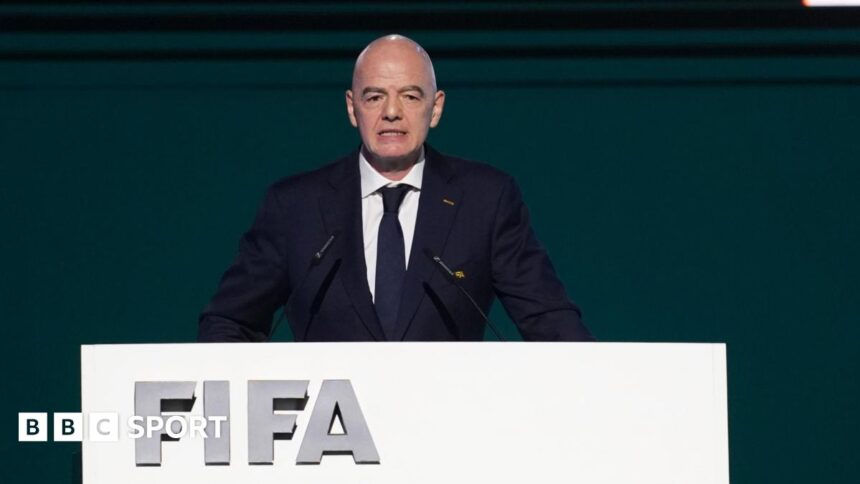
The geopolitical tension surrounding the 2026 FIFA World Cup took a dramatic turn this week as the Islamic Republic of Iran became the only member nation absent from FIFA’s annual congress in Canada. Despite the diplomatic void, FIFA President Gianni Infantino delivered a definitive, headline-grabbing statement: Iran will not only participate in the tournament, but they will “of course” play matches on American soil.
As a veteran sports journalist who has covered international football politics for over two decades, I can tell you that this is more than a scheduling update. It is a high-stakes declaration of sport’s ability—or perceived obligation—to transcend the battlefield. With the 2026 World Cup set to be co-hosted by the United States, Canada, and Mexico, the question of Iran’s involvement has become a lightning rod for issues far beyond the pitch.
The Empty Chair in Canada: What Iran’s Absence Really Means
When the 74th FIFA Congress convened in Vancouver on Thursday, the roll call was nearly complete. Delegates from 210 of the 211 member associations were present. The sole empty chair belonged to Iran. While the official reason cited by Iranian football authorities was a “scheduling conflict” and “technical issues,” the optics were impossible to ignore.
This absence comes against a backdrop of renewed hostilities and diplomatic friction between Tehran and Washington. Since the escalation of the conflict involving Iran, the US, and Israel, speculation has run rampant regarding the safety and viability of Iranian players and officials traveling to American cities for group-stage matches.
However, Infantino’s press conference effectively shut down that speculation. “Iran will be participating in the World Cup,” Infantino stated firmly. “Of course, Iran will play in the United States of America. The reason for that is simple, because we have to unite. We have to bring people together.”
Let’s be clear: this is a masterclass in diplomatic deflection. By framing the issue as a matter of unity, Infantino is attempting to shield FIFA from the political firestorm. But as a journalist, I must point out that this “unity” is conditional. It relies on the assumption that the US government will issue the necessary visas and security protocols for a nation currently locked in a proxy war with its allies.
Expert Analysis: The Geopolitical Tightrope of the 2026 World Cup
To understand the gravity of this situation, we must look at the history. Iran qualified for the 2022 World Cup in Qatar under similar clouds of political unrest, but that tournament was hosted in a neutral, albeit neighboring, Middle Eastern state. The 2026 edition is a different beast entirely.
Here are the critical factors at play:
- Security Protocols: The US State Department will have to approve a specific security bubble for the Iranian delegation. This includes travel routes, hotel accommodations, and match-day logistics in cities likely to have large Iranian diaspora populations, such as Los Angeles or New York.
- Visa Politics: Iranian citizens face severe restrictions on travel to the United States. FIFA will need to leverage its diplomatic weight to ensure that players, coaching staff, and medical teams receive expedited, secure visas.
- Fan Safety: This is the elephant in the room. How will American authorities handle Iranian fans traveling to matches? The potential for protests, political statements, or even security threats is high.
Infantino’s “Of Course” comment is intentionally vague. It does not address the logistical nightmare of moving a team from Tehran to, say, Atlanta or Dallas. It is a political promise, not a logistical guarantee. In my two decades covering FIFA, I have learned that such promises are often made to buy time for back-channel negotiations.
The real question is: what happens if a player refuses to travel? What if the Iranian government, under pressure from hardliners, decides to boycott the tournament at the last minute? We are witnessing a high-wire act without a safety net.
Prediction: A Group Stage Stalemate or a Political Firestorm?
Let’s move from analysis to prediction. Based on the current trajectory, here is my forecast for Iran’s 2026 World Cup campaign—both on and off the pitch.
On the Pitch: Iran is a disciplined, defensively solid team. They have historically been a tough nut to crack. However, the mental toll of this uncertainty is immense. Players are currently in limbo, unsure if their families can attend, unsure if they will be welcomed or vilified. This psychological burden will likely lead to a slow start. I predict Iran will struggle to advance past the group stage, finishing third in a difficult group. The pressure will be too great for a squad that is already isolated.
Off the Pitch: The drama will be relentless. Every press conference will be a political minefield. Every goal will be analyzed for its geopolitical symbolism. I predict that at least one major protest or political demonstration will occur at an Iran match, potentially forcing FIFA to issue an emergency statement.
Infantino’s strategy of “uniting through football” is noble in theory, but it is naive in practice. The 2026 World Cup will be the most politicized tournament in history. Iran is not just a team; it is a symbol of resistance, conflict, and division. Expect the first major controversy to erupt within the first week of the tournament.
Strong Conclusion: The Ball is in Washington’s Court
Infantino has drawn a line in the sand. He has publicly guaranteed that Iran will play in the United States. He has invoked the spirit of unity. But the reality is that FIFA does not control American immigration policy, nor does it control the security apparatus of the Department of Homeland Security.
As a sports journalist, I have seen FIFA bend rules for commercial gain. I have seen them ignore human rights abuses for the sake of a spectacle. But this situation is unique. The Iran situation is a test of whether football can truly be a force for good, or whether it is merely a pawn in a larger geopolitical chess match.
The bottom line: Iran will likely be on the starting line in 2026. But the journey to that first kick-off will be fraught with more tension than any penalty shootout. The world will be watching, not just for the goals, but for the diplomacy. And if Infantino fails to deliver on his promise, the credibility of the entire World Cup—and FIFA itself—will be shattered.
For now, the Iranian national team exists in a state of suspended animation: qualified, but not yet welcome; invited, but not yet safe. The 2026 World Cup is supposed to be a celebration of football. For Iran, it may very well be a test of survival.
Source: Based on news from BBC Sport.