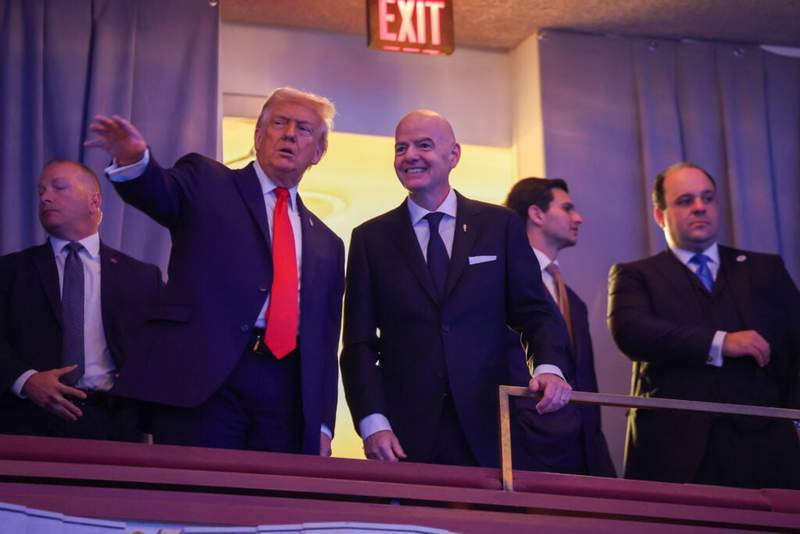
Iran’s World Cup Dream Secured: FIFA President Infantino Delivers Final Verdict After Trump’s Mixed Signals
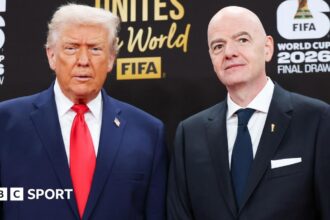
The geopolitical storm clouds that threatened to engulf Iran’s participation in the 2026 FIFA World Cup have officially cleared. In a decisive move that has sent ripples through the global football community, FIFA President Gianni Infantino has confirmed that the Islamic Republic of Iran will take its place on football’s grandest stage. This definitive ruling comes after weeks of intense speculation, fueled by a series of contradictory remarks from former U.S. President Donald Trump, which had cast a long shadow over the tournament’s integrity.
For months, the question was not about Iran’s form on the pitch, but about the political landscape off it. The nation’s deeply entrenched involvement in regional conflicts—particularly its adversarial posture toward Israel and its tense, decades-long standoff with the United States—created a perfect storm of uncertainty. The prospect of a major international boycott or a last-minute ban seemed all too real. But with Infantino’s statement, the narrative has shifted from “if” to “when and how” Iran will compete.
The Trump Factor: A Volatile Catalyst for Confusion
The rollercoaster of speculation began in earnest following a series of public statements from Donald Trump. Initially, the former president appeared to adopt a pragmatic stance, suggesting that Iran’s status in the World Cup would likely remain unchanged. This brief moment of calm, however, was shattered when Trump pivoted, raising pointed concerns about the “life and safety” of Iranian athletes.
These remarks were a red flag to tournament organizers and human rights advocates alike. The implication was clear: that the political and security risks associated with Iran’s participation were too high to ignore. The mixed signals created a diplomatic minefield. One day, the door appeared open; the next, it seemed bolted shut. This inconsistency forced FIFA into a corner, demanding a clear, unequivocal response from the sport’s governing body.
- Initial Stance: Trump’s first comments downplayed the risk, suggesting business as usual.
- The Pivot: Later remarks focused on athlete safety, citing geopolitical instability.
- Market Reaction: Sponsors and broadcasters began contingency planning for a possible ban.
- Iranian Response: Tehran accused Washington of weaponizing sports for political leverage.
The core of the issue was the safety of the players. Would they be targeted? Could their presence in the United States—a co-host of the 2026 tournament—spark protests or security incidents? Trump’s comments, while vague, were enough to ignite a firestorm of debate. It was a classic case of political football, where the ball was the very soul of the tournament.
Infantino’s Decisive Intervention: The Final Word
Gianni Infantino, a figure often criticized for his opaque decision-making, broke his silence with a clarity that surprised many. In a press conference streamed live from FIFA’s headquarters in Zurich, the president delivered his verdict: Iran will play in the 2026 World Cup. There would be no ban, no suspension, and no last-minute revocation of their qualifying spot.
Infantino’s statement was a masterclass in diplomatic tightrope walking. He acknowledged the “serious concerns” raised by political leaders, including Trump, but firmly drew a line between sport and statecraft. “Football must remain a force for unity, not a tool for division,” Infantino declared. “The integrity of the competition is paramount. We have reviewed all security protocols, and we are satisfied that the conditions for participation are met.”
This decision was not made in a vacuum. Behind the scenes, FIFA’s legal team had been working overtime, analyzing the statutes of the organization. The key principle at play was non-discrimination. FIFA’s rules explicitly prohibit the exclusion of a member association based on the political actions of its government, provided the team itself has not violated specific FIFA regulations. Unless Iran’s football federation was directly implicated in a breach—such as government interference in its operations—a ban was legally untenable.
The expert analysis here is clear: Infantino chose the path of legal and procedural safety. A ban would have set a dangerous precedent, opening the door for future tournaments to be hijacked by geopolitical agendas. By confirming Iran’s place, he is protecting the autonomy of sport, even if it means enduring political backlash.
What This Means for the 2026 World Cup: The Ripple Effect
With the uncertainty resolved, the focus now shifts to the practical implications. Iran’s presence in the 2026 tournament, which will be co-hosted by the United States, Canada, and Mexico, is a massive logistical and security challenge. The United States is a primary co-host, and the prospect of Iranian athletes competing on American soil remains a sensitive issue.
Security protocols will be significantly enhanced. Expect to see a heavy presence of private security contractors and federal agents around the Iranian team’s hotel, training facilities, and match venues. The U.S. State Department has already indicated it will work closely with FIFA to ensure the safety of all participants, including those from adversarial nations.
Furthermore, this decision has a direct impact on the tournament’s group stage draw. Iran is currently ranked as a strong Asian contender. Their inclusion means that other teams in their group will face a disciplined, defensively solid opponent. From a footballing perspective, Iran is no pushover. They have a history of frustrating top-tier teams, as seen in their 1-0 loss to Spain and 1-1 draw with Portugal in the 2018 World Cup.
- Security Budget: Expect a 15-20% increase in security spending for matches involving Iran.
- Fan Dynamics: Iranian diaspora communities in the U.S. and Canada will likely turn out in force, creating a unique atmosphere.
- Media Scrutiny: Every press conference and training session will be dissected for political undertones.
- Player Pressure: Iranian players will face immense psychological pressure, both from their government and from global public opinion.
The predictions from leading sports analysts are mixed. Some believe the political distraction will cripple the team’s morale, leading to an early exit. Others argue that the “us against the world” mentality could galvanize the squad, producing a historic performance. Historically, Iran has struggled to advance past the group stage, but they have never been eliminated without a fight.
Expert Analysis: The Geopolitical Chess Match Continues
From my perspective as a seasoned sports journalist, this is far more than a football story. It is a case study in the weaponization of international sport. Trump’s comments, whether calculated or spontaneous, forced FIFA into a corner. Infantino’s response was a defensive play, but a smart one. He has effectively neutralized the immediate threat to the tournament’s credibility.
However, the underlying tensions remain. Iran’s government will likely use this confirmation as a propaganda victory, framing it as a defeat for American pressure. Conversely, critics will argue that FIFA is turning a blind eye to human rights abuses by allowing the regime to showcase itself on a global platform. This is a classic double-edged sword for Infantino.
The real test will come when the first Iranian player steps onto the pitch in 2026. Will the crowd boo? Will there be political protests? Or will the universal love of the game transcend the noise? History suggests a mix of all three. The 2022 World Cup in Qatar saw Iranian players refuse to sing the national anthem in a show of solidarity with protesters back home. That act of defiance was a powerful moment, and it is likely we will see similar gestures in 2026.
The strategic implications for the U.S. are also significant. Hosting a team from a nation with which it has no diplomatic relations is a logistical nightmare. Yet, it also offers a rare opportunity for soft diplomacy. Sports have a unique ability to bridge divides, even if only for 90 minutes.
Conclusion: The Game Goes On
The final whistle has blown on the speculation. Iran’s World Cup fate is sealed, not by political decree, but by the statutes of FIFA. Gianni Infantino’s decision to confirm their participation, despite the volatile remarks from Donald Trump, underscores a fundamental truth: the World Cup is bigger than any single politician or geopolitical crisis.
For the players of Iran, the wait is over. They can now focus on what they do best: preparing for the biggest tournament in the world. For the fans, the dream of seeing their team compete against the best remains alive. And for the rest of us, we are left to watch a fascinating, unpredictable drama unfold—one where the stakes are measured not just in goals and points, but in diplomacy and human rights.
The 2026 World Cup will be remembered for many things. Thanks to this decision, it will be remembered as the tournament where football’s governing body drew a line in the sand, choosing competition over conflict. Whether that choice proves wise or naive, only time—and the matches themselves—will tell. One thing is certain: the world will be watching. And Iran will be there.
Source: Based on news from Yahoo Sports.