Ireland’s Six Nations Title Defence Begins in the Crucible of Paris Amidst Unusual Injury Crisis
The Six Nations Championship is a tournament built on narratives of renewal, rivalry, and resilience. For Ireland, the 2024 campaign presents a uniquely challenging plot twist before a ball has even been passed. Arriving in France as the world’s number two ranked team and Grand Slam defenders, Andy Farrell’s squad finds its preparations shrouded not only in the intense pressure of expectation but in the stark reality of a treatment room that is, in the head coach’s own words, “a bit larger than normal.” As they prepare to face the tournament holders in the daunting opening fixture in Marseille, Ireland’s quest for back-to-back titles is already a profound test of depth and mentality.
A “Larger Than Normal” List Tests Ireland’s Fortitude
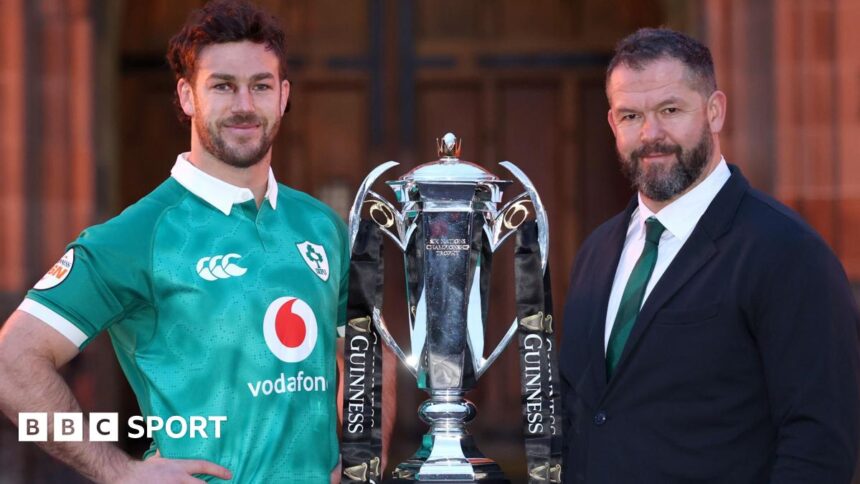
Speaking at the tournament launch in Edinburgh, Andy Farrell addressed the situation with characteristic pragmatism. “It is what it is,” he stated, acknowledging the disruptive wave of injuries. “It’s a bit larger than normal but there’s always something going on, there’s always someone retiring, in form, out of form, injured etc.” This understated admission belies a significant challenge. The injury list is not merely a handful of squad players; it strikes at established stars and critical positional depth simultaneously.
The backline has been hit early, with the dynamic Mack Hansen ruled out. His absence deprives Ireland of a unique creative spark and relentless work rate. Joining him is the promising Jamie Osborne, a player many believed was poised for a breakthrough tournament. However, the most acute crisis is unfolding in the front row, the engine room of any Test side. Loose-head prop, a position of traditional strength, is now an area of major concern.
- Andrew Porter, the Lions tourist and cornerstone of the scrum, is racing to be fit.
- Behind him, emerging talents Paddy McCarthy and Jack Boyle are also sidelined.
This unprecedented depletion has forced Farrell’s hand, leading to the call-up of Connacht’s uncapped 20-year-old Billy Bohan. Thrusting a novice into the cauldron of a Six Nations opener in France is a scenario no coach envisions, highlighting the severity of the situation.
Marseille as the Ultimate Proving Ground
The fixture list has been unforgiving. Kicking off a title defence away to France is arguably the toughest assignment in world rugby. Les Bleus, smarting from their own World Cup disappointment and now under the guidance of Fabien Galthié with point to prove, will be lying in wait at the Stade Vélodrome—a venue synonymous with intense, hostile atmospheres. For Ireland, this match was always going to be a monumental physical and tactical battle. The injury crisis adds a formidable psychological layer.
Can a patched-up front row establish the set-piece stability required to unleash Ireland’s fluid attacking system? How does the back three rebalance without Hansen’s aerial prowess and link play? Farrell’s selection for this opener will be dissected like never before. It may necessitate a shift in strategy, perhaps placing a greater emphasis on tactical kicking and defensive structure to weather the early French storm. The match becomes not just a contest for points, but a referendum on the squad’s resilience and the coaching staff’s adaptability.
This scenario, however, is not without a silver lining. As Farrell noted, he hopes the tournament will be a “good experience for the more untested players.” Adversity breeds opportunity. The likes of Bohan, or others who may step up, have a chance to author a career-defining moment. History is replete with examples of injury crises forging new heroes, and Ireland’s system, praised for its clarity and player development, is about to undergo its sternest audit.
Expert Analysis: Depth Chart Under the Microscope
From a strategic perspective, Ireland’s injury woes illuminate both a vulnerability and a potential strength. The vulnerability is obvious: the loss of multiple players in specialized positions, particularly prop, reduces margin for error and tactical flexibility. Scrum-halves and fly-halves can adapt on the fly; a prop cannot be improvised. The call for Bohan is a stark reminder of the physical specificity of the position.
Yet, the potential strength lies in the culture Farrell has meticulously built. This is a squad that prides itself on a “next man up” mentality, forged through consistent success and a unified system. Players are not thrown into the deep end unprepared; they are drilled in a cohesive game plan that operates from the academy level up. The integration of new faces like Calvin Nash or Jordan Larmour on the wing, or Cian Healy’s potential return to a starting role, will rely on this ingrained understanding.
The key battle will be mental. France will undoubtedly look to target Ireland’s perceived weak points, especially at scrum time. How Ireland manages this pressure—through clever refereeing engagement, rapid ball distribution, or sheer collective grit—will define their opening night. The leadership core of Peter O’Mahony (as new captain), James Ryan, and Johnny Sexton’s successor at fly-half will be crucial in steadying the ship amidst the Marseille maelstrom.
Predictions: A Campaign Defined by Its Start
The trajectory of Ireland’s entire Six Nations hinges on the result in Marseille. A victory or even a courageous losing bonus point gathered amidst the adversity would be a monumental result, injecting the squad with belief and allowing returning players to be integrated gradually. It would send a message that Ireland’s system, not just its first-choice XV, is a force to be reckoned with.
Conversely, a heavy defeat could amplify the pressure, making the following home game against Italy a nervy affair and emboldening subsequent opponents. The schedule does offer a slight respite after France, but in the modern Six Nations, there are no easy games.
Ultimately, this injury crisis may reframe the success metrics for Ireland’s campaign. While the Grand Slam remains the dream, navigating this storm to remain in title contention into the final weekend would represent a significant achievement. It could accelerate the development of the next generation, ensuring the post-World Cup transition is shorter than many anticipated.
Conclusion: Adversity as the True Test of Champions
Andy Farrell’s Ireland have conquered many peaks: a historic series win in New Zealand, a Grand Slam, and the world number one ranking. Now, they face a different kind of challenge. The “larger than normal” injury list is not an excuse, but the central condition of their 2024 Six Nations title defence. It transforms their opening match from a blockbuster into a siege, and their campaign from a procession into a trial by fire.
True championship mettle is not solely displayed when a team is at full strength, cruising to victory. It is forged in the difficult weeks, when key men are absent, and doubt whispers from the sidelines. The response to this crisis will reveal more about the character and depth of this Irish era than any routine victory ever could. As they run out in Marseille, the question will not just be about tactics or talent, but about heart. The stage is set for a new chapter in Irish rugby history—one defined not by who is missing, but by who steps up.
Source: Based on news from BBC Sport.