Ireland’s Parisian Puzzle: Can Anyone Catch the ‘Darting Fish’ Antoine Dupont?
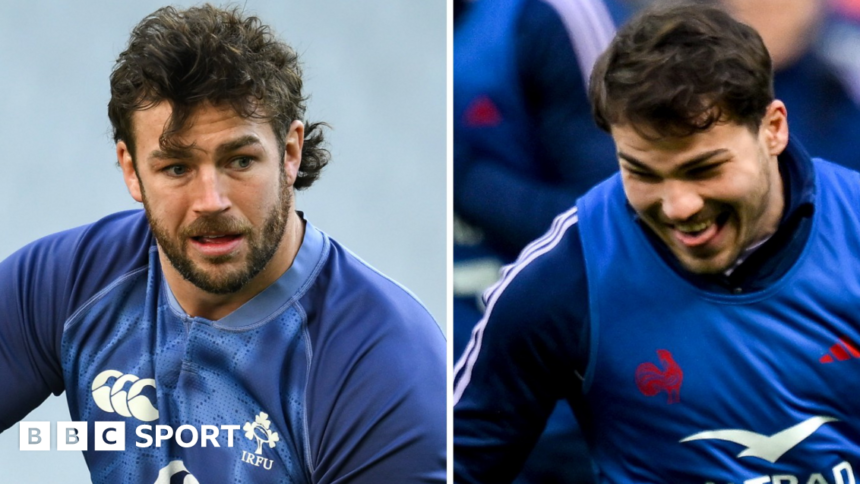
The air in Paris is thick with anticipation and the scent of brewing rivalry. As the Six Nations explodes into life at the Stade de France, a single, electrifying question hangs over the tournament’s blockbuster opener: How do you stop a force of nature? For Ireland captain Caelan Doris and his world-number-one-ranked side, the answer lies in solving a uniquely slippery problem. Their chief antagonist, returning France captain Antoine Dupont, was recently described by Doris not with technical jargon, but with a vivid, almost resigned aquatic analogy. He is, the Irish skipper admitted, “one of those little fish you try to touch and they dart away from you.” On Thursday night, Ireland must find a way to net the most elusive fish in rugby.
The Elusive Genius: Why Dupont Defies Conventional Defence
Antoine Dupont’s brilliance is a multi-faceted diamond, each facet engineered to cut defensive structures to ribbons. Labelling him a ‘scrum-half’ feels reductive. He is a tactical conductor, a brutal breakdown poacher, a punisher of the slightest gap, and a passer of supernatural precision. Ireland’s defensive mastermind, Simon Easterby, has spent months devising a plan, but as Doris conceded, Dupont has outmanoeuvred him “several times” in past encounters.
The core of the challenge is Dupont’s unpredictable threat radius. Unlike traditional scrum-halves, his point of maximum danger isn’t confined to the ruck. He lurks in the wide channels, appears as a first receiver off set-piece, and snipes around the fringes with the acceleration of a wing. Defenders must constantly recalculate his trajectory, a mentally exhausting task that creates micro-seconds of hesitation—all Dupont needs to strike.
- Explosive Power: His low centre of gravity and leg strength allow him to break tackles that would floor others.
- 360-Degree Vision: He sees and executes passes others don’t conceive of, often delivered off either hand while absorbing contact.
- Relentless Pressure: His defensive work, particularly jackaling for turnovers, can strangle an attack at source.
The Irish Blueprint: A Swarm, Not a Spear
Ireland will not assign one player to ‘mark’ Dupont. That is a fool’s errand. Instead, their system—the much-vaunted Irish defensive line—must function as a coordinated net. The principle is collective responsibility and communication. When Dupont darts, the entire defensive line must shift with synchronicity, closing his escape routes and funnelling him toward where the big hitters—like Doris himself, Peter O’Mahony, and Tadhg Beirne—lie in wait.
The key battlegrounds are clear:
Ruck Speed: Ireland’s clearers must be immaculate. Slow, messy rucks are Dupont’s playground, giving him time to organise or snipe. Josh van der Flier’s work here is paramount.
Channel Discipline: Ireland’s forwards, particularly the props in the wide channels, must be defensively astute. Dupont will target any forward he perceives as slow to realign.
The Kick Chase: Dupont is also a lethal counter-attacker. Johnny Sexton’s successor at fly-half, Jack Crowley, must find grass with his kicks. A poor kick to the French 15 is a pass to their most dangerous attacker.
Beyond Dupont: The Titanic Forward Collision
While the Dupont dilemma captivates, the match will be forged in the furnace of the forward pack. The Stade de France showdown is a clash of two behemoth scrums and lineouts. Ireland’s set-piece, under Paul O’Connell’s tutelage, is a weapon of precision. However, facing the colossal French front row of Baille, Mauvaka, and Atonio on home soil is the ultimate test.
This is where Doris’s leadership becomes tangible. To nullify Dupont, you must first negate his platform. Ireland must strive for parity, if not dominance, at the scrum and contest ferociously in the air. Stealing French lineout ball on their throw disrupts the entire French attacking rhythm and, crucially, keeps Dupont on the back foot. The battle between locks Tadhg Beirne and the returning French enforcer Paul Willemse could be decisive in this aerial duel.
Prediction: A Test of Nerve as Much as Skill
This is more than a first-round fixture; it’s a potential championship decider and a statement of World Cup intent. The pressure is immense. France, with their talisman back, are desperate to atone for a poor home World Cup. Ireland, under new leadership post-Sexton, are determined to prove their era of dominance is not over.
The prediction hinges on pressure. If Ireland’s system can withstand the early French onslaught, maintain discipline, and convert their red-zone opportunities—areas they excel in—they can quieten the Parisian crowd. However, French flair at home is a potent, often unstoppable force. Dupont only needs a sliver of light to change a game.
Expect a brutal, physical, and nervy affair. Ireland’s cohesion and systemic strength are arguably the best in the world. But France possess the ultimate X-factor. In a contest this tight, the genius of one “darting fish” might just be the difference. France by a razor-thin margin, perhaps a single score, in a modern classic.
Conclusion: The Eternal Rugby Conundrum
When the whistle blows under the Paris lights, Caelan Doris’s piscine metaphor will transform from amusing anecdote to lived reality for eighty minutes. Ireland’s quest to stop Antoine Dupont encapsulates rugby’s eternal struggle: structured excellence versus individual genius. Can a perfectly drilled system, a net woven from trust and repetition, finally contain the sport’s most uncontainable force? The answer will not only define the 2024 Six Nations opener but will reverberate through the entire championship. One thing is certain: all eyes will be on the darting, dazzling, mercurial figure in blue, as Ireland throws everything, including the kitchen sink, into the pond to try and catch him.
Source: Based on news from BBC Sport.