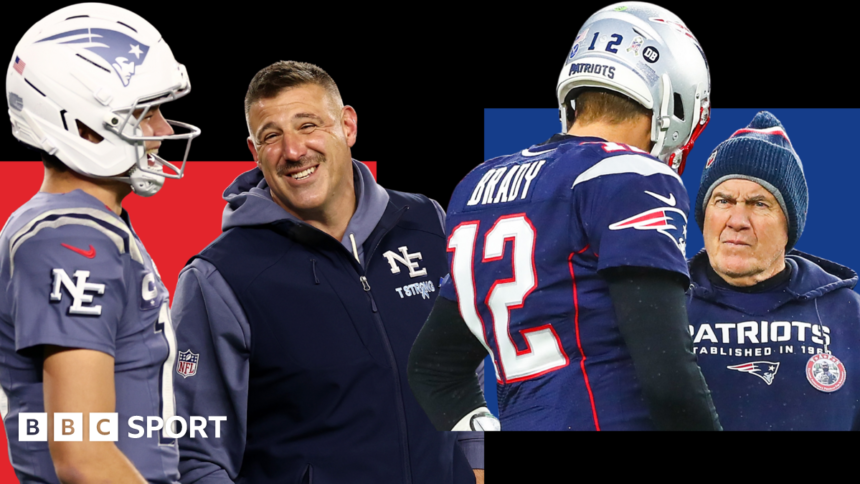
Is the Evil Empire Back? How the Patriots Rebuilt a Broken Dynasty for Super Bowl 60
The specter that haunted the NFL for two decades, the monolithic force that turned parity into a punchline, was supposed to be gone. With Tom Brady’s departure to Tampa and Bill Belichick’s eventual, messy exit, the New England Patriots’ dynasty was consigned to the history books. The league breathed a sigh of relief. The “Evil Empire” had fallen, collapsing into a four-win purgatory with no clear path forward. But history, as it turns out, has a cruel sense of humor. Seven years after their sixth Lombardi Trophy, the Patriots are not just back—they are in Super Bowl 60, and their resurgence, engineered by head coach Mike Vrabel and quarterback Drake Maye, has the distinct, chilling feel of a nightmare the league thought it had finally escaped.
The Fall: From Dynasty to Afterthought
For twenty years, Bill Belichick and Tom Brady were the NFL’s immutable law. Their partnership yielded six Super Bowl titles from nine appearances, a run of sustained excellence that turned Foxborough into a fortress of fear. They were the benchmark, the villain, the unsolvable puzzle. When it ended, it ended hard. The post-Brady years under Belichick were defined by flawed rosters and quarterback missteps. The post-Belichick era began with the stark reality of a complete teardown. The Patriots were irrelevant, a franchise living on faded glory, their identity lost.
The rebuild required a painful but necessary scorched-earth policy. The new front office, led by a collaborative group including Eliot Wolf, made the bold decision to trade down from the No. 1 overall pick, accumulating a war chest of future assets while still landing their franchise quarterback. They shed aging contracts, prioritized youth, and for the first time in a generation, embraced a long-term vision that didn’t involve a 40-year-old quarterback covering all flaws.
The Blueprint: Vrabel’s Toughness Meets Maye’s Brilliance
The hiring of Mike Vrabel was the first signal that this would not be a soft rebuild. A cornerstone of the Patriots’ first three championship teams, Vrabel embodied the old-school, physical, and intelligent brand of football that defined the dynasty’s peak. But he was no mere nostalgia act. His work in Tennessee proved he could build a tough, adaptable culture. In New England, he fused that mentality with a modern offensive scheme, installing a system that would maximize a rookie quarterback’s strengths.
That quarterback was Drake Maye. The North Carolina product possessed the prototype size, arm talent, and athleticism that scouts dream of. But the key to his immediate success was the structure around him. The Patriots prioritized his protection and weaponry, using their draft capital to select a top tackle and trade for a proven star wide receiver. Maye didn’t have to be a superhero; he just had to execute.
Vrabel and Maye quickly forged a partnership that echoes the Belichick-Brady dynamic in its effectiveness, if not its temperament.
- Vrabel’s Defensive Mastery: He rebuilt the Patriots’ defense into a top-three unit, versatile and ruthless, directly mirroring the principles of his mentor.
- Maye’s Poise Beyond His Years: The rookie displayed uncanny processing ability and clutch gene, winning multiple games with fourth-quarter drives.
- A Synergy of Old and New: The combination of Vrabel’s defensive-minded, tough culture and Maye’s explosive offensive talent created a perfectly balanced team.
They are not Brady and Belichick. The dynamic is different—more collaborative, less austere. But the results are hauntingly familiar: a team that doesn’t beat itself, excels in critical moments, and peakes in January.
The Meteoric Ascent to Super Bowl 60
This season was not a slow build; it was a detonation. The Patriots started strong, weathered mid-season injuries, and hit their stride in December. They won close games. They dominated elite opponents. In the playoffs, they displayed a chilling efficiency. A road win in Kansas City silenced the doubters. A defensive masterpiece in Baltimore to win the AFC Championship announced their official return. Suddenly, the team that was picking in the top three a year ago was the last one standing in the conference.
Their run has been powered by a formula the league knows all too well: elite defense, timely quarterback play, and mistake-free football. Watching them dismantle opponents has triggered a collective PTSD across the NFL fanbase. The “evil empire” moniker, born out of jealousy and resentment during the first dynasty, has returned to the lexicon. The fear is not just that they are good, but that they are built to be good for a long time. With a young, cost-controlled franchise quarterback and a coach in his prime, the Patriots’ window is just creaking open.
Super Bowl 60 and Beyond: A New Reign of Terror?
As they prepare to face the Seattle Seahawks in Santa Clara, the narrative is irresistible. It’s the league’s most recent dynasty (Seattle’s Legion of Boom era) against the ghosts of dynasties past, resurrected in frighteningly familiar form. Many fans are picking the Seahawks not out of belief, but out of pure dread—a desperate hope to keep the Lombardi Trophy out of Foxborough for fear it may not leave again for years.
The Patriots enter as a slight favorite, and for good reason. Their path to victory is clear:
- Strangle the Seahawks’ Run Game: Force Seattle into obvious passing situations and let Vrabel’s complex pressures loose.
- Protect Drake Maye: The offensive line must handle Seattle’s fierce pass rush to allow their rookie to work the intermediate game.
- Win the Turnover Battle: The foundational tenet of the Belichick era remains the ultimate key under Vrabel.
Win or lose on Sunday, the broader implication is what terrifies the league. The Patriots have their quarterback. They have their culture-setting coach. They have a young, talented roster supplemented by future draft capital. The machinery of sustained contention is not just reassembled; it’s been upgraded for a new era.
Conclusion: The Empire Never Really Died
The obituary for the Patriots’ dynasty was written prematurely. It turns out the foundation of the “evil empire” wasn’t just Brady or Belichick—it was an institutional standard of excellence, a ruthless pragmatism, and a willingness to adapt. That infrastructure never fully vanished; it merely lay dormant, waiting for the right combination of leadership and talent to reboot the system.
Mike Vrabel and Drake Maye are that combination. Their success this season proves the Patriots’ model was always replicable, given the right pieces. The rest of the NFL now faces a sobering reality: the brief period of Patriot vulnerability is over. The empire has not just returned; it has been rebuilt from the ground up, younger, hungrier, and perhaps more dangerous than before. The league’s long nightmare may have just entered its second act.
Source: Based on news from BBC Sport.