Jake Paul vs Anthony Joshua: Final Punch Stats Reveal Story of a Ruthless Demolition
The spectacle was global, the stakes were immense, and the result was definitive. This past Friday night in Miami, the collision between sporting royalty and social media supremacy ended not with a question, but with an exclamation point. Anthony Joshua, the former two-time unified heavyweight champion of the world, systematically dismantled Jake Paul, handing the YouTube sensation a brutal, sixth-round stoppage defeat. Now, with the final punch stats officially revealed, the numerical tale confirms what the eyes witnessed: a masterclass in controlled aggression against a survival mission that ultimately failed.
The Numbers Don’t Lie: A Statistical Whitewash
While the fight itself was far from a tactical classic, the CompuBox statistics paint a stark picture of dominance and desperation. The figures crystallize the narrative of the bout, moving beyond the mere result to quantify the “how.”
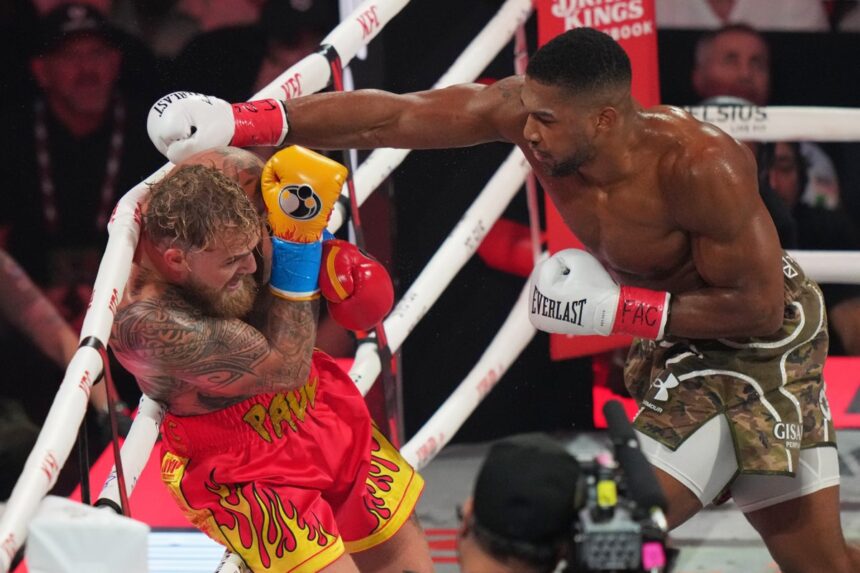
Anthony Joshua’s surgical precision was the headline. The Briton landed 68 of 187 total punches (36% connect rate), but the power shot tally is where the story truly unfolds. Joshua connected with 58 of 126 power punches—a devastating 46% accuracy rate. Every meaningful right hand and thudding left hook that found its home is counted here, culminating in four knockdowns.
In contrast, Jake Paul’s offensive output was virtually non-existent. The American landed a mere 24 punches total across nearly six rounds of action. Of those, only 14 were considered power shots. His connect percentage languished at 17%. Perhaps most telling is the disparity in power punches landed: Joshua’s 58 to Paul’s 14. This isn’t just a gap; it’s a chasm, illustrating the vast gulf in class, power, and composure under fire.
Round-by-Round Breakdown: The Erosion of a Game Plan
The fight’s progression is etched into the stats and the footage. Paul, to his credit, began with clear, evasive movement, making Joshua miss and think in the first two rounds. However, this was not the prelude to a counter-attacking masterstroke, but rather the calm before a storm of overwhelming force.
- Rounds 1-2: Feeling-out process. Paul’s movement frustrated Joshua, but the YouTuber offered almost nothing offensively. The seed of Joshua’s patience was planted.
- Round 3: The paradigm shifted. A stiff Joshua jab began to find its range, followed by a seismic right hand that sent Paul to the canvas for the first time. The punch stats spike in Joshua’s favor from this point onward.
- Rounds 4-5: The demolition phase. Joshua, smelling blood, closed the distance. Paul’s primary offence devolved into repeated, desperate dives at Joshua’s legs—a tactic widely criticized as less of a strategic clinch and more of a bid to halt the assault and buy seconds of recovery. Each time they separated, Joshua met him with heavier, more accurate shots, scoring three more knockdowns.
- Round 6: The merciful conclusion. After a fourth knockdown, with Paul offering no return fire and visibly compromised, the referee waved it off. The punch stats for the round were a microcosm of the fight: Joshua landing 15 power punches to Paul’s 2.
Paul’s evasive strategy and limited offence were exposed as inadequate against an elite-level predator. The “Problem Child” had no solution for the problem standing across from him.
Expert Analysis: What This Means for Both Men’s Legacies
For Anthony Joshua, this victory was about more than just another win. It was a statement of intent in the influencer boxing era. He approached the contest with professional ruthlessness, never treating Paul as a novelty act. By refusing to brawl and instead breaking down his opponent with fundamental, powerful boxing, Joshua reaffirmed his standing at the sport’s pinnacle. It was a performance that whispers a warning to the likes of Tyson Fury and Oleksandr Usyk: the polished, powerful AJ is still very much a threat to the heavyweight throne.
For Jake Paul, the defeat is a pivotal, perhaps necessary, moment. He faced a genuine, top-tier heavyweight for the first time and the difference was catastrophic. The fight revealed the ceiling of his “celebrity boxer” experiment against true world-class opposition. His offence was extremely limited, and his survival tactics, while savvy in their own right, underscored a fundamental gap in skill and power. This loss does not end his boxing career—his drawing power remains immense—but it radically recalibrates his path. The conversation must now shift from “Can he beat a real boxer?” to “Which level of professional boxer can he actually compete with?”
The Road Ahead: Predictions for the Post-Miami Landscape
The fallout from Miami will create divergent paths for the two superstars.
Anthony Joshua’s Future: AJ immediately returns to the championship conversation. A potential megafight with the winner of Fury-Usyk is the obvious goal. Alternatively, a stadium fight in the UK against a contender like Filip Hrgovic or a glamour matchup against someone like Joseph Parker becomes viable. This victory cleanses any residual doubt from his previous losses and re-establishes him as the division’s premier attraction.
Jake Paul’s Crossroads: Paul’s venture, “Most Valuable Promotions,” and his role in elevating women’s boxing remain significant achievements. However, as a fighter, he must take a considerable step back. Expect a return to fights against seasoned but aged MMA legends or lower-tier cruiserweight/lighter heavyweight boxers. A rematch with Tommy Fury becomes a more logical, if less glamorous, target. His narrative must now be one of rebuilding and proving he belongs in the sport’s middle tier, not its apex.
Conclusion: A Lesson Delivered With Power
The final punch stats from the Kaseya Centre serve as the unassailable evidence in the case of class vs. clout. Anthony Joshua’s KO win was not an upset, but an inevitability written in the language of jabs, hooks, and knockdowns. He proved that despite the new-age hype and digital fame, the foundational principles of boxing—power, technique, and championship pedigree—still reign supreme.
Jake Paul suffered a stoppage defeat that many fans wished for, but the manner of it was sobering. He was not just beaten; he was outclassed in every facet of the sweet science. The fight answered a bold question definitively, closing one chapter in the influencer boxing saga while powerfully reasserting the traditional hierarchy of the sport. In the end, the numbers—58 to 14 in power punches—tell the whole story: a brutal, one-sided lesson delivered by a master to an ambitious, but ultimately outmatched, student.
Source: Based on news from Yahoo Sports.