Joshua to Fury: “Fight Me If You’re a Real Bad Boy!” – The Gauntlet is Thrown Again
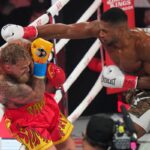
The neon lights of Miami had barely faded on Anthony Joshua’s brutal, two-round demolition of Jake Paul when the conversation, as it always does, snapped back to the one man who defines his legacy. With the echoes of the knockout still ringing in the Hard Rock Stadium, Joshua didn’t bask in the glory of a viral victory. Instead, he turned his gaze north, across the Atlantic, and issued a challenge that felt equal parts plea and provocation. In a moment of raw, post-fight clarity, AJ looked into the camera and called out the one name that matters: Tyson Fury. His message was succinct and loaded with intent: “Fight me, Fury, if you’re a real bad boy.”
This isn’t just another call-out in the noisy world of boxing promotion. This is the resounding, persistent drumbeat that has haunted the heavyweight division for the better part of a decade. It is the fight that British fans have dreamed of, that the world has demanded, and that circumstance, politics, and ego have perpetually denied. Now, with Joshua looking ominously powerful under the guidance of trainer Ben Davison and Fury’s schedule momentarily clear, the question hangs heavier than ever: Is the final, fateful obstacle to this historic clash finally about to be removed?
The Miami Statement: More Than Just a Knockout
Anthony Joshua’s dispatch of Jake Paul was clinical and devastating. It served a multifaceted purpose. Primarily, it was a business obligation, a high-profile spectacle that fulfilled a contractual duty. But for the astute boxing observer, it was a strategic masterpiece. Joshua needed to look dominant, sharp, and, most importantly, hungry. He accomplished all three in under six minutes of ring time. The performance was a stark reminder that beneath the global brand and the Olympic pedigree lies a concussive puncher who is refining his approach.
By immediately pivoting to Fury in his post-fight interview, Joshua accomplished two critical things. First, he re-centered his narrative. He signaled to the world that “The Problem Child” was a sidebar, a lucrative detour on the road back to the summit. The true destination remains Tyson Fury. Second, he applied direct public pressure. Framing the challenge around Fury’s proclaimed “bad boy” persona was a clever piece of psychological warfare. It’s a dare that questions Fury’s authenticity and courage in the language he himself uses.
This call-out carries a new weight because Joshua is no longer the unified champion chasing the elusive Fury. He is a former champion on a resurgent path, having won four straight fights, three by knockout. The dynamics have shifted. The aura of invincibility around Fury was pierced by Francis Ngannou and further questioned by his performance in their rematch. The perception that Joshua is the “B-side” in negotiations is evaporating.
The Tangled Web: Why This Fight Has Never Happened
To understand the magnitude of this moment, one must revisit the labyrinth of missed opportunities. The fight between Anthony Joshua and Tyson Fury has been the great ghost of heavyweight boxing. It has been signed, announced, and collapsed. It has been derailed by arbitration, broadcast disputes, and alternative opponents.
- 2021: A two-fight deal was agreed, only to be scuppered when Deontay Wilder won an arbitration case forcing Fury into a trilogy fight.
- 2022: After Joshua lost to Oleksandr Usyk a second time, Fury offered a fight for the WBC title, but negotiations over dates and splits broke down in a very public war of words.
- The Narrative Battle: Throughout, a story has been crafted: Fury, the mercurial, fearless “Gypsy King” vs. Joshua, the corporate, mentally fragile athlete. This framing has often influenced negotiations and fan perception.
Now, the landscape is different. Fury is coming off a taxing, if victorious, rematch with Francis Ngannou. The demand for an undisputed fight with Oleksandr Usyk has been satisfied, with a rematch looming but not yet scheduled. There is, for the first time in years, a genuine window. The primary obstacles are no longer legal or contractual—they are purely about financial terms and will.
Expert Analysis: Stylistic Clash of the Titans
If and when this fight is made, it presents a fascinating, era-defining stylistic puzzle. On one side, Tyson Fury (34-0-1, 24 KOs) is the defensive savant. His size (6’9″), unorthodox movement, and ring IQ make him a nightmare to pin down. He can switch from a slick, back-foot boxer to a mauling, weight-draining pressure fighter in an instant. His victory over Wladimir Klitschko remains a masterclass in tactical disruption.
Anthony Joshua (28-3, 25 KOs) represents a different kind of threat. Under Ben Davison, he appears to be synthesizing his attributes—the explosive, athletic power-puncher of his early career with the more measured, jab-centric technician he later became. The key for Joshua lies in his educated pressure and body attack. To beat Fury, he must cut the ring off effectively, invest in punches to the midsection to slow the champion down, and use his own formidable jab to set up fight-ending power shots.
The critical factors will be:
Joshua’s Gas Tank vs. Fury’s Durability: Can AJ maintain a high-intensity, intelligent attack for 12 rounds? Can Fury, who has been dropped before, withstand the clean, heavyweight power Joshua possesses?
The Mental Battle: Fury’s pre-fight mind games are legendary. Joshua’s mental fortitude has been questioned. Who wins the psychological war in the weeks and moments before the first bell may determine the physical one.
Ring Rust vs. Momentum: Fury will have a significant layoff. Joshua, with this Miami knockout, is active and sharp. This intangible could be a major equalizer.
Prediction: The Final Reckoning on British Soil
While the path is clearer, the final hurdle—getting two proud, wealthy men to agree—remains high. However, the stars are aligning. The public demand is at a fever pitch. Both men are in the latter stages of their careers and understand that this fight is the single biggest commercial and sporting event available to them. The prediction here is that commercial necessity will finally overcome ego.
Expect a deal to be struck for late 2025 or early 2026, almost certainly at Wembley Stadium in London. The venue is symbolic; this is a British sporting event that will transcend the sport. In terms of a fight prediction, it’s a pick’em that leans slightly with the evolution we are witnessing. If Anthony Joshua can implement the disciplined, aggressive game plan he’s shown glimpses of, he has the tools to win. He must avoid boxing at Fury’s range and tempo. He must make it a physical, punishing fight.
The bold forecast? Joshua, harnessing his renewed confidence and refined technique, weathers an early storm from Fury. He gradually finds a home for his power shots, particularly to the body, slowing Fury’s movement. In a dramatic, back-and-forth contest, Joshua finds a late-round stoppage, perhaps between rounds 10 and 12, to cement the most remarkable comeback in modern heavyweight history and finally settle the debate.
Conclusion: The Bad Boy Challenge Awaits an Answer
Anthony Joshua’s words in Miami were not just a soundbite. They were a manifesto. “Fight me, Fury, if you’re a real bad boy.” This challenge cuts to the core of Tyson Fury’s public persona. To ignore it now, when the road is finally clear, would be to admit that the “Gypsy King” prefers the safety of his throne to the danger of a true legacy-defining war.
For Joshua, this is the final mountain. For Fury, it is the last, great validation. For boxing, it is the fight that must happen. The heavyweight division has been waiting for its two most famous sons to decide supremacy. The knockout in Miami was spectacular, but it was merely the opening act. The main event, the one that has been a decade in the making, now hangs in the balance. The gauntlet lies at Fury’s feet. The world is watching to see if the bad boy is real.
Source: Based on news from Sky Sports.
Image: CC licensed via www.airforcemedicine.af.mil