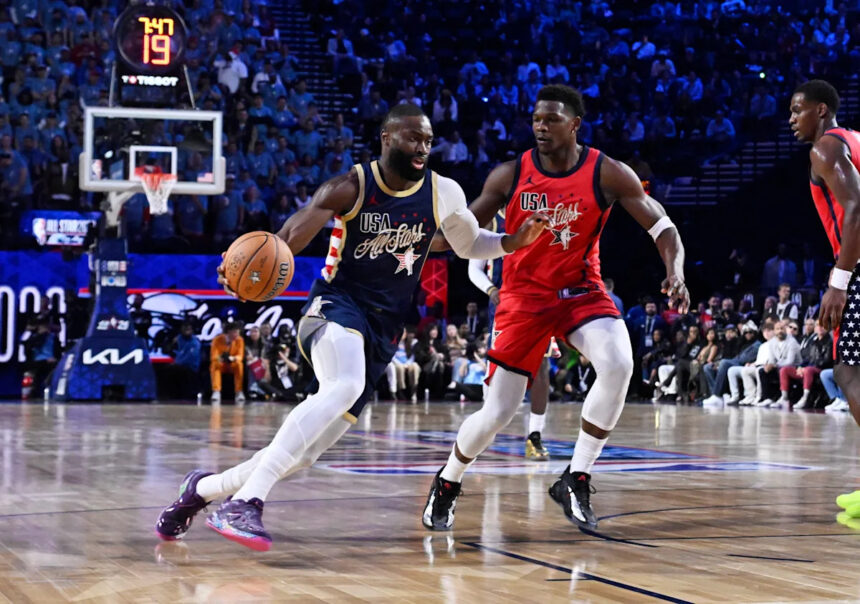
Jaylen Brown Calls Out Beverly Hills After All-Star Weekend Event Shutdown: A Clash of Perception and Protocol
The glitz of NBA All-Star Weekend in Los Angeles is meant to be a celebration, a confluence of basketball’s elite and the cultural forces they influence. For Boston Celtics star Jaylen Brown, it was also an opportunity to host a curated brand event, a gathering for networking and discussion at a mansion in the prestigious Trousdale Estates of Beverly Hills. Instead, the weekend took a contentious turn, culminating in a public dispute that raises questions about perception, protocol, and who gets to control the narrative when things go sideways.
The Shutdown: Police on Stage and a Statement in Dispute
On Saturday night, as a panel discussion was underway at Brown’s event, the scene was abruptly interrupted. Beverly Hills police officers walked onto the stage, informing the crowd of approximately 200 people that the event was being shut down. Outside, a visible show of force—at least seven police cars—awaited to ensure dispersal. The official reason, per initial reports, centered on a permit issue.
The following day, the City of Beverly Hills released a formal statement seeking to clarify the action. The statement asserted that an event permit had been applied for and denied due to “previous violations at the event address.” This framing suggested a procedural failure on the part of the event organizers, painting the shutdown as a straightforward enforcement of municipal codes.
However, from the hardwood of the Intuit Dome after Sunday’s All-Star Game, Jaylen Brown launched a forceful rebuttal. He didn’t just disagree with the logistics; he took personal and professional offense to the city’s characterization.
Brown’s Rebuttal: “I’m Offended” and the Question of Fairness
Brown’s response was pointed and layered with frustration. “I’m offended by Beverly Hills by the statement they put out, like we applied for something and didn’t get it, and we did it anyway [and] we were insubordinate,” Brown told ESPN. He framed the city’s narrative as an attack on his intelligence and integrity.
Jaylen Brown disputed the police statement not merely on factual grounds but on the principle of the implication. “I know how to follow the rules. I’m smart enough to follow the guidelines,” he stated, emphasizing his role as a Vice President of the NBA Players Association and a businessman accustomed to navigating complex agreements.
His most compelling argument moved beyond the permit itself to a broader context. “It just seemed like somebody didn’t want whatever we had going on to go on because out of everybody that was doing something, it seemed like I was the only one that gets shut down.” This sentiment touches a nerve far beyond a single weekend. It raises the specter of selective enforcement, a concern that when countless high-profile events dot the city during All-Star Weekend, the criteria for shutdown may not be applied uniformly.
Key elements of Brown’s position include:
- Dispute of Narrative: He rejects the idea his team was “insubordinate” or knowingly violated rules.
- Assertion of Competence: He highlights his experience and capability in executing major events.
- Allegation of Disparity: He implies his event was uniquely targeted amid a weekend of widespread activities.
Expert Analysis: The Intersection of Code, Celebrity, and Control
This incident is more than a he-said-they-said about paperwork. It sits at a fraught intersection. From a municipal perspective, Beverly Hills has a vested interest in strictly enforcing noise ordinances, capacity limits, and permit requirements, especially in its exclusive residential enclaves like Trousdale Estates. The citation of “previous violations at the address” suggests a history that likely put any new event under heightened scrutiny. Cities must apply codes consistently to maintain safety and quality of life.
However, the Beverly Hills police permit issue collides with the reality of modern athlete empowerment. Stars like Jaylen Brown are not just players; they are brands, entrepreneurs, and community leaders. Their All-Star Weekend activities are strategic business and networking engagements. The public shutdown—particularly the image of police on stage—carries a symbolic weight that can feel like a public dressing down, clashing with the professional image Brown cultivates.
The core conflict may lie in communication and process. Did the event organizers misinterpret a pending application as sufficient? Was the denial communicated with enough clarity and time for recourse? The city’s statement is generic, while Brown’s offense is personal. This gap often fuels such disputes, where one side sees a black-and-white code violation and the other perceives a lack of respect, poor communication, or even bias.
Predictions and Repercussions: What Happens Next?
The fallout from this incident will likely unfold on two tracks: the immediate resolution and the longer-term impact on perception.
In the short term, expect legal and administrative follow-up. Brown’s team may seek further clarification on the permit denial specifics or challenge any fines. The reference to “previous violations at the address” will be a key point of investigation—were those violations connected to Brown’s team or a previous tenant? This detail could significantly sway public opinion.
Longer-term, this event becomes a case study in the relationship between host cities and the NBA’s elite during mega-events. We predict:
- Increased Scrutiny on City Processes: Future All-Star host cities may work more closely with the NBA and player reps to clarify permit pathways for ancillary events, aiming to avoid very public disputes.
- Empowerment of Player Caution: Star players hosting events will likely invest even more in pre-emptive legal and municipal liaison work, potentially shifting events to more commercially zoned or accommodating locales.
- A Lingering Narrative for Brown: Known for his intellectual pursuits and social advocacy, Brown may channel this experience into broader discussions about entrepreneurial barriers or equitable treatment, further solidifying his voice beyond basketball.
Conclusion: More Than a Permit, A Matter of Respect
The shutdown of Jaylen Brown’s All-Star Weekend event is a multifaceted story. On its surface, it is a municipal enforcement action. But through Brown’s lens, it transformed into an issue of dignity, professional respect, and equitable treatment. While Beverly Hills has the responsibility and right to enforce its codes, the method and messaging of that enforcement are critically important, especially when dealing with individuals of significant public stature.
Brown’s statement, “I’m offended,” is the heart of the matter. It signals that for today’s athlete, the stakes are not just about fines or logistics, but about reputation and the principle of fair dealing. Whether this was a simple case of an unpermitted event or a more complex failure of process and communication, the incident underscores a modern reality: in the era of athlete empowerment, how you shut something down can be as consequential as why you shut it down. The resolution, or lack thereof, will resonate with players and host cities for All-Stars to come.
Source: Based on news from Yahoo Sports.