Jimmy Kimmel’s Trophy Prank: When Late-Night Meets College Hoops and Campus Politics
The confetti had settled, the championship rings were being designed, and the UCLA women’s basketball team was enjoying a well-deserved victory lap on the late-night circuit. But what began as a celebratory appearance on “Jimmy Kimmel Live” this week took an unexpected pivot, blending sports, politics, and the complex campus climate of Westwood into a single, eyebrow-raising segment that has sparked conversation far beyond the basketball court.
A Celebrity Request with a Political Edge
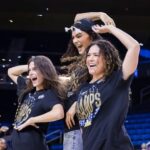
Seated alongside teammates Lauren Betts, Kiki Rice, Gabriela Jaquez, Angela Dugalić, and head coach Cori Close, the conversation naturally turned to the flood of accolades following the team’s historic national championship win. Host Jimmy Kimmel noted that former President Barack Obama—a noted basketball enthusiast—had publicly congratulated the team on social media. Then, Kimmel posed the question: had former President Donald Trump reached out?
The answer was a unanimous “no” from the players. Seizing the comedic moment, Kimmel then presented the Bruins with a political quest. He handed the team a faux national championship trophy, a prop from his show, and implored them to gift it to Trump under false pretenses. “I want you to present it to him and say, ‘We won the national championship, and we know how much you love winners, so we wanted you to have this trophy,'” Kimmel quipped, adding the punchline, “And just see if he takes it.”
The segment played for laughs, with the players smiling along in the surreal moment. However, the Kimmel trophy prank instantly transcended typical late-night fare. It placed a group of student-athletes, still basking in a pure athletic achievement, squarely at the intersection of America’s deep political divisions. The request, though made in jest, raised immediate questions about the appropriateness of involving athletes in a partisan stunt and highlighted how sports figures are increasingly viewed as potential conduits for political messaging.
UCLA’s Delicate Campus Climate: Protests, Pressure, and Progress
Kimmel’s segment aired against a backdrop of ongoing sensitivity at UCLA. Just weeks prior, the campus was a national focal point due to intense, and at times violent, anti-Israel protests and encampments. The situation drew scrutiny over campus safety, free speech, and allegations of antisemitism. According to two UCLA students who recently spoke to Fox News Digital, while palpable tensions have eased since the peak of the protests, underlying concerns persist.
The students revealed that a sense of administrative pressure and lingering unease remains for some on campus. Key concerns include:
- Antisemitism concerns lingering for some Jewish students despite the dismantling of the encampment.
- Debate over whether administrative pressure has effectively silenced certain viewpoints in the aftermath.
- A general yearning for normalcy and a return to a unified campus identity centered on academic and athletic achievement.
In this context, the women’s basketball team’s championship run was seen by many as a unifying force, a proud moment for the entire Bruin community that transcended politics. Kimmel’s prank, however innocently intended, risked reframing that unifying achievement within a partisan lens, potentially complicating the team’s role as a symbol of campus pride.
Expert Analysis: The Unwitting Athlete in a Polarized Arena
Sports media analysts see the Kimmel incident as a microcosm of a larger trend. “The modern athlete, especially at the elite college and professional levels, is constantly navigating a minefield of potential political entanglement,” says Dr. Lena Torres, a professor of sports sociology. “What makes this case unique is that the political proposition was externally imposed by an entertainment figure during a celebratory moment, not initiated by the athletes themselves. It puts them in a passive, yet highly visible, position.”
The calculus for these student-athletes is complex. Appearing on a major talk show is a pinnacle of mainstream recognition, crucial for building personal and team brand equity. Pushing back against a host’s bit could be seen as awkward or combative on national television. Playing along, however, opens the door to being used as a prop in a political satire narrative they did not choose.
Coach Cori Close, a leader known for fostering character as much as championship culture, faced an unscripted leadership test in real-time. Her role shifts from drawing up plays to navigating the subtle pressures of media environments where her players’ images and the university’s reputation are on the line. The team’s polite but non-committal smiles were likely the safest and most diplomatic response in the moment.
Predictions: Lasting Impact or Late-Night Fodder?
What are the potential repercussions of this brief late-night exchange? Predictions vary based on the lens through which one views the incident.
Short-Term Narrative: The story will likely fuel segments on partisan news networks and social media for a cycle, with reactions split along predictable political lines. The team itself will almost certainly not follow through on the prank, allowing the incident to fade as a peculiar footnote in their championship season.
Athlete Endorsement Landscape: Brands associated with these players may conduct subtle reviews of the segment. In today’s climate, corporations are exceedingly cautious about unintended political associations. While no wrongdoing occurred, it serves as a case study for agents preparing clients for high-stakes media appearances.
Campus Impact: The most significant effect may be reinforcing a sense of caution at UCLA. For a campus working to heal and project unity, the incident is a reminder that its highest-profile ambassadors can be drafted into national political discourse at any moment. It may accelerate media training for athletic departments, focusing not just on handling tough questions, but on navigating seemingly benign entertainment scenarios laden with political undertones.
Conclusion: The Championship That Was, and the Noise Around It
Ultimately, the legacy of the 2024 UCLA Bruins should be—and likely will be—defined by their toughness, skill, and historic triumph on the hardwood. The national champion women’s basketball team earned their trophy through sweat and execution, a testament to Coach Close’s program and the players’ dedication. Jimmy Kimmel’s prop trophy and political jest are a fleeting echo, a moment of broadcast comedy that says more about our culture’s insistence on mixing entertainment and politics than about the athletes themselves.
However, the episode serves as a potent reminder. In an era where every platform can become a political stage, even the purest of sports celebrations are vulnerable to being framed by external narratives. The hope for UCLA is that the powerful, unifying memory of a championship will thoroughly overshadow the brief suggestion of a partisan prank. The team’s real victory lies in their resilience and talent—a narrative no late-night host can reframe.
Source: Based on news from Fox Sports.