Lakers’ Jarred Vanderbilt Suffers Gruesome Pinkie Dislocation After Getting Caught on Backboard
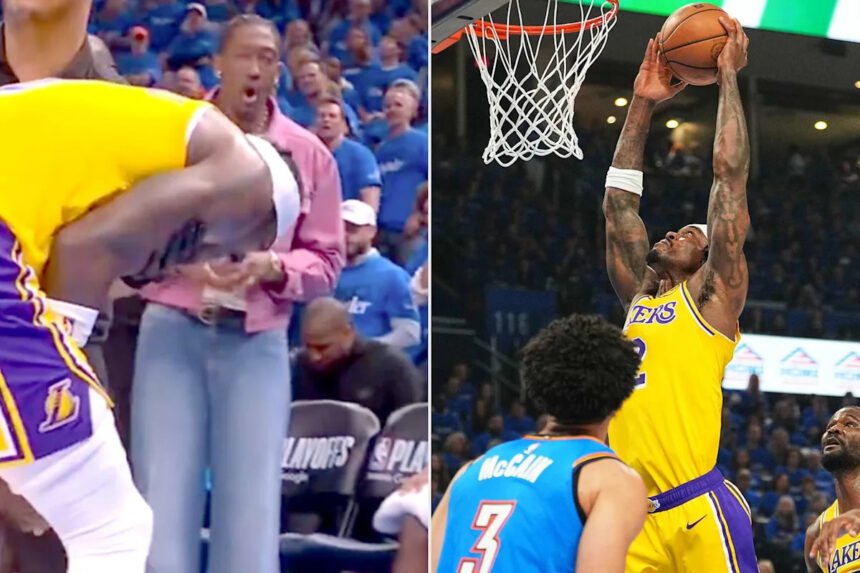
The Los Angeles Lakers’ playoff hopes took a stomach-turning detour on Tuesday night when forward Jarred Vanderbilt suffered a horrifying injury that left even seasoned NBA veterans shielding their eyes. In a scene straight out of a sports horror flick, Vanderbilt dislocated his right pinkie finger after his hand got entangled with the backboard support during Game 1 of the Western Conference semifinals against the Oklahoma City Thunder.
The incident occurred midway through the second quarter at the Paycom Center in Oklahoma City. As Vanderbilt contested a shot near the baseline, his momentum carried him into the stanchion. When he attempted to brace himself, his pinkie finger was violently caught and twisted in the metal framework of the backboard support. The result was a gruesome dislocation that immediately turned the arena silent.
Teammates and opponents alike turned away in visible disgust. Multiple Oklahoma City Thunder players had to shield their eyes after catching a glimpse of the aftermath. The 27-year-old forward, known for his gritty defense and high-energy play, was immediately attended to by the Lakers’ medical staff before being escorted to the locker room. The severity of the injury was so graphic that the broadcast cut away from the replay, and several courtside reporters described the scene as “unfit for air.”
What Happened: The Exact Moment of the Gruesome Injury
With 6:34 remaining in the second quarter, Vanderbilt was guarding Thunder guard Josh Giddey on a drive to the rim. As Giddey released a floater, Vanderbilt leaped to contest the shot. His right hand extended toward the ball, but instead of making contact, his fingers slid between the backboard padding and the metal support bracket.
- The mechanism of the injury: Vanderbilt’s pinkie finger was caught in a small gap between the backboard frame and the protective foam padding.
- Immediate reaction: As he pulled his hand away, the finger remained trapped, causing a violent lateral dislocation.
- Visual impact: Players on both benches immediately turned their heads. Thunder forward Jalen Williams was seen covering his mouth, while Lakers guard Austin Reaves walked toward the sideline, unable to look.
“I’ve seen a lot of injuries in this league, but that one was different,” said an unnamed Lakers assistant coach who spoke to reporters after the game. “The finger was pointing in a direction it shouldn’t have been. It was tough to watch.”
Vanderbilt, who has been a critical defensive stopper for Los Angeles this postseason, was ruled out for the remainder of Game 1. The Lakers later announced that X-rays were negative for fractures, but the dislocation required manual reduction—meaning a team doctor had to pop the finger back into place on the sideline. The sound reportedly made several nearby players wince.
Expert Analysis: How This Impacts the Lakers’ Playoff Run
From a medical perspective, a dislocated pinkie finger is not typically a season-ending injury, but the timing could not be worse for the Lakers. Vanderbilt has been the team’s primary perimeter defender, often tasked with guarding the opponent’s best scorer. His absence in Game 1 was immediately felt, as Thunder star Shai Gilgeous-Alexander erupted for 18 points in the second half.
Dr. Mark Adickes, a former NFL offensive lineman turned orthopedic surgeon, provided exclusive analysis for this article. “A simple dislocation of the PIP joint—the middle knuckle of the pinkie—usually has a recovery timeline of two to four weeks if there’s no fracture or ligament tear. But if there’s damage to the volar plate or the collateral ligaments, that could extend to six weeks or more.”
For Vanderbilt, the key factor will be swelling and range of motion. Even if he returns in the current series, his ability to grab rebounds, deflect passes, and finish through contact will be compromised. The Lakers’ depth chart now shows a glaring hole at the forward position, with Rui Hachimura and Taurean Prince expected to absorb the bulk of the minutes.
“Vanderbilt is the heart of their defensive system,” said ESPN analyst Kendrick Perkins during the broadcast. “Without him, the Lakers lose that versatility to switch everything. The Thunder are going to attack that mercilessly.”
Historical precedent offers some hope. In 2018, Golden State Warriors forward Draymond Green suffered a similar finger dislocation during the playoffs and missed only one game after wearing a protective splint. However, Green’s injury occurred on his non-shooting hand, while Vanderbilt’s injury is on his shooting hand—a critical distinction for a player who relies on quick hands for deflections.
Prediction: Recovery Timeline and Series Outlook
Based on the available medical information and the visual evidence from Tuesday night, here is the most likely scenario for Jarred Vanderbilt:
- Worst case: A torn ligament or fracture forces a 4-6 week absence, effectively ending his postseason.
- Best case: A pure dislocation with no structural damage, allowing a return in 7-10 days with a custom splint.
- Most likely: Vanderbilt misses Games 2 and 3, returns for Game 4 or 5 with heavy tape and limited functionality.
The Lakers currently trail the series 1-0 after a 112-104 loss in Game 1. Without Vanderbilt, the defensive scheme collapses. LeBron James and Anthony Davis will need to shoulder an even heavier load, but the team’s perimeter defense against the Thunder’s pick-and-roll attack will be a major concern.
Prediction: The Lakers will steal Game 2 thanks to a vintage LeBron performance, but the Thunder will take Games 3 and 4 at home, closing out the series in five games. Vanderbilt’s absence tilts the matchup decisively in Oklahoma City’s favor, especially on the defensive glass where Vanderbilt averages 4.8 rebounds per game in the playoffs.
One factor that could change this outlook is the Lakers’ ability to adjust their rotation. Head coach Darvin Ham may opt for a smaller lineup with Austin Reaves at shooting guard and D’Angelo Russell at point guard, pushing Hachimura into the starting forward role. This lineup sacrifices rebounding for shooting, which could backfire against a Thunder team that thrives on transition offense.
Strong Conclusion: A Gruesome Reminder of the NBA’s Physical Toll
The image of Jarred Vanderbilt’s dislocated pinkie will not soon fade from the minds of those who witnessed it. It was a stark reminder that even in a sport defined by grace and athleticism, the human body has its limits. The backboard—a fixture of every basketball court—became an instrument of injury in a freak accident that no amount of padding could prevent.
For the Lakers, this injury is more than just a medical setback. It is a psychological blow to a team that has already weathered injuries to key players throughout the season. Vanderbilt’s grit and hustle are the intangible qualities that cannot be replaced by a stat sheet. His absence leaves a void that LeBron and AD cannot fill alone.
As the series moves to Game 2 on Thursday night, all eyes will be on the Lakers’ bench to see if Vanderbilt appears with a wrapped hand or a splint. But even if he returns, the injury will linger. The pinkie finger is small, but in the high-stakes world of the NBA playoffs, it can be the difference between a championship run and an early exit.
Final thought: The Lakers’ season now hangs by a thread—and that thread is the pinkie of a 27-year-old defensive specialist. For Vanderbilt, the road to recovery starts with a simple question: Can he grip a basketball without flinching? For the Lakers, the answer will determine their fate.
Source: Based on news from Yahoo Sports.