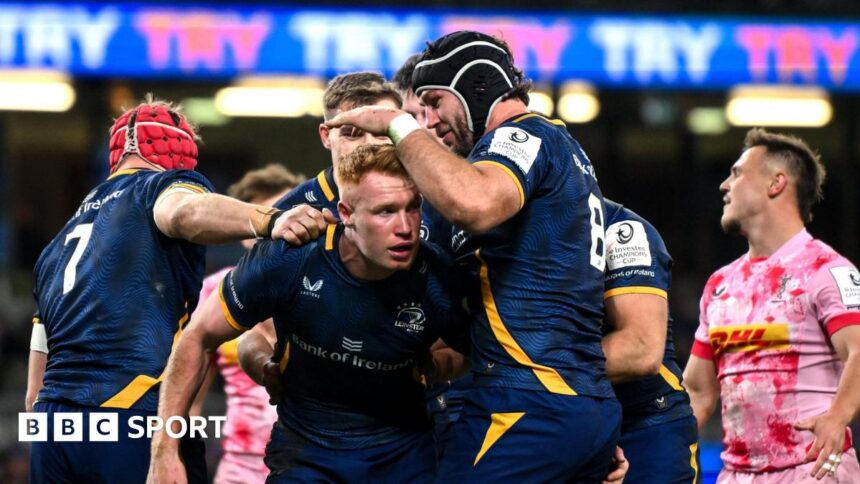
Leinster Exorcise Demons with Powerful Finish to Overcome Harlequins in Champions Cup Opener
The Aviva Stadium exhaled. For 80 minutes, the ghosts of Lyon, Marseille, and Toulouse whispered from the rafters, reminders of a painful recent history. But on Saturday, Leinster, with a performance blending first-half brilliance and second-half grit, took a decisive first step towards silencing them. Their 45-31 bonus-point victory over a dogged Harlequins side was more than a pool win; it was a statement of intent, a cathartic release, and the launch of their latest, most urgent quest for a fifth Champions Cup crown.
A First-Half Blitz and the Lingering Shadow of Doubt
Leinster exploded from the blocks with a ferocity that spoke of a team carrying a point to prove. The attacking patterns were razor-sharp, the support lines relentless. Jordan Larmour, seizing his opportunity on the wing, crossed twice in the opening quarter, his finishing a potent mix of pace and precision. The clinical nature of the attack was summed up by tries from Garry Ringrose, gliding through a gap, and Ciaran Frawley, who showcased his growing influence at fly-half. The bonus point was secured before the break, a dream start engineered by Sam Prendergast and Ross Byrne‘s reliable boot.
Yet, beneath the 28-point haul, the familiar narrative threatened to resurface. Harlequins, true to their “Come All Within” mantra, refused to capitulate. Luke Northmore and the electric Cassius Cleaves struck back, exposing moments of defensive frailty. The penalty try awarded just after half-time, coupled with a score from Jarrod Beard, suddenly cut the lead to a precarious seven points. The spectre of past collapses—the three final defeats and a semi-final exit in their last four campaigns—loomed large over Ballsbridge.
The Defining Phase: Leinster’s Maturity Under Fire
This is where the new chapter was written. Previous iterations of this Leinster team might have tightened, their expansive game shrinking under pressure. Not this time. This was the expert analysis takeaway. Instead of retreating, they recalibrated. The bench, a point of criticism in past finals, became a decisive weapon.
- Impactful Substitutions: The introduction of experienced campaigners like Jamison Gibson-Park and Caelan Doris stabilized the ship, while the fresh legs in the pack regained dominance.
- Set-Piece Supremacy: When needing to stem the tide, Leinster leaned on their maul, a relentless weapon that yielded crucial penalties and drained Quins’ spirit.
- Clinical Finishing: The coup de grâce was delivered through Tommy O’Brien, Jack Conan, and Jimmy O’Brien, their late tries a testament to Leinster’s superior depth and conditioning.
This strong finish wasn’t just about scoring; it was about control. They managed the game’s chaotic final quarter, choosing when to play and when to squeeze, demonstrating a hard-earned maturity that has so often been the difference in Europe’s latter stages.
Harlequins’ Valour and the Road Ahead for Both Sides
Credit must go to Harlequins for their part in a spectacular contest. They absorbed Leinster’s early onslaught and responded with ambition and skill. Their attack, led by the lively Marcus Smith and Danny Care, always carried a threat, proving they can trouble any defence on their day. However, their defensive structure was too often stretched to breaking point by Leinster’s multi-phase attacks, and their discipline in key moments proved costly. They leave Dublin with two losing bonus points, a fair reflection of their endeavour, and the knowledge that they can still progress from a tough pool.
For Leinster, the victory provides a vital platform. The bonus-point win is gold dust in a competitive Pool 3, but the psychological boost is immeasurable.
- Distributed Scoring: Seven different try-scorers alleviates the pressure on any one individual and highlights a multifaceted attack.
- Half-Back Depth: The performances of Frawley, Prendergast, and Byrne offer Leo Cullen rich options at number 10.
- Conquering Nerves: Successfully navigating a high-pressure, momentum-swinging game is the best possible preparation for the knockout football that awaits.
Predictions: Is This Finally Leinster’s Year?
It is far too early for declarations, but the early evidence is compelling. The pain of the last four years has forged a more resilient, more versatile Leinster. They have retained their breathtaking attacking DNA but appear to have added a harder edge, a clearer head for the tactical battle. The quest for a fifth Champions Cup title is laden with expectation, but this performance suggests they are ready to shoulder the burden.
The predictions for their campaign must now be upgraded. They have navigated what was, on paper, their toughest pool match. The key will be maintaining this standard on the road and ensuring the squad’s depth holds through the winter months. If they can consistently marry their first-half flair with their second-half resolve shown today, they will be unbearable. For Harlequins, they remain a thrilling wildcard, capable of beating anyone but needing to find greater defensive consistency to be true contenders.
Conclusion: Leinster’s victory over Harlequins was a tale of two halves that ultimately told one very important story: this is a team learning from its past. The early tries announced their quality, the mid-game wobble recalled their fragility, but the powerful, composed finish revealed a newfound strength. The Champions Cup is a marathon of the mind as much as the body. In holding off a spirited Harlequins, Leinster didn’t just win a game; they took a significant stride towards winning back their belief. The journey to Tottenham Hotspur Stadium in May has begun not just with points, but with purpose.
Source: Based on news from BBC Sport.
Image: Source – Original Article