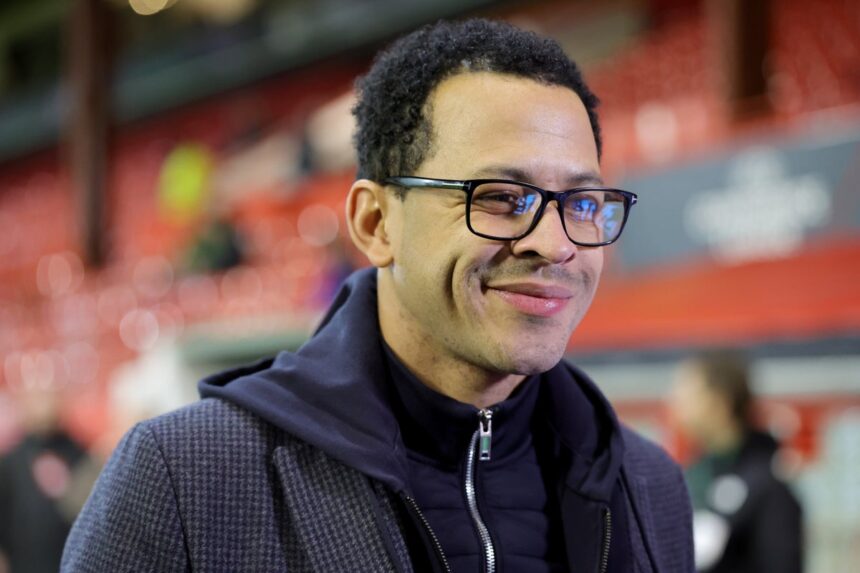
Liam Rosenior Appointed Chelsea Manager in Shock BlueCo Gambit
In a move that has sent shockwaves through the Premier League, Chelsea Football Club has confirmed the appointment of Liam Rosenior as their new head coach. The announcement comes just hours after the club revealed the sudden, mutual departure of Enzo Maresca on New Year’s Day. Rosenior, 41, has signed a staggering long-term contract at Stamford Bridge, tying him to the club until 2032, in a clear signal of a bold and unorthodox new direction under the BlueCo ownership.
The swiftness of the transition and the source of the new appointment are as telling as the decision itself. Rosenior arrives not from a traditional European powerhouse, but from French Ligue 1 side Strasbourg—a club that, crucially, also falls under the multi-club portfolio of Chelsea’s owners. This internal promotion within the BlueCo ecosystem marks a definitive and controversial step in the group’s project, prioritizing a known philosophical entity over a marquee external name.
From Alsace to SW6: The Rosenior Project Explained
Liam Rosenior’s managerial stock has risen steadily, albeit away from the glaring spotlight of the English game. His 18-month tenure at Strasbourg is viewed internally as a resounding success. Taking over a team flirting with relegation, he implemented a cohesive, possession-based style and guided them to an unexpected UEFA Conference League qualification in his first season. He leaves with the club a respectable seventh in Ligue 1, having built a reputation for tactical clarity and player development.
His journey to the Chelsea hotseat, however, is unprecedented. A respected former player and coach, notably as assistant at Derby County, Rosenior’s path has now been accelerated by the multi-club model. BlueCo’s strategy appears to be one of creating a pipeline not just for players, but for coaching talent and a unified football ideology across its holdings.
Chelsea’s decision to appoint from within the group suggests two core beliefs:
- Philosophical Alignment: Rosenior is a known quantity who understands and has executed the data-informed, progressive style favored by the ownership and sporting directors.
- Structural Control: It reinforces a model where the club’s identity is dictated from the top of the portfolio, reducing the risk of a manager deviating from a long-term project.
“I am extremely humbled and honoured to be appointed head coach of Chelsea,” Rosenior stated. “This is a club with a unique spirit and a proud history of winning trophies. My job is to protect that identity and create a team that reflects these values in every game we play as we continue winning trophies.”
Analysing the Sudden End of the Maresca Era
The departure of Enzo Maresca, after just six months in charge, reveals the ruthless exigencies of modern Chelsea. While officially “mutual,” reports indicate a growing friction between the coach’s methodology and the club’s demand for immediate, upward trajectory. Maresca, a disciple of Pep Guardiola, was hired to instill a complex, possession-dominant system. While flashes were promising, a perceived lack of adaptability and inconsistent results—leaving Chelsea mid-table—sealed his fate.
The New Year’s Day timing is brutal but strategic. It provides Rosenior with a minor winter break window to instil his ideas before the season’s gruelling second act. The Chelsea board has demonstrated a chilling lack of sentimentality, viewing the manager’s role as that of a high-performance engineer within their system, replaceable if the outputs don’t meet projections.
This move raises profound questions about the viability of long-term “projects” in the face of instant demand for success. Maresca was, in theory, hired for a project; his dismissal suggests the project’s timeline is measured in months, not years, unless it yields immediate positive metrics.
Rosenior’s In-Tray: Immediate Challenges and Squad Dynamics
Walking into the Cobham training ground, Liam Rosenior faces a task of monumental scale. His appointment, seen by many fans as a left-field risk, means he must win over a sceptical dressing room and an even more sceptical Stamford Bridge crowd from day one.
His primary challenges are stark:
- Establishing Authority: Coaching a young, expensively-assembled squad requires instant respect. His success at Strasbourg will be noted, but he must now command stars with bigger reputations.
- Tactical Translation: Can his Ligue 1 philosophy translate to the higher intensity and physicality of the Premier League? He is known for structured build-up, but Chelsea’s squad is still a work in progress.
- Managing the BlueCo Link: He will be perceived by some as “the ownership’s man.” Rosenior must transcend this label to become “Chelsea’s manager,” making independent football decisions for the benefit of the first team, even if it conflicts with wider group strategy.
- Unlocking Potential: Getting consistent performances from the likes of Enzo Fernández, Moisés Caicedo, and the attacking unit is paramount. His man-management will be under a microscope.
The January transfer window adds another layer of complexity. Will he have a true say in incomings and outgoings, or will he be presented with players identified by the recruitment team for the broader BlueCo model?
Predictions: A New Dawn or False Start for Chelsea?
Predicting the outcome of this appointment is fraught with difficulty. It is a high-reward, high-risk strategy from BlueCo.
The optimistic view is that Rosenior represents a cohesive next step. He is a bright, modern coach who understands the club’s structure, can communicate a clear style, and has already achieved relative success with a team not considered a giant. With better players, the thinking goes, his methods could flourish. The long-term contract offers the one thing recent Chelsea managers haven’t had: the illusion of time.
The pessimistic view is that this is an experiment that underestimates the Premier League. The jump from Strasbourg to Chelsea is astronomical. The pressure, the scrutiny, and the expectation are of a different galaxy. If results don’t improve quickly, the “project” narrative will evaporate, and Rosenior could be another casualty, further entrenching a cycle of instability.
Key to his survival will be early signs of progress: improved defensive structure, clearer attacking patterns, and, most crucially, points on the board. The fanbase will accept a work in progress if the direction of travel is clear and the team plays with visible passion and identity—something Rosenior explicitly promised in his statement.
Conclusion: A Defining Gambit for a New Chelsea Model
The appointment of Liam Rosenior is more than a simple managerial change. It is the purest expression yet of the BlueCo vision for Chelsea: a club run as a central asset in a global network, with shared resources and a top-down football ideology. In bypassing the traditional managerial carousel to promote from within their own system, the owners have made a statement of self-reliance.
For Rosenior, this is the opportunity of a lifetime, but it comes with historically intense pressure. He is not just managing Chelsea; he is serving as the proof-of-concept for BlueCo’s multi-club managerial pathway. His success or failure will be studied as a case study in modern football ownership.
Chelsea have traded the known quantity of a managerial merry-go-round for the calculated risk of a systemic appointment. The 2032 contract length is a facade if results don’t materialize, but it is a bold declaration of intent. The Enzo Maresca era is over, barely after it began. The Liam Rosenior era starts under a cloud of intrigue, scepticism, and immense possibility. At Stamford Bridge, a fascinating and pivotal new chapter has begun, not just for a team, but for an entire footballing model.
Source: Based on news from Yahoo Sports.