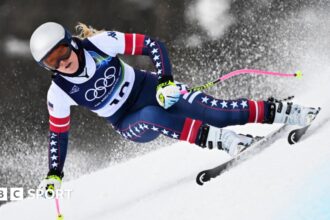
Lindsey Vonn’s Final Ascent: Defying a Ruptured ACL for One Last Olympic Run
The Olympic spirit is often defined by triumph against the odds, but rarely does it manifest with such raw, physical defiance as it does now with Lindsey Vonn. Just days before what she has declared will be the final Olympic race of her legendary career, the American skiing icon faces a hurdle that would end the season for any other athlete: a completely ruptated anterior cruciate ligament in her left knee. Yet, in a stunning display of willpower that has become her trademark, Vonn has declared her intention to start in the women’s downhill at the Milano Cortina Olympics. This isn’t just a race for a medal; it’s a race against anatomy, a final, breathtaking chapter in a story written in grit and glory.
A Crashing Halt in Crans-Montana: The Injury That Changed Everything
The narrative of Vonn’s farewell tour took a dramatic and painful turn last Friday in Crans-Montana, Switzerland. During a World Cup downhill training run, a sport where margins are measured in hundredths of a second and consequences in catastrophic injuries, Vonn lost control. The crash was severe, necessitating an airlift to a nearby hospital. Initial fears were grave, but the full diagnosis—delivered just four days before her scheduled Olympic swan song—presented a stark reality. Vonn confirmed a complete ACL rupture, coupled with significant bone bruising, an injury that typically requires months of rehabilitation and surgery.
For an athlete whose career has been a brutal war of attrition with her own body—including multiple knee reconstructions, fractures, and a harrowing crash at the 2013 World Championships—this latest setback seemed a cruel, final blow. The timing was almost Shakespearean: the champion, seeking one final moment on the grandest stage, felled in the final act. Yet, the script was not finished. Vonn immediately shifted focus from despair to determination, embarking on an aggressive, non-surgical therapy protocol with a single, audacious goal: standing in the start gate at Cortina.
The Anatomy of Defiance: Can She Physically Compete?
The central question hanging over the Tofane Alpine Skiing Center is not about Vonn’s courage—that is unquestioned—but about biomechanical possibility. A ruptured ACL compromises knee stability, crucial for absorbing the immense G-forces and making precise, razor-edge adjustments at 80+ miles per hour. So, how is this even a consideration?
Expert analysis points to several factors that make Vonn’s attempt less implausible than it seems:
- Unparalleled Muscle Memory and Technique: Vonn’s decades of experience allow her to ski with an efficiency that may reduce erratic, stability-testing movements. She can trust her form implicitly.
- Aggressive Conservative Management: Her team is employing intensive physiotherapy, cutting-edge modalities for swelling and pain, and likely utilizing a sophisticated brace. Her comment, “my knee feels stable,” suggests the supporting musculature and other ligaments are compensating.
- The “Vonn Factor”: Sports medicine professionals often speak of the psychological component of pain and instability. Vonn’s legendary pain tolerance and mental fortitude allow her to interpret signals from her knee differently than a less experienced athlete.
However, the risks are monumental. The bone bruising indicates a significant impact, causing pain with every compression. The lack of an ACL leaves the knee vulnerable to further, potentially career-ending damage, especially in the event of another awkward landing or minor mistake. She is, in essence, skiing on a compromised structural foundation.
Beyond the Clock: The Legacy Run at Cortina
When Lindsey Vonn pushes out of the start house on Sunday, the timer will tell only a fraction of the story. This run transcends the pursuit of gold. It is a culmination of a five-Olympic journey marked by the highest peaks—a downhill gold in Vancouver 2010—and the deepest valleys, including missing the 2014 Sochi Games due to injury. At 41, she is not the outright favorite for victory; that mantle falls to a new generation of skiers like Sofia Goggia or Mikaela Shiffrin. But her presence changes the entire dynamic of the event.
This final descent is about closure and statement. It is a statement to every young athlete watching about resilience. It is a thank you to the sport that defined her life. And it is a defiant roar against the physical toll that elite skiing exacts. Her participation alone, regardless of result, will be a historic moment in Olympic Alpine history, echoing the brave final runs of other greats who competed on sheer will.
Predictions and What Success Truly Means
Setting realistic expectations is crucial. Predicting a podium finish would be to ignore the severe physical handicap Vonn is managing. The realistic outcomes fall into three tiers:
- The Victory of Participation: Simply skiing a clean, controlled run from top to bottom, finishing with a smile and a wave to the crowd, would be a monumental triumph. It would cement her legacy as the sport’s ultimate warrior.
- A Top-15 Miracle: If her knee holds and her muscle memory takes over completely, a finish within the top 15 would be an achievement that defies all medical textbooks and would stun the skiing world.
- The Heartbreak Scenario: The fear is a cautious, painful run or, worse, a re-injury in front of the world. Her team and fans will be holding their breath until she safely crosses the finish line.
Success on Sunday will not be measured by hundredths of a second, but by the sheer act of completion. The Olympic spirit embodies the struggle as much as the victory, and Vonn is poised to deliver its purest expression.
Conclusion: The Unbreakable Spirit of a Champion
Lindsey Vonn’s career has never been defined by the easy path. It has been defined by comebacks. From the hospital bed to the podium, her narrative arc is one of relentless return. This final Olympic chapter, written with a ruptured ACL and unbreakable spirit, may be her most powerful yet. As she stands alone in the start gate at Cortina, staring down the icy mountain that has been both her canvas and her adversary, she carries the hopes of anyone who has ever been told something is impossible. When the clock starts, she will not just be racing the skiers who came before her; she will be racing her own history, her own pain, and the very limits of human determination. In that moment, Lindsey Vonn will have already won, proving once more that the strongest part of an athlete is not the ligament, but the will.
Source: Based on news from Deadspin.
Image: CC licensed via www.wallpaperflare.com