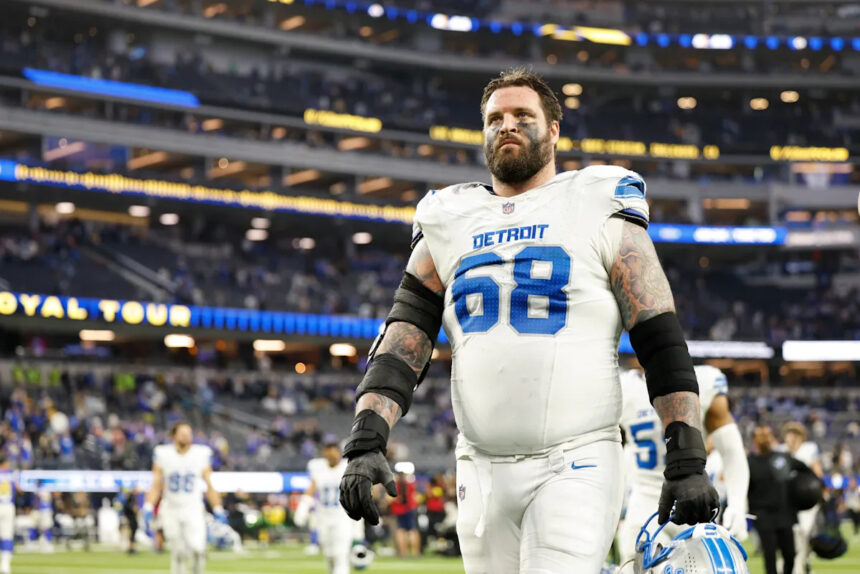
Taylor Decker’s Stunning Exit: The End of an Era for the Detroit Lions
The foundation of a franchise isn’t built on flashy skill players alone. It’s forged in the trenches, by the men who protect the quarterback and open lanes for the run. For a decade, Taylor Decker was that foundational piece for the Detroit Lions. That’s why his sudden, public request for release on Friday sent shockwaves through the NFL, marking a seismic and unexpected shift for a team at a crossroads.
Just weeks after declaring his intention to return for an 11th season, the veteran Pro Bowl tackle is seeking “a clean and amicable close” to his tenure in Detroit. This isn’t a quiet retirement whisper; it’s the sound of a cornerstone being pulled away, revealing potential fissures beneath the surface of a Lions organization that has prided itself on stability and culture in recent years.
A Decade of Dependability Ends in Discord
Taylor Decker’s legacy in Detroit is one of resilience and reliability. Drafted in the first round in 2016, he endured the bleakest years of the franchise’s modern history, starting 140 games through multiple coaching regimes. He was a constant, a professional anchor during a period of profound instability. His performance peaked with a Pro Bowl selection in 2024, a testament to his skill and a crowning achievement in a career spent protecting Matthew Stafford’s blindside and later, Jared Goff’s.
His importance was underscored in 2023 when the Lions signed him to a $60 million, three-year extension, a deal designed to keep him in Honolulu Blue through the 2027 season. He was viewed not just as a left tackle, but as a pillar of the team’s celebrated culture under head coach Dan Campbell and GM Brad Holmes. This context makes his Instagram post all the more jarring.
“In the weeks since notifying the team of my return, there have been numerous discussions,” Decker stated. “Many of which were a surprise to me, and we could not find common ground.”
This single sentence opens a window into a private negotiation that clearly went sideways. The nature of the “surprise” discussions remains undisclosed, but the implications are significant.
- Contractual Restructuring? The Lions, potentially tight against the salary cap, may have sought to adjust the remaining years on his lucrative deal.
- Positional or Role Change? At 32 and coming off a season hampered by a shoulder injury, the team could have broached a move to right tackle or a reduced snap count.
- Philosophical Divide: After Decker’s contemplation of retirement, the Lions’ long-term planning at the tackle position may have accelerated, creating a clash of visions.
Whatever the cause, the result is a fractured relationship with a franchise icon, forcing an end few saw coming.
Expert Analysis: Reading Between the Lines of a Lions Shockwave
From a football operations perspective, this move is fraught with risk and symbolism. Decker, even at 32, was coming off a Pro Bowl year. His departure immediately creates a massive hole at the most critical position on the offensive line, aside from quarterback. The Lions’ identity under Campbell has been a physically dominant, run-first attack, and that identity starts with its elite offensive line.
“This isn’t just about losing a good player; it’s about disrupting the very engine of your offense,” says a veteran NFC scout who requested anonymity. “Goff’s resurgence, the success of the running game—it all flows from that line. Decker was a leader there. When a player of his stature uses the word ‘surprise’ and asks out, it suggests a major disconnect in communication or planning from the front office.”
The timing is particularly brutal. The Lions finished 9-8 and missed the playoffs for the first time since 2022, a clear step back after their NFC Championship game appearance. The offseason was supposed to be about retooling and reloading, not subtracting core veterans. Replacing a left tackle of Decker’s caliber is one of the most difficult and expensive tasks in the NFL. Options are limited:
- Internal Promotion: Rely on a younger, unproven player like 2023 first-round pick Colby Sorsdal or move Penei Sewell back to his college position (a move they’ve resisted).
- Free Agency: Dive into a thin and expensive market, a difficult proposition with cap constraints.
- The NFL Draft: Use a high pick on a tackle, but rookies are notoriously inconsistent at the position.
Each path carries significant uncertainty for a team that can ill afford a step backward in protection.
Predictions: Ripple Effects for Decker and the Lions’ 2025 Season
The fallout from this decision will define the early part of the Lions’ offseason and has major implications for Taylor Decker’s career.
For Taylor Decker: If released, he will immediately become one of the most intriguing free agents on the market. A veteran, proven left tackle with recent Pro Bowl credentials is a rare commodity. Contending teams with a need at tackle and cap space—think the New York Jets, Chicago Bears, or Los Angeles Chargers—will likely have strong interest. While he may not recoup the full value of his Detroit extension on a new deal, a lucrative short-term contract with a contender is a near certainty. His career is far from over, but it will continue in a new uniform.
For the Detroit Lions: The pressure on General Manager Brad Holmes intensifies dramatically. His next move at left tackle will be scrutinized more than any draft pick or free-agent signing. The team’s offensive line, once its undeniable strength, is now a question mark. This also places immense pressure on quarterback Jared Goff, who thrives in a clean pocket. Any regression in pass protection could lead to offensive stagnation.
Furthermore, this incident could subtly impact the locker room culture. Players saw a respected, long-tenured veteran who wanted to stay but felt compelled to leave. How that narrative is managed internally will be a test of Dan Campbell’s leadership. The “all-in, gritty” culture faces its first significant challenge from a business decision.
Conclusion: An Unceremonious End to a Defining Tenure
Taylor Decker’s departure is not the storybook ending anyone envisioned. It is a stark reminder that in the NFL, even the most entrenched relationships are subject to the cold calculus of roster building, salary caps, and aging curves. For ten years, Decker was a symbol of durability through dysfunction and excellence during the resurgence. His request for release flips that narrative, introducing a note of discord at a time when the Lions needed unity.
The legacy of the Dan Campbell/Brad Holmes era will now be tested by how they respond to this self-inflicted wound. Can they find a suitable replacement and maintain their offensive identity? Or does Decker’s exit mark the beginning of a difficult recalibration for a team that seemed on the cusp of sustained contention?
One chapter of Detroit Lions history closes with a social media post. The next one begins with a glaring, unanswered question at the most important spot on the offensive line. The foundation, once thought to be rock solid, now has a crack running right through the blindside.
Source: Based on news from Yahoo Sports.