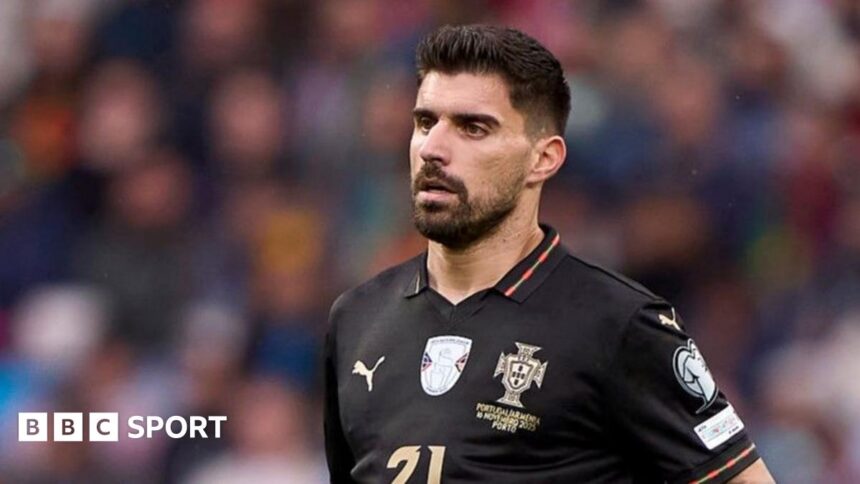
Manchester United’s January Dilemma: Debt, Desperation, and the Ruben Neves Link
The January transfer window looms over Old Trafford like a specter, promising potential salvation but threatening further financial strain. Head coach Ruben Amorim has cautiously opened the door to the possibility of mid-season reinforcements, a statement that will ignite hope among the fanbase. Yet, this glimmer of hope is cast against the stark, red-tinged backdrop of the club’s latest accounts, revealing a staggering £1.1bn debt. The burning question is not just who United might sign, but how they can possibly afford to, with the name Ruben Neves emerging as a fascinating and contentious possibility.
The Precarious Balance: Financial Reality vs. Sporting Necessity
Amorim’s admission that a January signing is “possible” is a masterclass in understatement, given the glaring issues within his squad. The club invested £230m in new talent last summer, yet weaknesses in central midfield and at left wing-back have been ruthlessly exposed. The strategy of integrating Premier League-proven players, seen with the successes of Bryan Mbeumo and Matheus Cunha, appears to be a template. However, the financial landscape is alarming. To fund the summer spree, the club leveraged an additional £105m in debt. This is not sustainable growth; it is a high-stakes gamble. Any January move would likely require further creative—and costly—financing, player sales, or loan deals with obligations. The board is walking a tightrope, balancing the immediate need to secure Champions League football against the long-term health of the club.
Profile Analysis: Why Ruben Neves Fits the Amorim Mold
The link to Ruben Neves is intellectually compelling when viewed through Amorim’s apparent philosophy. The Portuguese midfielder is the epitome of Premier League experience, with 177 appearances and 21 goals for Wolverhampton Wanderers. His profile offers specific solutions:
- Deep-Lying Playmaking: Neves possesses a passing range and game intelligence that could help United break down low-block teams, a recurring issue this season.
- Set-Piece Threat: His expertise from dead-ball situations adds a crucial dimension to a team that often struggles to create from open play.
- Tactical Discipline: Amorim values structured systems, and Neves is a seasoned professional who understands positional responsibility in a midfield pivot.
However, the move is not without its questions. Neves is not a dynamic, box-to-box ball-winner; he would likely require a highly energetic partner to thrive. Furthermore, his current club situation and potential cost—even on an initial loan—would be a significant hurdle given United’s financial constraints. He represents a known quantity, a “safe” bet in terms of adaptation, but perhaps not the transformative, athletic presence the midfield desperately needs.
The Broader Shortlist: Semenyo, Gallagher, and Strategic Needs
Neves is not the only name in the frame, and the other targets reveal the club’s priority areas. Antoine Semenyo of Bournemouth is a player of raw power and direct running, a profile different from United’s current attacking options. His potential acquisition signals a desire for more varied offensive weapons. More intriguing is the link to Chelsea’s Conor Gallagher. The England international embodies the relentless energy and pressing intensity that Amorim’s system sometimes lacks. His availability, due to Chelsea’s own squad management, presents a rare opportunity to inject proven Premier League dynamism directly into the engine room.
The pursuit of these specific profiles underscores a critical admission: the summer rebuild was incomplete. The left wing-back issue remains particularly acute, though less highlighted in current rumors. A move for any of these attackers or midfielders without addressing the defensive flank would be another example of reactive, unbalanced planning.
Predictions & The January Window Verdict
Navigating this window will be a defining test for United’s hierarchy. Here is what our analysis predicts:
- One Major Incoming (Likely a Loan): The financial reality points towards a strategic loan with an option or obligation to buy. This mitigates immediate cash flow impact. A move for Conor Gallagher fits this model perfectly and addresses a more urgent need than Neves.
- The Neves Conundrum: A permanent deal for Ruben Neves in January seems financially improbable unless it involves a complex player-exchange. He remains a more likely summer target, dependent on European qualification and player sales.
- Outgoings are Non-Negotiable: To facilitate any meaningful business, United must sell players. The squad has several high-wage earners who are peripheral figures. Clearing space and generating funds is as crucial as any incoming deal.
- A Reactive, Not Proactive, Window: Expect United’s activity to be dictated by opportunity (like Gallagher’s availability) and desperation, rather than a clear, long-term vision. The debt burden ensures this.
Conclusion: A Test of Vision and Viability
Ruben Amorim’s first season at Manchester United has been a turbulent baptism. The gap between the club’s aspirations and its operational reality has never been wider. The links to Ruben Neves, Antoine Semenyo, and Conor Gallagher are logical from a sporting perspective, aligning with a strategy of recruiting proven league talent. However, the £1.1bn debt is not just a number on a spreadsheet; it is a shackle on ambition. The January window, therefore, is less about a marquee signing and more about a delicate surgical operation. Can the club find a cost-effective solution that patches a critical hole without mortgaging more of the future? The pursuit of a player like Neves symbolizes the club’s enduring pull, but the potential move for Gallagher may reveal its pragmatic, constrained new reality. One thing is clear: at Manchester United, the drama of the transfer window is now inextricably linked to the drama of the balance sheet.
Source: Based on news from BBC Sport.