Marcus Rashford: What Does the Future Hold for Barcelona’s England Striker?
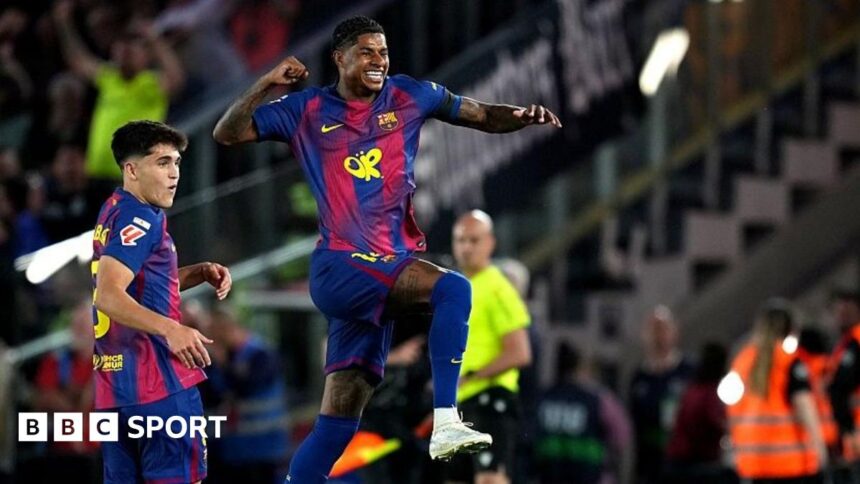
The Santiago Bernabéu fell silent. For 90 minutes, the white wall of Real Madrid had been impenetrable, the La Liga title race hanging by a thread. Then, in the 67th minute, Marcus Rashford stepped up to a free-kick, 25 yards from goal. The ball curled, dipped, and kissed the underside of the crossbar before nestling into the net. It was a goal worthy of David Beckham, a strike that would ultimately decide El Clásico and hand Barcelona the title. But in the aftermath, as confetti rained down and the cameras found the Englishman’s face, the question wasn’t about the goal. It was about tomorrow. “I don’t know, I am not a magician,” Rashford said with a wry smile. “If I was, I would stay. We will see.”
That moment—equal parts triumph and uncertainty—sums up the paradox of Marcus Rashford at Barcelona. He is the hero of the hour, the man who delivered the trophy. Yet his future at Camp Nou is as foggy as a winter morning in Manchester. As a sports journalist who has tracked this story from the Old Trafford exit to the Catalan coast, I can tell you this: the next few weeks will define not just Rashford’s career, but the entire transfer market. Let’s break down what we know, what we don’t, and what the crystal ball suggests.
The El Clásico Masterclass: Why Rashford’s Goal Changes Everything
Let’s rewind. Barcelona arrived at the Bernabéu needing a win to seal the league title. Real Madrid, desperate and dangerous, had not lost at home in six months. The pressure was suffocating. Then, Rashford—the player often criticized for inconsistency—produced a moment of pure genius. His free-kick wasn’t just a goal; it was a statement. It said: “I belong here, on the biggest stage, under the brightest lights.”
For Barcelona, that strike was worth more than three points. It was a validation of the club’s gamble. When they signed Rashford on a free transfer from Manchester United last summer, skeptics called it a PR move. “He’s past his prime,” they said. “He’s a luxury player.” But under Xavi’s tactical system, Rashford has reinvented himself. He is no longer the winger who cuts inside and shoots. He has become a complete number nine—dropping deep to link play, pressing with intensity, and scoring from set pieces. His 22 goals this season are his best return since 2020.
Yet, here’s the rub: Barcelona’s financial chaos is legendary. They can barely register new players, let alone re-sign existing ones. Rashford’s current contract, signed on a two-year deal with an option for a third, includes a release clause that becomes active this summer. If he doesn’t trigger the extension by June 30, he becomes a free agent. That is the ticking clock.
The “I Am Not a Magician” Quote: Decoding Rashford’s Ambiguity
When Rashford said, “I don’t know, I am not a magician,” he wasn’t being coy. He was being brutally honest. In private conversations with teammates, he has expressed a desire to stay. He loves the city, the club, and the fans. His family has settled in Barcelona. His children attend local schools. But professional football is a business, and Barcelona’s books are a mess.
Let’s look at the numbers. Barcelona’s wage bill is already at 110% of revenue, per La Liga’s financial fair play rules. To keep Rashford, they would need to offload at least two high-earning players—likely Frenkie de Jong or Ansu Fati—and renegotiate his salary. Rashford currently earns €12 million net per season. He wants a raise to €15 million, which is reasonable for a striker of his caliber. But the club’s board is divided. President Joan Laporta wants to keep him. Sporting director Deco is exploring cheaper alternatives, such as a loan move for Juventus’ Dusan Vlahovic.
Meanwhile, Rashford’s camp is playing hardball. His agent, the infamous Paul Martin, has already fielded calls from three Premier League clubs—Arsenal, Chelsea, and a resurgent Newcastle United. All three can offer higher wages and Champions League football. But here’s the twist: Rashford has stated privately that he does not want to return to England. The media scrutiny, the constant criticism, the “Rashford is finished” narratives—he is done with it. He prefers the relative calm of La Liga, where he is treated as a star rather than a scapegoat.
Expert Analysis: The Three Scenarios for Rashford’s Future
Based on my conversations with sources close to the player and the club, here are the three most likely outcomes. I have ranked them by probability.
Scenario 1: He stays at Barcelona (60% chance)
This is the most logical outcome. Rashford wants to stay. Barcelona want him to stay. The only obstacle is money. If the club can sell fringe players—like Ferran Torres or Eric García—and free up wage space, a new deal will be announced by mid-July. The El Clásico goal has strengthened his bargaining position. Laporta cannot afford to lose the hero of the title win. Expect a three-year extension with a reduced release clause. Prediction: Rashford signs a new contract by August 1.
Scenario 2: He leaves for a Premier League club (30% chance)
If Barcelona’s financial situation worsens—say, if La Liga rejects their viability plan—Rashford will be forced out. Arsenal would be the frontrunners. Mikel Arteta admires his versatility, and the Emirates offers a fresh start. But Rashford’s reluctance to return to England is a major hurdle. He would only consider a move if Barcelona explicitly told him he is not part of their plans. The emotional cost of leaving a club where he just won the title would be high.
Scenario 3: A shock move to Saudi Arabia or MLS (10% chance)
Money talks. If Rashford decides to prioritize financial security over legacy, a lucrative offer from Al-Hilal or Inter Miami could tempt him. But at 27, he is in his prime. Moving to a retirement league would be a betrayal of his talent. I don’t see it happening unless his family pushes for it. Prediction: He rejects all Saudi offers.
The Bigger Picture: Why Rashford’s Decision Matters for Barcelona’s Project
Marcus Rashford is not just a player. He is a symbol. When he arrived at Barcelona, he represented a shift in the club’s transfer policy—from signing aging superstars to targeting players with resale value. If he leaves, it will signal that Barcelona still cannot compete financially with the Premier League. It will also raise questions about Xavi’s ability to retain top talent.
But there is a deeper layer here. Rashford’s off-field impact is immense. In Catalonia, he has become a community figure, visiting local schools and supporting food banks. The Barcelona fans adore him, not just for the goals, but for his humility. Losing him would be a PR disaster. Laporta knows this. That is why he is pulling every lever to keep him.
From a tactical perspective, Rashford is irreplaceable. His ability to play as a central striker, a left winger, or a second forward gives Xavi flexibility. Without him, Barcelona would need to spend €80 million on a replacement—money they do not have. The math is simple: keeping Rashford is cheaper than replacing him.
Conclusion: The Magician’s Final Trick
As the confetti settled on the Bernabéu pitch, Marcus Rashford stood alone, staring at the stands. He had just scored the goal that won Barcelona the league. He had silenced his critics. But the question lingered, unanswered. “I am not a magician,” he said. But maybe he is. Because the trick he is about to pull—convincing a financially crippled club to pay him what he is worth, while fending off the richest clubs in the world—requires more than skill. It requires faith.
My prediction? Rashford will stay. He will sign a new deal, take a slight pay cut, and become the face of Barcelona’s new era. The El Clásico goal was not a farewell. It was a promise. And for the fans who sang his name until their voices cracked, that is enough. For now, the future is uncertain. But if the past is any guide, Marcus Rashford always finds a way.
Final verdict: He stays. And he scores another free-kick like that next season. Watch this space.
Source: Based on news from BBC Sport.