Marie-Philip Poulin’s Injury Casts Shadow Over Canada’s Olympic Hockey Campaign
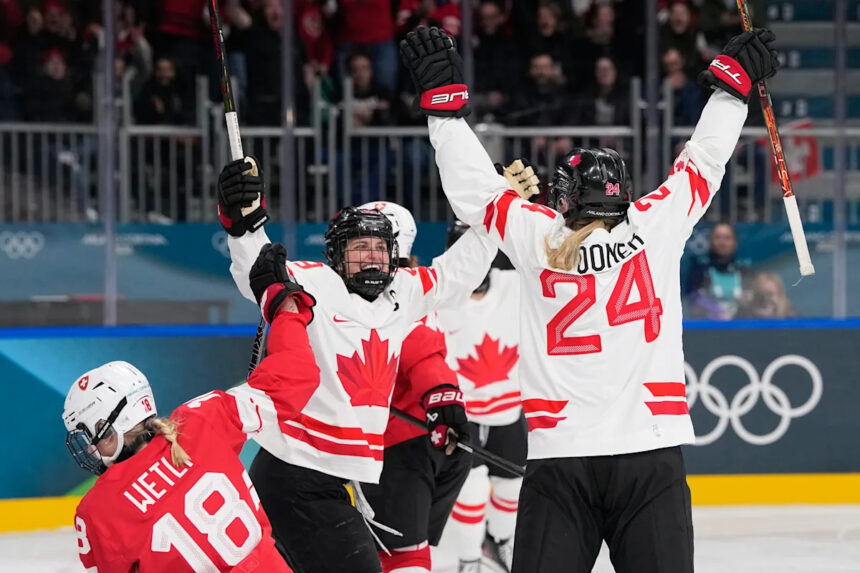
The air in Milan’s Olympic ice hockey arena turned from electric to anxious in an instant. In a moment that could define Canada’s quest for gold at the 2026 Winter Games, captain Marie-Philip Poulin—the player known simply as “Captain Clutch”—lay on the ice after a punishing hit. As she limped to the locker room during Canada’s preliminary round game against Czechia, a single, unnerving question echoed from the stands to living rooms across the nation: What does a Canadian women’s hockey team look like without its heartbeat?
The Incident: A Tense Sequence in Milan
The play unfolded with alarming speed at the 8:52 mark of the first period. Czech forward Kristyna Kaltounkova delivered a hard check where her upper arm made direct contact with Poulin’s helmet. Poulin immediately went down and remained on the ice, a sight that sent a chill through the Canadian bench. Officials assessed Kaltounkova a two-minute penalty for an illegal hit, but the damage, both physical and psychological, was already done.
In a display of trademark toughness, Poulin returned to the ice for the ensuing power play. Yet, the brief appearance was telling. Within seconds, she was back on the bench, visibly favoring her right leg. The attempt to play through the pain was a brave but short-lived effort. After a trip to the locker room for evaluation, she returned to the bench near the end of the period, flashing a broad smile to teammates and cameras—a classic leader’s attempt to project calm. However, that smile was the last sight of Poulin on the ice for the night; she did not emerge for the second period, her status suddenly the tournament’s biggest storyline.
Analyzing the Impact: Beyond the Scoreboard
While Canada secured the victory over Czechia, the win felt pyrrhic. The potential loss of Marie-Philip Poulin is not merely about subtracting a top-line forward; it’s about removing the team’s central nervous system. Her legacy is built on legendary, game-defining goals in Olympic gold medal games (2010, 2014, 2022). Her absence would force a profound tactical and emotional recalibration.
Here is what Canada potentially loses without a healthy Poulin:
- Offensive Production: Poulin is a perennial point-per-game player in elite competition, a dual threat who can both finish plays and create them for linemates.
- Power Play Quarterback: She is the focal point of Canada’s power play, operating from the half-wall with unparalleled vision and a lethal release.
- Leadership and Clutch Factor: Her nickname is earned. In high-pressure moments, the team and the opposition know the puck will find her stick. This psychological edge is immeasurable.
- Defensive Responsibility: Often overlooked is her elite two-way play. She is trusted in key defensive situations and on the penalty kill.
“Poulin’s presence dictates how opponents defend,” says a veteran international hockey analyst. “Without her, other teams can match lines differently, pressure more aggressively. It changes the entire chessboard for Canada, especially against a team like the United States.”
Navigating the Path Forward: Canada’s Contingency Plans
All eyes now turn to the Canadian medical staff and head coach Troy Ryan. The immediate concern is the nature of the injury—whether it’s a knee issue, as the weight-bearing hesitation suggested, or something related to the initial head contact. The timeline for evaluation is cruelly short with the U.S. matchup looming.
If Poulin is sidelined, even temporarily, Canada must activate a next-player-up mentality with structural changes. We could see:
- Line Re-Shuffling: A player like Sarah Fillier or Brianne Jenner may need to ascend to the top center role, demanding increased minutes and offensive burden.
- Power Play Reformation: The entire first power-play unit would need redesigning, potentially spreading Poulin’s responsibilities across multiple players like Natalie Spoonmaker and Emily Clark.
- Elevated Role for Veterans: This is where the leadership of players like Rebecca Johnston and Laura Stacey becomes critical, both on the ice and in steadying the room’s morale.
The silver lining is the depth of the Canadian program. This is the most talented and deep roster in women’s hockey history, built to withstand adversity. However, there is no replacing a legend’s intangible qualities when the stakes are at their absolute highest.
Olympic Implications and Rivalry Dynamics
The injury dramatically alters the landscape of the tournament, particularly the iconic Canada-U.S. rivalry. For Team USA, Poulin’s absence is a tactical opportunity but also a complicating factor. Beating a full-strength Canada is the ultimate goal; beating a diminished one could feel hollow. Nonetheless, U.S. coaches will undoubtedly instruct their players to test Canada’s adjusted lines early and often, applying relentless forechecking pressure.
The broader Olympic picture now includes several key questions:
- Can Canada’s depth generate enough elite-level scoring to win gold without its primary weapon?
- Does this open the door for other rising powers like Finland or Czechia to dream of an even bigger upset?
- How will the emotional weight of playing for their injured captain affect the Canadian squad? Could it galvanize them into a more determined, unified force?
The narrative of the women’s hockey tournament has been irrevocably shifted. What was once a presumed collision course between two titans at full strength is now a story of resilience, adaptation, and uncertainty.
Conclusion: The Ultimate Test of a Team’s Mettle
Marie-Philip Poulin’s injury is a stark reminder of the fine margins that define Olympic glory. In a split-second, a team’s destiny can hinge on a single, painful moment. For Canada, the path to defending its 2022 gold medal has become exponentially steeper. The coming days will test the very foundation of their program—its depth, its adaptability, and its heart.
True champions, however, are often forged in adversity. The legacy of this Canadian team may no longer be solely about Poulin’s heroics, but about how the collective rose to meet an unimaginable challenge. Whether “Captain Clutch” returns to the ice or leads from the bench, her spirit will undoubtedly permeate every shift. The world will be watching to see if a team built around a superstar can transform, on the fly, into an indomitable whole. The quest for gold in Milan just became the most compelling story in sports.
Source: Based on news from Yahoo Sports.