Mavericks Dispute Lakers Coach JJ Redick’s Claim of Medical Misstep in Austin Reaves Injury
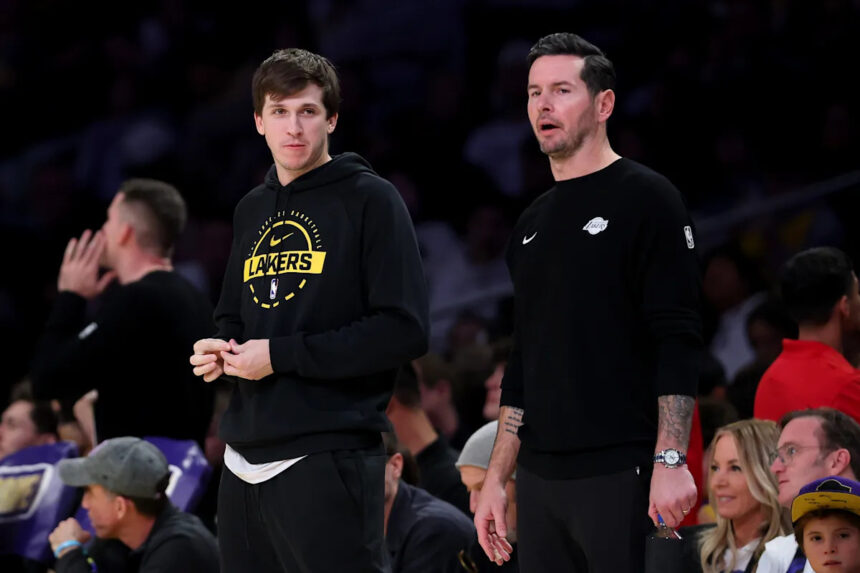
In the high-stakes final days of the NBA regular season, where every win and every healthy body is paramount, a dispute has erupted off the court. The Dallas Mavericks have formally pushed back against claims made by Los Angeles Lakers head coach JJ Redick regarding the medical evaluation of guard Austin Reaves, creating a tense subplot between two Western Conference rivals. This disagreement centers on the critical moments following an injury and raises questions about communication, protocol, and the pressure-cooker environment of the playoff race.
- The Incident and the Accusation: A Timeline of Events
- Medical Protocols and the “Standard of Care” in the NBA
- Playoff Implications and the Bigger Picture for Both Teams
- Expert Analysis: What This Means for Reaves, Redick, and League Relations
- Conclusion: A Clash of Narrative in the Crucible of Competition
The Incident and the Accusation: A Timeline of Events
The controversy stems from an injury sustained by Austin Reaves during the Lakers’ game against the Oklahoma City Thunder on Thursday. Reaves suffered what was later diagnosed as a Grade 2 oblique strain, a significant injury that has since ruled him out for the remainder of the regular season. The Lakers’ next game was on the road against the Dallas Mavericks on Sunday.
In the interim, Coach JJ Redick publicly described the medical process. Redick suggested that the initial imaging performed on Reaves—under the care of the Mavericks’ medical staff, as is customary for the home team—had scanned the incorrect area of his body. This claim implied a procedural error that could have delayed an accurate diagnosis for the Lakers’ key player.
However, the Dallas Mavericks have strongly refuted this narrative. In a statement released to DLLS Sports, the franchise defended its medical team’s actions: “Our medical team followed standard imaging protocols based on the information provided at the time. There was no error in the scan performed.” This direct contradiction sets the stage for a classic “he said, they said” scenario, with significant implications for both teams involved.
Medical Protocols and the “Standard of Care” in the NBA
To understand the dispute, one must examine the standard NBA injury protocols. When a player is injured on the road, the home team’s medical staff provides immediate evaluation and emergency care. This system is built on professional trust and league-wide standards.
- Initial Evaluation: The team’s own training staff and the home team’s physicians conduct an on-site assessment of the injury.
- Imaging Decisions: Based on the player’s symptoms, pain localization, and physical exam, the medical team determines what type of imaging (X-ray, MRI, ultrasound) is needed and where to scan.
- Communication is Key: Accurate information from the player and his personal training staff is crucial for targeting the correct anatomical area.
The Mavericks’ statement hinges on the phrase “based on the information provided at the time.” This subtly shifts the focus to the initial presentation and communication of Reaves’ injury. An oblique strain can present with referred pain, meaning the discomfort might be felt in a different location than the actual tissue tear. It is possible, from a medical perspective, for a scan to be performed on the area of greatest *pain* (e.g., lower back or hip) before the underlying oblique muscle injury is pinpointed through further examination or subsequent imaging.
“This is less about a ‘wrong’ scan and more about the evolving nature of soft-tissue diagnosis,” says a veteran NBA athletic trainer not affiliated with either team. “The initial scan often rules out the worst-case scenarios. A more specific diagnosis for a muscle strain sometimes requires the inflammation to settle or a more focused exam after the acute pain subsides.”
Playoff Implications and the Bigger Picture for Both Teams
This medical disagreement cannot be separated from the dire playoff implications currently facing both franchises. The injury news for both teams has been devastating:
- Austin Reaves (Lakers): Ruled out for the regular season with a Grade 2 oblique strain. His availability for the play-in tournament or playoffs is uncertain.
- Luka Dončić (Mavericks): Also ruled out for the regular season with a Grade 2 hamstring strain. His playoff status is similarly up in the air.
In this context, Redick’s comments could be viewed through a lens of frustration. Losing a critical two-way player like Reaves is a massive blow to the Lakers’ fragile postseason hopes. The suggestion of an external error, whether intended or not, externalizes some of that frustration. For the Mavericks, defending their medical staff’s reputation is paramount, especially as they navigate the loss of their own superstar, Dončić. They cannot afford any perception of compromised care, both for player recruitment and their own locker room’s trust.
The timing of the public dispute is also telling. It erupted just before the Lakers and Mavericks faced each other on Sunday—a game with major seeding consequences. While not a direct cause, the underlying tension may have added an extra layer of intensity to the contest, which the Mavericks ultimately won.
Expert Analysis: What This Means for Reaves, Redick, and League Relations
From a media and league operations perspective, this incident is a fascinating case study. JJ Redick, a first-year head coach, is known for his direct and analytical approach. His public candor, a trait that made him a successful podcaster, is now colliding with the more guarded, diplomatic norms of NBA front-office communication.
“Redick is learning in real-time that every public word from an NBA head coach is dissected and carries weight,” notes a longtime Western Conference executive. “Questioning another organization’s medical staff is a serious charge. The Mavericks’ swift and definitive response shows they felt their professionalism was directly challenged and they needed to shut it down immediately.”
For Austin Reaves, the focus is purely on recovery. A Grade 2 oblique strain typically requires a multi-week recovery timeline. The true test will be his ability to generate core torque and withstand contact. His potential return, likely only in a playoff scenario, would be carefully managed.
Predictions for the fallout are twofold:
- This will likely result in a private conversation between the two franchises, and potentially a reminder from the league office about public comments regarding other teams’ medical procedures.
- It sets a precedent for Redick’s tenure. He may need to calibrate his transparency when it involves external organizations, even while remaining forthright with the Lakers’ fanbase.
Conclusion: A Clash of Narrative in the Crucible of Competition
The dispute between the Mavericks and JJ Redick over the evaluation of Austin Reaves’ injury is more than a minor squabble. It is a microcosm of the pressures at the end of an NBA season, where health is the ultimate currency and margins for error are nonexistent. The Mavericks have staunchly defended their medical protocols, while Redick’s comments reflected the acute frustration of a coach seeing his team’s playoff chances diminish by the hour.
Ultimately, the truth about the initial scan likely resides in the complex, often murky, realm of immediate post-injury medicine. What is clear is that in the modern NBA, injury management is as much a part of the strategy as the playbook, and how teams communicate about it—both publicly and privately—has real consequences. As both the Lakers and Mavericks limp toward the finish line without key players, this off-court controversy serves as a stark reminder that the battles fought in training rooms and press conferences can be just as decisive as those on the hardwood.
Source: Based on news from Yahoo Sports.