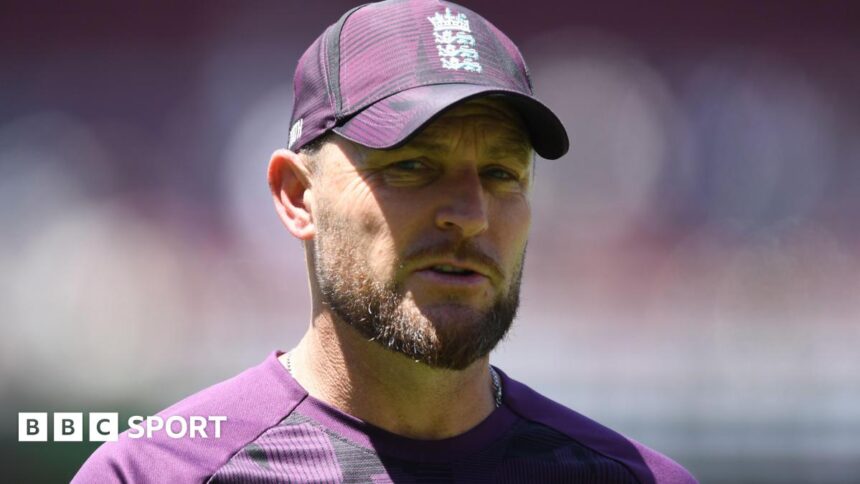
Brendon McCullum’s Bold Vision: Why England’s ‘Bazball’ Architect Wants to Stay the Course
The dust has settled on another Ashes campaign in Australia, the urn remaining firmly in Antipodean hands. For many coaches, a series defeat labelled as “defining” beforehand would spell the end. Not for Brendon McCullum. In the wake of that loss, England’s charismatic head coach has delivered a message that is as clear as it is defiant: he wants to stay. But in a revealing admission, McCullum acknowledges that his future is a decision that will ultimately be made for him. This moment presents a critical juncture for English cricket, forcing a fundamental question: is the ‘Bazball’ revolution a work in progress, or a beautiful but flawed experiment that has run its course?
The Unfinished Symphony: McCullum’s Contract and His Candid Admission
Formally, Brendon McCullum’s position appears secure. He is contracted with the England and Wales Cricket Board (ECB) through to the conclusion of the 2027 50-over World Cup, a timeline that strategically encompasses the next home Ashes series. Yet, the world of elite sport is rarely governed by paper alone. McCullum’s recent comments peel back the curtain on the reality of high-pressure coaching. “It’s a pretty good gig. It’s good fun,” he stated, highlighting the cultural journey. “You travel the world with the lads and try to play some exciting cricket and try to achieve some things.” However, his follow-up was telling: a decision on his future is “out of his hands.”
This blend of enthusiasm and pragmatism is pure McCullum. He is not a coach who operates from a place of fear. “I don’t do anything to protect the job,” he asserted, framing his role as a pure pursuit of potential. “It’s a matter of trying to just get the very best out of the people and try to achieve what you can with them.” This philosophy is the bedrock of his tenure. The results, however, present a complex picture that the ECB’s hierarchy must now decipher.
Defining Defeat: Weighing the Ashes Setback Against the ‘Bazball’ Legacy
There is no sugar-coating the Australian chapter. Losing an Ashes series inside three Tests is a painful outcome for any England coach. McCullum himself had set the stakes, calling it a series that would “define” his team. By that stark metric, the definition currently reads: exhilarating but not yet conquering. The critique is straightforward: has the relentless aggression of ‘Bazball’ tipped into recklessness at critical moments against the very best? Did the ethos fail its ultimate examination?
Yet, to judge McCullum’s era solely on this one away Ashes result is to ignore the seismic shift he engineered. Let’s consider the landscape he inherited in mid-2022:
- A team in crisis: 1 win in 17 Tests, morale at rock bottom, a stifling fear of failure.
- A stylistic vacuum: Cricket that was reactive, joyless, and consistently unsuccessful.
- Talented players underperforming: Key figures like Joe Root, Jonny Bairstow, and Ben Stokes were shadows of their potential.
McCullum’s impact was immediate and transformative. He unleashed a philosophy of freedom, empowering players to express themselves. The results were spectacular: a stunning run of victories, world-record chases, and the reclamation of a lost identity. He didn’t just change tactics; he changed mindsets. The question for Rob Key and the ECB is whether this foundational cultural shift is worth more than a single, albeit monumental, series loss.
The Road to 2027: McCullum’s Blueprint for Redemption
Looking ahead, the pathway is etched with both opportunity and peril. McCullum’s stated desire to continue suggests he views the project as unfinished business. The 2025/26 away Ashes in Australia looms as the ultimate redemption arc, with the 2027 home series as the targeted pinnacle. His vision likely involves:
Evolving ‘Bazball’ into ‘Smartball’: The core aggressive intent will remain, but with a sharper, more situationally aware edge. The focus will be on refining decision-making under pressure, knowing when to press the accelerator and when to momentarily consolidate—a nuance that was sometimes missing in Australia.
Nurturing the next generation: McCullum’s man-management skills will be vital in integrating young talent into the high-octane environment. Identifying and developing bowlers who can execute aggressive fields and batters who can blend flair with resilience is the next phase.
Sustaining the culture: Above all, his role is to protect the liberated environment he created. This means continuing to shield players from external noise and fostering the collective belief that their method, honed and refined, can win the biggest prizes.
The Verdict: Should the ECB Stick or Twist?
This is the multimillion-pound question. Dismissing McCullum now would be a profoundly reactionary move. It would signal a return to the short-termism that has plagued English cricket for decades, potentially undoing all the positive cultural capital built over the last two years. The players, notably captain Ben Stokes, are unequivocally bought into his leadership. Changing course could trigger a damaging regression.
However, the ECB will rightly demand progress. McCullum’s future may hinge on the upcoming challenges in India and the subsequent home summer. Evidence of tactical learning and adaptability will be crucial. The board must assess if the partnership with Stokes still has the creative energy to innovate and problem-solve.
From a purely strategic standpoint, continuity offers the clearest route to the 2027 Ashes. A new coach would inevitably bring a new philosophy, requiring another period of transition and adjustment—time that is not abundantly available. McCullum knows the players, the system, and the scale of the task.
Conclusion: Faith in the Philosophy
Brendon McCullum’s declaration that he wants to stay is a challenge to the ECB’s nerve. It is easy to support a revolutionary style when it is winning; the true test of conviction comes after a high-profile setback. The Ashes defeat in Australia was a body blow, but it did not knock out the philosophy’s core value: making England a fearless, attractive, and potent force in world cricket.
To remove McCullum would be to admit that the journey itself was a mistake. A more courageous and likely more rewarding path is to double down on the vision, learning from the harsh lessons of Australia. McCullum is not a coach protecting his job; he is a believer advocating for more time to complete his mission. The ECB’s decision will reveal whether they are still believers too. For the sake of English cricket’s entertainment value and long-term identity, they should be. The ‘Bazball’ story, with its charismatic author at the helm, deserves its next chapter.
Source: Based on news from BBC Sport.