Van de Ven’s Desperate Lunge: A Red Card Offense or Unfortunate Collision?
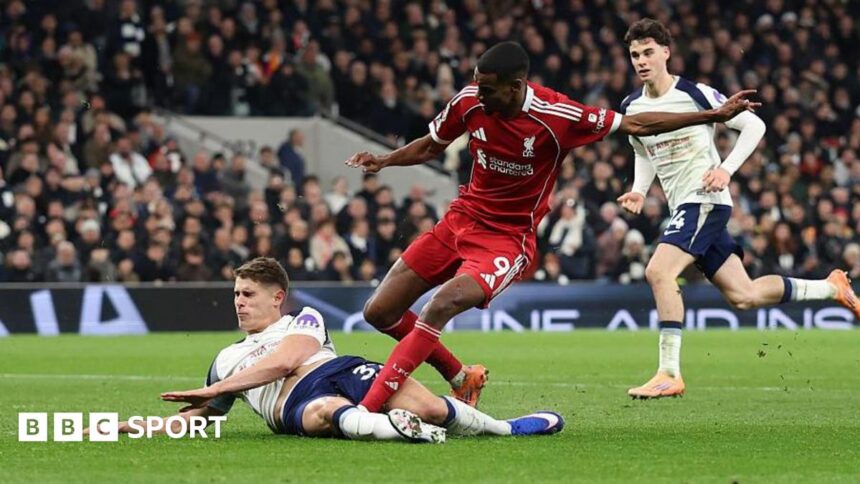
The North London air was thick with tension, the stakes crystal clear. Liverpool, clinging to a narrow lead, faced a Tottenham side reduced to nine men but refusing to yield. In a moment of pure, desperate defending, Spurs’ lightning-fast center-back Micky van de Ven hurled himself across the turf in a last-ditch attempt to block Alexander Isak’s shot. The Swede was quicker, his finish precise, but the aftermath was a scene of agony. Isak’s goal sealed a vital win for Liverpool, but his injury cast a long shadow, sparking a fiery debate that transcends the result: should Micky van de Ven have been sent off for that tackle?
The Anatomy of a Season-Defining Moment
To understand the controversy, we must dissect the millisecond of action. With Tottenham’s defensive line in disarray, Alexander Isak, a picture of cold-blooded composure, found a pocket of space inside the box. Micky van de Ven, recognizing the mortal danger, initiated a covering sprint of remarkable pace. His intent was undeniable: to block the shot. Isak’s execution, however, was a fraction faster. As the ball rocketed into the corner, Van de Ven’s momentum carried him through, his trailing leg making contact with Isak’s planted standing leg after the ball had long gone.
The outcome was brutal. Isak crumpled, his season likely over with a significant ligament injury. The referee, consulting with his assistant, produced a yellow card for the Dutch defender, a decision met with incredulous fury by the Liverpool bench and fans. This decision hinges on three critical, interpretable factors:
- Timing of the Challenge: The contact was undeniably late. The ball was in the net before Van de Ven arrived.
- Intent vs. Recklessness: While malicious intent was absent, the reckless nature of a full-stretch lunge at such speed, with the attacker in a vulnerable position, is a key consideration.
- Seriousness of the Foul: The Laws of the Game categorize a foul as reckless if a player “acts with disregard to the danger to, or consequences for, an opponent.” The severe injury is a tragic consequence, not the direct measure, but it underscores the danger inherent in the action.
Expert Analysis: Navigating the Gray Area of the Laws
From a strict, by-the-book perspective, this is the quintessential “orange card” incident—a decision that could reasonably go either way. Supporters of the yellow card will argue that Van de Ven was making a legitimate attempt to play the ball, his eyes were on it, and the contact, while late, was a consequence of his momentum and Isak’s own shooting motion. He was punished for a foul, and a yellow for a professional foul stopping a promising attack could be justified.
However, a strong case for a red card exists under Law 12. Serious foul play is defined as a challenge that “endangers the safety of an opponent or uses excessive force or brutality.” The pivotal question is: did Van de Ven’s challenge endanger Isak’s safety?
Consider this: the defender was out of control, traveling at high speed, and made contact with force on a planted leg. The potential for serious injury in such scenarios is extremely high, as the tragic outcome proved. In the modern era, where player safety is increasingly paramount, referees are urged to punish actions that have a high degree of danger, regardless of whether the player wins the ball. Van de Ven did not win the ball; he was miles from it. His action was a desperate, high-risk intervention that had catastrophic results for the opponent.
Furthermore, the “double jeopardy” rule—designed to avoid penalizing a team twice for a penalty-box foul (penalty and red card)—does not apply here, as Isak scored. The referee was free to judge the challenge on its own merit for a potential red card.
Key Considerations in the Red Card Argument:
- Excessive Force: The velocity and lack of control.
- Endangering Safety: The vulnerable position of Isak’s planted leg.
- Post-Ball Contact: The challenge was a clear foul after the shot was taken.
Broader Implications: A Precedent for Player Safety?
This decision does not occur in a vacuum. The football world is in a constant state of evolution regarding concussion protocols, tackle heights, and the protection of players. This incident sits at the heart of that conversation. If such a challenge, which directly results in a long-term injury, is only deemed a yellow-card offense, what message does it send?
It potentially normalizes high-risk, out-of-control defending in critical moments. Defenders may feel they can commit to these “last-ditch” lunges with only a booking as the probable cost, even if they miss the ball entirely. The counter-argument is that over-policing such moments could sterilize the game, removing the desperate, heroic block from its fabric.
Yet, the balance must tip towards safety. A red card for Van de Ven would have been a harsh but defensible statement: that even without malice, a challenge of that nature, with that degree of risk, is unacceptable. It would have placed player welfare above the context of the game—a principle many believe should be non-negotiable.
Predictions and Lasting Repercussions
The immediate fallout is clear: Liverpool secured a monumental victory, while Tottenham’s defeat was compounded by the loss of their defensive stalwart for the next match through suspension for accumulated yellows. Alexander Isak faces a grueling rehabilitation.
Looking ahead, this incident will undoubtedly become a reference point in referee training and VAR review sessions. While not every late challenge is a red card, this one, due to its consequences and the visible danger, will be studied. We may see a slight tightening in similar situations in the coming weeks, with referees perhaps more inclined to view comparable lunges as serious foul play.
For Van de Ven, a player known for his recovery pace and clean tackling, this will be a harsh lesson. The fine line between a celebrated last-gasp block and a season-altering foul has never been more apparent. His future challenges will be scrutinized under a more intense microscope.
Conclusion: A Decision That Defines More Than a Game
In the cold light of day, the decision to show a yellow card to Micky van de Ven was understandable but arguably a missed opportunity. Understandable, because split-second judgments in a frenetic environment are hellishly difficult. A missed opportunity, because it failed to adequately address the core issue of a dangerously reckless challenge that had severe consequences.
This was not a case of violent conduct or malicious intent. It was a case of a defender, in a moment of pure desperation, committing to an action with a disregard for the danger posed to his opponent. The laws of the game exist to punish such disregard. While Tottenham’s fight with nine men was heroic, and Liverpool’s resilience commendable, the image of Alexander Isak being helped down the tunnel should be the lasting takeaway. It forces the question: what do we truly value in our sport? The argument for a red card is, fundamentally, an argument for prioritizing the safety of the individuals who provide the drama we so cherish. On that basis, Van de Ven was fortunate to stay on the pitch.
Source: Based on news from BBC Sport.