Mick Cronin’s Sideline Eruption: A Calculated Message or a Bridge Too Far?
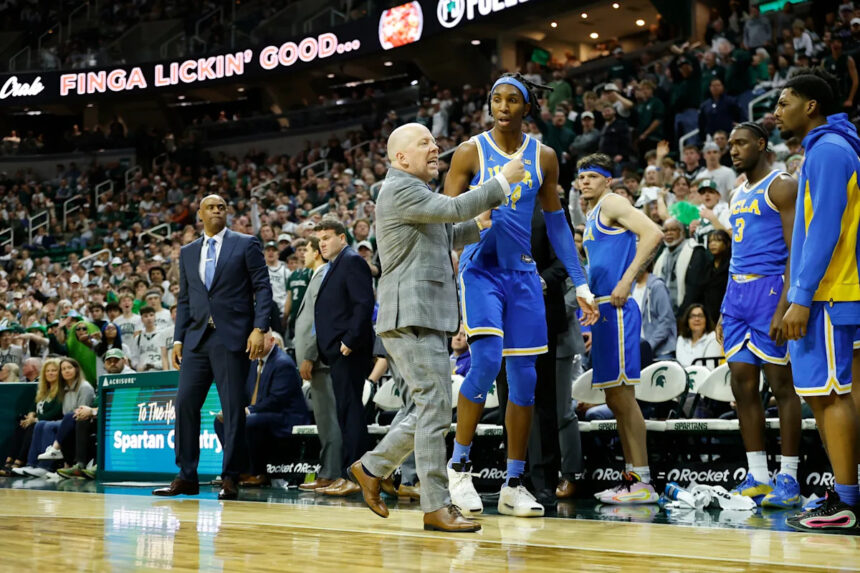
The cacophony of a college basketball arena—squeaking sneakers, roaring fans, the shrill blast of a referee’s whistle—often follows a predictable rhythm. But during Tuesday night’s clash between the UCLA Bruins and Michigan State Spartans, the script was ripped up and thrown aside. In a moment that left fans and analysts bewildered, UCLA head coach Mick Cronin didn’t just argue with the officials; he overruled them, ejecting his own player, Steven Jamerson III, in a stunning act of sideline sovereignty that culminated in a fiery post-game confrontation with a reporter. This wasn’t just a coach managing a game; it was a public, visceral manifesto on culture, accountability, and the boiling point of a frustrating season.
The Incident: A Flagrant Foul and a Coach’s Decisive Overrule
The game itself was slipping away from UCLA, facing a blowout loss to a physical Michigan State team. In a transition play, Bruins forward Steven Jamerson III hustled back, committing a hard foul on Spartans big man Carson Cooper to prevent an easy basket. The play escalated briefly as the players squared up. Officials reviewed the monitor and assessed Jamerson with a flagrant foul, a ruling that kept him in the game but sent Cooper to the line.
For most coaches, this is a moment of frustration, perhaps a heated discussion with the referees. For Mick Cronin, it was an opportunity for a dramatic, unilateral decision. Visibly incensed, Cronin pointed toward the locker room and ejected his own player from the contest. The officials had not ruled for an ejection; this was a decree from the head coach. Jamerson, stunned, removed his jersey and headed up the tunnel, a walk of shame ordered by his own general. The message was clear, brutal, and public: the standard within Cronin’s program, in his eyes, was higher than the rulebook’s.
The Berserk Post-Game: Cronin’s Philosophy Collides with the Press
If the in-game ejection was the explosion, the post-game press conference was the radioactive fallout. When asked by a reporter to explain his decision to eject Jamerson, Cronin’s temper, already simmering, reached a full boil. His response was less an explanation and more a torrent of passionate, unfiltered coaching ethos.
Cronin went berserk on the reporter, not with personal insults, but with an intense defense of his principles. He framed the incident not around the single foul, but as a culmination of lessons unheeded. In a raised voice, he articulated a core tenet of his tough-nosed coaching philosophy: a hard, tactical foul is one thing, but a “dangerous” and “emotional” play that puts an opponent at risk and sparks confrontation is unacceptable. He famously demands “no excuses” and maximum effort, but within a framework of controlled aggression. The ejection, in his view, was the ultimate teaching tool—a public accountability moment meant to resonate with the entire roster.
This raw display highlighted the widening gap between how a old-school coach views team discipline and how the modern media (and public) often interprets such actions. Cronin wasn’t just managing a game; he was managing a culture, and he was willing to become the story to protect it.
Expert Analysis: Discipline or Dysfunction?
Basketball analysts and coaching peers are deeply divided on Cronin’s drastic move. Some see it as a masterstroke of culture-setting, while others question its effectiveness and timing.
- The Pro-Cronin Perspective: Proponents argue that in an era of player empowerment and transfer portals, establishing non-negotiable standards is paramount. “Cronin is coaching for March, not just for Tuesday night in November,” notes one Pac-12 analyst. “He’s signaling that lack of discipline, even in a blowout, will not be tolerated. That message now echoes in every practice and every film session. It’s a short-term shock for long-term gain.” They point to his successful tenures at Cincinnati and UCLA as built on this very foundation of tough love and accountability.
- The Critical Perspective: Critics counter that publicly humiliating a player, especially one like Jamerson who was hustling on a play, can fracture locker room trust. “There’s a difference between being tough and being theatrical,” argues a sports psychologist familiar with team dynamics. “The teaching moment could have happened in the locker room after the game or at the next practice. Ejecting him in front of thousands fans and millions on TV risks alienating not just that player, but his teammates who might see it as an overreaction.” They question whether the ends justify the means, especially for a team already struggling for cohesion.
At its core, the analysis boils down to a philosophical debate: Is team culture forged in the fire of public reprimands, or built more carefully in private, with public support? Cronin firmly believes in the former.
Predictions: Ripple Effects for UCLA’s Season and Beyond
The immediate and long-term consequences of this incident will define UCLA’s season. Here’s what to watch for:
- Locker Room Reaction: The true impact will be measured internally. Does the team rally around Cronin’s “no nonsense” stance, playing with more controlled intensity? Or does it create a rift, with players walking on eggshells, afraid to make a mistake? Jamerson’s response and integration back into regular rotation will be the first clue.
- Recruiting & Transfer Portal Implications: This is a double-edged sword. Some recruits and their families are drawn to strict, disciplined programs that promise structure and development. Others may be wary of a coach whose eruptions are very public. Cronin’s pitch is now crystal clear, for better or worse.
- On-Court Performance: Will this be the galvanizing moment that turns UCLA’s season around? Or will it be a distracting sideshow? The Bruins’ attention to detail, composure in close games, and foul discipline in the coming weeks will be the ultimate barometer of the ejection’s effectiveness.
- The “Cronin Factor”: Officiating crews will now be acutely aware of Cronin’s own personal threshold for fouls. It adds another layer of tension to every UCLA game, for better or worse.
Conclusion: More Than a Moment of Anger
To dismiss Mick Cronin’s sideline eruption and subsequent press conference as merely a coach losing his temper is to miss the point entirely. This was a deliberate, if emotionally charged, strategic decision. In a single, breathtaking sequence, Cronin attempted to reclaim the narrative of a faltering season, set a brutal standard for his players, and remind the college basketball world of the uncompromising principles upon which his program is built.
Whether history judges this as a pivotal turning point toward toughness and success or a misstep that undermined player-coach trust depends entirely on what happens next. The UCLA Bruins, under Cronin’s fiery guidance, have been given a lesson they will never forget. The question now is not why he did it, but how they will respond. In the high-stakes world of college basketball, Cronin has put all his chips on the idea that fearlessness starts with accountability, even if he has to be the one to enforce it in the most dramatic way imaginable. The season, and his legacy at UCLA, now hinges on that bet.
Source: Based on news from Yahoo Sports.