Mikaela Shiffrin Conquers the Comeback, Captures Slalom Gold to End Olympic Medal Drought
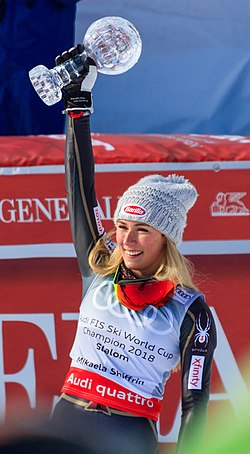
The roar that erupted from the base of the Tofana slope in Cortina d’Ampezzo was one of collective catharsis. It was a sound eight years in the making, a geyser of pressure finally released. On Wednesday, in the final Alpine event of the Milano Cortina 2026 Olympics, Mikaela Shiffrin did not just win a gold medal. She authored a definitive, breathtaking chapter in her legendary career, claiming victory in the women’s slalom and silencing any lingering whispers about her Olympic fortunes with a masterclass in resilience and technical supremacy.
A Run of Redemption: Precision Under Immense Pressure
Entering these Games, the narrative was inescapable. Shiffrin, the most successful skier in World Cup history, had not stood on an Olympic podium since her gold and silver in PyeongChang in 2018. The intervening years brought unparalleled World Cup dominance but also profound personal tragedy and Olympic heartbreak in Beijing 2022. In Cortina, she had two prior chances in the combined and giant slalom, finishing just off the podium. The slalom—her undisputed kingdom, having won seven of eight World Cup events this season—represented the final, monumental opportunity.
Starting seventh, Shiffrin attacked the icy, technical Cortina track with a ferocity that was both calculated and courageous. Her first run was a statement: a blistering 47.13 seconds, more than a second clear of the field save for Germany’s Lena Duerr. But the numbers only tell half the story. Shiffrin skied on the absolute limit, a high-wire act of aggression and control.
“It felt very good, it was very good skiing. I was super active and I was also a bit on the limit,” Shiffrin reflected. “There were probably three different times when I felt I could probably easily be pushed off the course but I guess it was what it required.” This admission reveals the champion’s mindset: acknowledging the peril while embracing it as the necessary cost of gold.
Anatomy of a Champion’s Performance: Where the Race Was Won
Shiffrin’s victory was a tapestry woven from mental fortitude, tactical brilliance, and peerless technique. While others skied to survive the tricky Cortina set, Shiffrin skied to dominate. Expert analysis points to three key pillars of her win:
- Early Aggression: From the first gate, Shiffrin generated explosive, clean acceleration. She carried more speed into the fallaway turns than any competitor, a risk that paid massive dividends on the timer.
- Mid-Course Tactical Adjustment: Shiffrin highlighted the mental chess match within the run. “It requires a lot of precision … mentality and a bit of tactical planning in the middle,” she said. Where others might have protected a lead, she recalculated and attacked.
- The Champion’s Composure: With the world watching and the weight of expectation heavier than any backpack, her ability to execute under this unique Olympic pressure—distinct from World Cup success—was the ultimate differentiator.
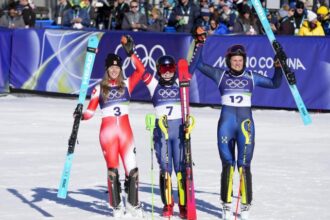
The second run was a formality of excellence. Protecting a commanding lead, Shiffrin skied with controlled aggression to secure the top step of the podium. Switzerland’s Camille Rast, with a stunning second run, claimed the silver, while Sweden’s slalom stalwart Anna Swenn Larsson earned bronze. Germany’s Lena Duerr, so close after the first run, ultimately finished fourth.
The Legacy Secured: What This Gold Means for Shiffrin’s Place in History
This gold medal does more than just end a drought; it recontextualizes Shiffrin’s entire Olympic journey. The conversation can now permanently shift from “what went wrong” to “what has been achieved.” With this victory, Shiffrin:
- Claims her fourth Olympic gold medal (adding to slalom golds in 2014 and 2018, and giant slalom gold in 2018).
- Wins her seventh Olympic medal overall, tying her for the most ever by an American Alpine skier.
- Solidifies her status as the greatest technical skier, male or female, the sport has ever seen.
- Completes a career Olympic set in slalom, winning the discipline in three consecutive Games she has entered—a staggering feat of longevity and excellence.
This victory is a testament to a profound psychological rebound. It proves that her champion’s mentality, forged in the crucible of World Cup battles and tempered by adversity, is fully intact on the grandest stage. The blank in Beijing is now a prelude to a Cortina comeback that will define her legacy as much as any of her 100-plus World Cup wins.
Looking Ahead: The Shiffrin Era and the Next Generation
At 30 years old, with this monumental hurdle cleared, what’s next for Mikaela Shiffrin? The 2026 season is not over, with a World Cup overall title still very much in play. But looking further, the landscape is fascinating.
Predictions for the coming years include:
- Sustained Slalom Dominance: This win will only deepen her aura in the discipline. Challengers like Rast and Swenn Larsson have closed the gap, but Shiffrin remains the benchmark.
- A Shift in Focus: We may see her increasingly prioritize major championships and select World Cup events, managing her schedule for longevity.
- Inspiration for a New Wave: Her resilience will become a blueprint for young skiers. Her victory demonstrates that career trajectories are not linear and that comebacks are possible with unwavering belief and work ethic.
The women who shared the podium with her—Rast (24) and Swenn Larsson (33)—represent both the rising talent and the enduring veterans who have chased Shiffrin for a decade. Their success underscores a deep and healthy competitive field, making Shiffrin’s continued reign all the more impressive.
Conclusion: More Than Gold, A Testament to Tenacity
As the Italian sun set on the Dolomites and the American anthem played for Mikaela Shiffrin, it marked the end of one story and the glorious continuation of another. This was not a victory of sheer talent alone; it was a victory of character. Shiffrin faced down a defining career challenge and answered with a performance for the ages, a run that blended artful precision with raw courage.
She ended the medal drought not with a whimper, but with a roar heard across the sport. The gold medal in the Cortina slalom is a permanent emblem of her greatness, a hard-won prize that secures her legacy not just as a statistical marvel, but as one of the most mentally resilient champions Olympic sports has ever known. The queen of slalom has reclaimed her throne, and the view from the top has never been sweeter.
Source: Based on news from Deadspin.
Image: CC licensed via commons.wikimedia.org