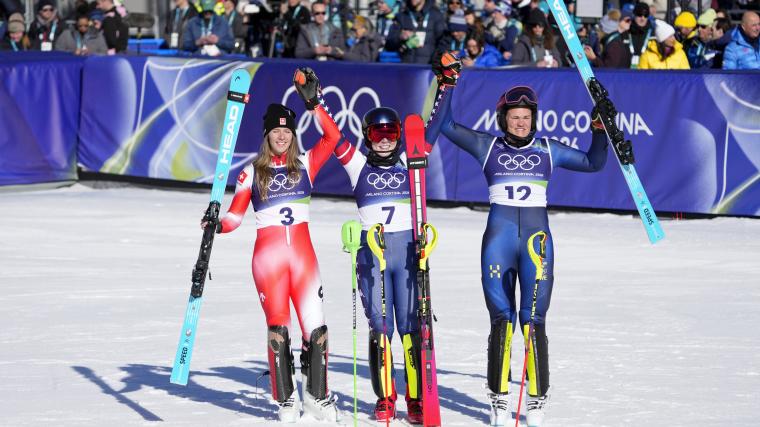
Mikaela Shiffrin’s Historic Slalom Gold: A Masterclass in Redemption and Dominance
The echo of skis carving ice, the blur of a red suit against a white canvas, the roar of a crowd sensing history—these are the sensations of alpine skiing at its zenith. For Mikaela Shiffrin, the sport’s most decorated skier, the final chapter of her 2026 Olympic journey in Milan was not just about adding another line to her staggering resume. It was a cathartic release, a defiant statement, and a performance for the ages. After the crushing weight of Beijing 2022, Shiffrin didn’t just win the slalom gold; she authored a masterpiece of dominance, securing a victory so comprehensive it rewrote the Olympic record books and silenced any lingering doubt.
From Beijing Heartbreak to Milan Catharsis
To understand the magnitude of Shiffrin’s triumph, one must first revisit the abyss. The 2022 Beijing Olympics were a public and personal trial, a series of uncharacteristic mistakes that resulted in a stunning 0-for-6 in medals. The narrative shifted from “greatest of all time” to questions of fortitude. In the years that followed, Shiffrin answered with a relentless onslaught on the World Cup circuit, shattering the all-time win record. Yet, the Olympic stage remained an unfinished symphony. Entering Milan at 30 years old, the slalom—her first love and most natural discipline—represented her final, best chance for redemption.
The pressure was palpable. The world watched, wondering if the ghosts of Beijing would reappear. What transpired was not a skier battling her demons, but one who had long since conquered them. Shiffrin’s first run was a declaration: a blistering, flawless descent that put her 0.82 seconds ahead of her nearest rival, an eternity in slalom. In a sport where victories are often measured in hundredths, this was a thunderclap.
Dissecting a Historic Margin of Victory
If the first run was a statement, the second was a coronation. Shiffrin, skiing last with the luxury of a massive lead, didn’t protect. She attacked. She extended her lead further, crossing the finish line with a combined time that left the alpine world in awe.
Mikaela Shiffrin’s margin of victory was a staggering 1.34 seconds. To contextualize this dominance:
- Historic Scale: It stands as one of the largest winning margins in Olympic alpine skiing history, reminiscent of the commanding victories of legends like Vreni Schneider and Deborah Compagnoni.
- Technical Mastery: The gap was built not on raw speed alone, but on pristine technique. Her skiing line was tighter, her edge transitions were sharper, and her ability to accelerate out of turns was unmatched.
- Mental Fortress: With the gold virtually assured after Run 1, the second run was a high-pressure test of focus. Shiffrin’s ability to block out noise and execute underscored a champion’s mindset.
Furthermore, at 30 years and 267 days, Shiffrin became the oldest U.S. gold medalist in women’s alpine skiing, a testament to her evolution, durability, and sustained excellence in a sport often dominated by younger athletes.
Expert Analysis: The Anatomy of a Perfect Race
From a technical standpoint, Shiffrin’s slalom was a clinic. Experts point to several key factors that created the historic gap.
Early Pressure Application: Shiffrin is a master of being “on the gas” from the very first gate. While others ease into the course rhythm, she establishes intensity immediately, gaining crucial hundredths that compound over 60 gates.
Minimalistic Movement: In slalom, excess motion is wasted energy. Shiffrin’s upper body remains remarkably quiet and disciplined, while her legs work like pistons beneath her. This economy of movement allows for faster, cleaner turns.
Tactical Intelligence: Reading a slalom course is an art. Her team, led by coach Mike Day, provided a perfect plan, and Shiffrin’s experience allowed her to adjust in real-time, finding speed where others could not.
This victory was more than a medal; it was a career-defining moment that seamlessly wove together the threads of her story: prodigious talent, profound setback, relentless work, and ultimate vindication.
The Legacy Cemented and the Future Unwritten
With this gold, Shiffrin’s legacy is unassailable. She joins an elite group of athletes with three or more Olympic golds in alpine skiing. The debate about the greatest alpine skier of all time, already leaning in her favor, now feels conclusively settled. She possesses the complete portfolio: unprecedented World Cup success (over 100 wins), World Championship dominance, and now, a redeeming, historic Olympic crown that showcases her champion’s heart.
What comes next for Mikaela Shiffrin? Predictions are challenging with an athlete of her caliber.
- Immediate Future: She will likely return to the World Cup circuit, continuing to chase records and refine her craft. The 2027 World Championships in Crans-Montana will be a major target.
- The 2030 Olympics Question: At 34, another Games is not out of the question. Her technical events, slalom and giant slalom, reward experience and precision. This gold may have ignited a new Olympic fire.
- Lasting Impact: Beyond medals, Shiffrin’s influence on the sport—her professionalism, her public vulnerability, and her technical brilliance—will inspire generations of skiers. She has redefined the ceiling of what is possible.
Conclusion: A Victory for the Ages
Mikaela Shiffrin’s slalom gold at the Milan 2026 Olympics will be remembered not merely for the color of the medal, but for the manner in which it was won. It was a victory of historic dominance, a 1.34-second margin that echoed through the Dolomites. It was a victory of perseverance, a powerful response to the deepest adversity of her career. And it was a victory of legacy, cementing her status as the greatest alpine skier the world has ever seen.
In the end, the numbers tell a story of supremacy: oldest U.S. women’s alpine gold medalist, one of the largest victory margins ever, three Olympic golds. But the true story is etched in the journey—from the tears of Beijing to the triumphant scream in Milan. Mikaela Shiffrin didn’t just win a race; she completed her own remarkable narrative arc, reminding the world that true greatness is not defined by the absence of failure, but by the power of the response.
Source: Based on news from Yahoo Sports.