Moutet’s Maverick Move: The Underarm Ace That Sealed an Australian Open Upset
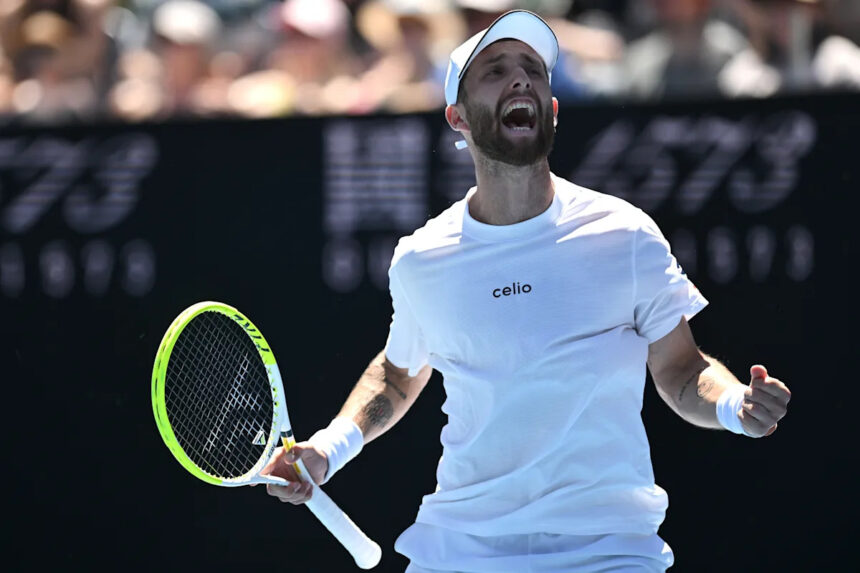
The roar of the Australian Open crowd is a familiar soundtrack to tennis glory. But on Sunday at Kia Arena, the sound that punctuated match point was not a cheer, but a cascade of boos. In a moment of pure, unscripted audacity, France’s Corentin Moutet, seeded 32nd, sliced in an underarm serve on match point against Australian wildcard Tristan Schoolkate. The local hopeful, caught in a vortex of surprise, floated a forehand long. Point, set, match—Moutet. A 6-4, 7-6 (1), 6-3 victory sealed not with a thunderous ace, but with a whisper of gamesmanship that ignited immediate controversy and laid bare the evolving, psychological battleground of modern tennis.
The Maverick’s Moment: Instinct Over Tradition
In the sanctified arenas of Grand Slam tennis, tradition holds immense weight. The serve is a weapon of power and intimidation, a statement of physical dominance. The underarm serve, by contrast, is often viewed as a trick, a gimmick, or worse—a sign of disrespect. Yet, as Moutet calmly explained in his post-match press conference, his decision was stripped of malice and rooted in pure competitive instinct.
“I did it because I thought it would be… I could win the point,” Moutet stated, addressing the crowd’s negative reaction. “I won the point actually. Of course, no disrespect or anything.” This justification is crucial. For Moutet, a player known for his flamboyant shot-making and cerebral approach, the calculus was simple: identify a weakness and exploit it within the rules. The move was less a premeditated provocation and more a spontaneous reading of the match’s geometry. With Schoolkate positioned deep behind the baseline anticipating a powerful delivery, the vast, unprotected space in the forecourt became an irresistible target.
This incident underscores a significant shift. The underarm serve, once the domain of club hackers and last-resort tactics, is being recalibrated as a legitimate strategic tool. It punishes extreme return positions, breaks rhythm, and introduces a potent element of doubt. Moutet’s application of it on match point, the highest-pressure moment in a match, signals a new level of tactical boldness and mental fortitude.
Gamesmanship or Genius? The Fine Line in Modern Tennis
The crowd’s boos highlight the persistent tension between innovation and etiquette in sports. The shot is perfectly legal, yet it violates an unwritten code of conduct for many purists. However, to dismiss Moutet’s move as mere gamesmanship is to overlook its strategic genius.
Let’s break down why this was an astute, high-risk, high-reward play:
- Psychological Shock Factor: On match point, a returner’s nerves are already frayed. An underarm serve is a complete pattern interrupt, bypassing muscle memory and forcing a split-second, panicked decision.
- Exploiting Positioning: Modern baseliners like Schoolkate often station themselves meters behind the baseline to handle powerful serves. Moutet turned this defensive strength into a fatal vulnerability.
- Controlling the Narrative: The move seized not just the point, but the entire emotional momentum of the match’s conclusion. It was a statement of control, showing Moutet was thinking several moves ahead while his opponent was reacting.
This is not the first time the shot has caused a stir. Nick Kyrgios has used it effectively against Novak Djokovic. Even the greats like Roger Federer and Andy Murray have acknowledged its strategic validity. Moutet’s execution, however, on such a pivotal point at a major, feels like a watershed, forcing players, fans, and pundits to officially recognize its place in the elite tactical arsenal.
The Ripple Effect: Predictions for Moutet and the Field
Corentin Moutet has now stamped himself as the tournament’s premier disruptor. This victory does more than advance him to the second round; it announces a dangerous and unpredictable opponent for anyone in his path. His game is a blend of old-school touch, fiendish slice, and lefty angles, now compounded by the proven willingness to deploy a psychological wildcard.
Looking ahead, we can predict several consequences:
- Moutet’s Confidence Surge: Pulling off such a bold move successfully is a massive boost. He played the match on his terms, in his chaotic rhythm, and won. Future opponents will now have to prepare for the underarm serve threat, splitting their focus and potentially adjusting their return stance—a win for Moutet before a ball is even struck.
- A Wake-Up Call for the Tour: Young players and deep returners will be studying this tape. The underarm serve is no longer a joke; it’s a scouting report bullet point. We should expect to see it used more frequently, though perhaps not on match points, as players integrate it to keep opponents honest.
- Moutet’s Draw Opened Up: With this win, Moutet has shed any label of being a straightforward, power-based opponent. He is a puzzle. In the high-stakes, pressure-cooker environment of a major, facing a player who thrives on unpredictability is a uniquely stressful proposition. He becomes a very tricky out for even the top seeds.
Conclusion: The Unwritten Code Rewritten
Corentin Moutet’s underarm serve to close out his Australian Open first-round match will be replayed and debated for years. It was a moment that transcended the scoreline, a flashpoint between tradition and progression, between sportsmanship and cutthroat competition. The boos from Kia Arena were a tribute to the shot’s disruptive power, a visceral reaction to a challenged norm.
But in the cold light of analysis, Moutet’s move was a masterstroke. It was legal, effective, and born of a sharp competitive instinct. It highlighted a tangible strategic evolution in the sport, proving that at the highest level, mental innovation is as critical as physical power. The Frenchman didn’t just win a match; he served notice that every inch of the court, and every page of the rulebook, is in play. The underarm serve has been legitimized on one of the sport’s biggest stages. The mavericks are writing the new rules, and the game is all the more fascinating for it.
Source: Based on news from Yahoo Sports.