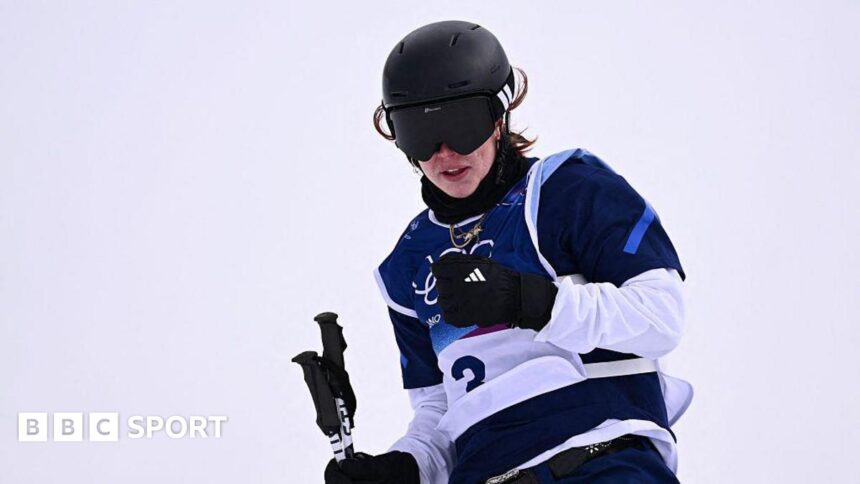
Heartbreak in Livigno: Kirsty Muir Misses Olympic Slopestyle Medal by Agonizing 0.41 Points
The cruelest of margins in sport is not a mile, nor a second. It is a fraction of a point, a subjective sliver of judgment separating elation from an emptiness that echoes. In the shadow of the Livigno peaks, under the glare of the Olympic stage, Great Britain’s Kirsty Muir experienced that precise, piercing heartbreak. The freestyle skier, in a breathtaking display of courage and skill, soared, spun, and stomped her way to a brilliant final run, only to finish fourth in the women’s slopestyle. The gap to the bronze medal? A mere 0.41 points.
The Agony and the Ecstasy of a Final Run For the Ages
Muir’s journey to that fateful third run was a narrative of resilience. The opening run was marred by a fall on the penultimate jump, a crushing start for a medal hopeful. Her second run was cleaner, landing her in sixth position but leaving her with a mountain to climb. The pressure cooker of an Olympic final, where only your best score counts, was at its most intense.
Then came the magic. With everything on the line, Muir delivered her best when it mattered most. She attacked the Livigno course with a combination of technical precision and stylish amplitude. Each rail feature was handled with confidence, each jump launched with explosive power. The run was a masterpiece of modern slopestyle: progressive, packed with difficulty, and flawlessly executed. As she crossed the finish line, the score flashed: 76.05 points. It was a massive jump, catapulting her from sixth and right into the medal conversation. The wait began, a torturous pause where hope and history hung in the balance.
When the standings finalized, the reality was a gut punch. Canada’s Megan Oldham had edged her out, 76.46 to 76.05. Fourth place by 0.41 points. In a sport judged on impression, where a slight hand drag or a marginally less clean landing can decide destinies, Muir had fallen an eyelash short. The image of her hopeful smile fading into stunned realization captured the brutal beauty of Olympic competition.
Expert Analysis: Decoding the Sliver of Separation
From a technical standpoint, understanding the 0.41-point deficit requires delving into the nuanced world of freestyle skiing judging. Scores are based on overall impression, broken into:
- Amplitude: The height and style of jumps.
- Execution: How cleanly and precisely tricks are performed.
- Difficulty: The complexity and risk of the trick selection.
- Variety: Using both directions of spin and a mix of grabs.
- Progression: Pushing the sport forward with innovative combinations.
Muir’s run was undoubtedly world-class. However, in a field where the top six were separated by less than five points, the minutiae become monumental. Analysts reviewing the runs might pinpoint subtle differentiators:
- A slightly more critical grab on a 900-degree spin.
- The Canadian bronze medallist Megan Oldham potentially achieving a fraction more height on a key jump.
- The inherent subjectivity of “style” points, where a judge’s preference for fluidity or aggression can tilt the scale.
Ultimately, Muir did nothing wrong. She laid down a run worthy of the podium on any given day. At the 2026 Games, on that day, it was simply, agonizingly, not quite enough. This analysis isn’t about fault, but about the fine margins at the Olympic pinnacle.
From Beijing Promise to Livigno Pain: Muir’s Trajectory
This was Kirsty Muir’s second Olympic Games. As a 17-year-old in Beijing 2022, she announced herself with a stunning fifth-place finish, a result that far exceeded expectations and marked her as Britain’s next great freestyle hope. The journey from promising youngster to established contender is fraught, and Muir has handled it with remarkable grace and consistent performance on the World Cup circuit.
The fourth-place finish in Livigno, while devastating, solidifies her status among the global elite. It is a different kind of pain than an early exit or a fall. It is the pain of being so close to the ultimate dream that you can almost touch it, a pain that only the very best athletes ever experience. This narrowest of margins for Great Britain’s first medal of the 2026 Games adds a layer of national narrative to her personal disappointment, a weight she carried admirably.
The Road Ahead: What’s Next for Kirsty Muir?
In the immediate aftermath, the focus will rightly be on recovery from this psychological blow. However, Muir’s career trajectory remains pointed sharply upward. At just 21 years old in Livigno, her prime years are squarely ahead of her.
Predictions for her future are overwhelmingly positive. This experience, as harrowing as it is, becomes a powerful fuel. Champions are often forged in the fire of such near-misses. The 0.41-point gap will become a motivational constant, driving refinement in training, a relentless pursuit of that incremental gain that turns fourth into first.
Look for Muir to:
- Return to the World Cup circuit with a vengeance, targeting the crystal globe.
- Further refine her trick repertoire, adding even more difficult combinations to her already impressive arsenal.
- Enter the 2030 Olympic cycle not as a hopeful, but as a focused and formidable favorite for gold.
The history of Olympic sports is littered with athletes who used fourth-place heartbreak as a springboard to future glory. Muir possesses the talent, the temperament, and now, the profound motivation to join those ranks.
Conclusion: A Defining Moment of Grit and Grace
Kirsty Muir did not win a medal in Livigno. But she won something perhaps equally important in the long arc of a champion’s story: the profound respect of the sporting world. To fall, to regroup, and to then produce a career-best Olympic run under duress is the mark of an extraordinary competitor. The 0.41-point margin will forever be a part of her narrative, but it should not define it.
It defines instead the razor’s edge on which Olympic dreams are balanced. For Team GB, the wait for a first medal in 2026 continues, but it is not for lack of heroism. Muir’s performance was a masterclass in resilience, a demonstration that heartbreak and brilliance can coexist in the same run down the mountain. As the dust settles in Livigno, one thing is clear: this is not the end of Kirsty Muir’s Olympic story. It is a heartbreaking, yet powerfully compelling, new chapter. The podium in 2030 awaits, and a young woman from Scotland now knows exactly, painfully, precisely how close she can get.
Source: Based on news from BBC Sport.