‘Mums thank me for changing the narrative’: The Revolutionary Evolution of Motherhood in Rugby
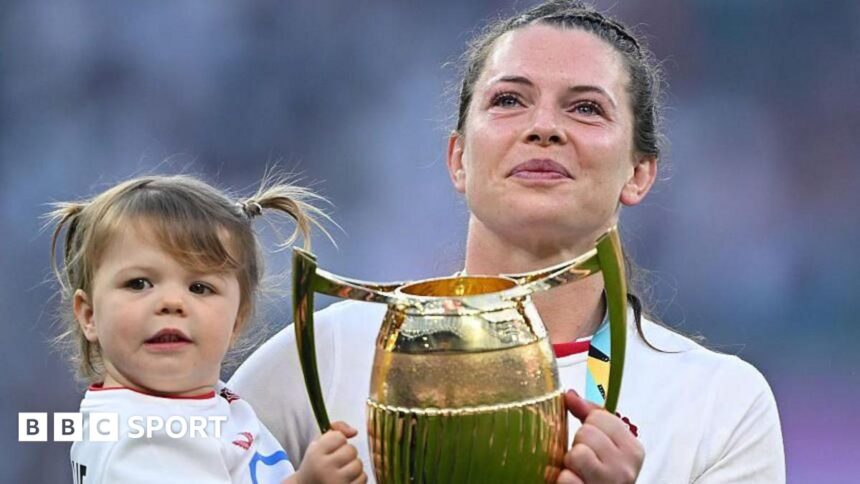
The picture was worth more than a thousand points on the scoreboard. Abbie Ward, the indomitable England lock, parading around a sold-out Allianz Stadium with the Women’s Rugby World Cup trophy held aloft in one hand, and her young daughter, Hallie, cradled securely in the other. For teammate Lark Atkin-Davies, and for a global audience, it was a seismic image. It was a declaration, in real time, that the landscape of elite women’s sport had irrevocably changed. This was not an athlete who had shelved her dreams for motherhood, nor a mother who had abandoned her identity as a world-class competitor. She was, powerfully and unapologetically, both.
From Taboo to Triumph: Shattering the Professional Ceiling
For generations, the narrative surrounding motherhood in contact sports was one of finality. Pregnancy signaled the end of a playing career. The physical demands, the perceived incompatibility, and a lack of structural support created a binary choice: family or football, babies or boots. The professionalization of the women’s game, however, has forced a necessary and profound evolution. Abbie Ward’s journey is the blueprint. In 2023, she became the first contracted England Red Rose to have a baby since the squad turned fully professional in 2019. Her path was uncharted, but her resolve was clear: motherhood did not have to wait.
Her return to international rugby in 2024, a mere 17 weeks after giving birth, was a feat of physical and mental fortitude. But the true pinnacle came just under two years postpartum, when she not only started but scored a try in the 2025 World Cup final. This was not a sentimental comeback story; it was a statement of high-performance excellence, achieved on the other side of pregnancy. Ward’s success has systematically dismantled the outdated assumption that an athlete’s prime and a woman’s childbearing years are mutually exclusive domains.
Lifting the Weight of Expectation: Redefining Pregnancy Fitness
Central to this new narrative is a radical shift in understanding athletic training during pregnancy. The old model prescribed rest and caution, often interpreting pregnancy as a period of fragility. Today’s athlete-mothers, backed by evolving sports science, are rewriting the manual. Lifting weights while pregnant has become a symbol of this change. Under expert guidance, maintaining strength and conditioning is now seen as beneficial for both mother and baby, promoting healthier pregnancies and laying the foundation for a more robust postpartum return.
“Mums thank me for changing the narrative,” Ward has said, highlighting the broader cultural impact. Her visible, documented training while expecting her second child sends a powerful message to women everywhere: strength is not a liability. This paradigm shift is underpinned by key principles:
- Individualized Programming: Training is meticulously tailored by specialists to the stage of pregnancy and the athlete’s unique physiology.
- Focus on Foundation: Emphasis shifts to core stability, pelvic floor health, and maintaining functional strength over peak performance.
- Postpartum as a Phase, Not a Setback: The return-to-play protocol is treated with the same rigor as rehabilitating a major injury, with phased benchmarks and long-term athletic health as the goal.
This scientific, empowered approach transforms pregnancy from a career hiatus into a strategic period of athletic development, fundamentally altering the career trajectory for women in rugby and beyond.
The Infrastructure of Inclusion: Contracts, Care, and Culture
An athlete’s personal determination can only go so far without institutional support. The evolution of motherhood in rugby is as much about policy as it is about personal triumph. The professionalization of the women’s game has been the critical catalyst. Central contracts from unions like the RFU now provide the financial security and job protection that make planning a family feasible. Maternity policies, once non-existent, are becoming standard, covering leave, medical care, and structured return-to-play pathways.
Perhaps more subtle but equally important is the cultural shift within teams. The image of Ward with Hallie celebrates a new kind of team environment—one where children are visible in the high-performance space. This normalization is vital. It tells younger players that they can envision a full career and a family. It fosters a supportive culture where teammates celebrate a baby’s first steps with the same enthusiasm as a try-saving tackle. This holistic support system ensures that the pioneering efforts of athletes like Ward create a permanent, welcoming path for those who follow.
The Future of the Game: Predictions for a New Era
The ripple effects of this evolution will define the next decade of women’s rugby. We are moving from the era of the pioneer to the era of the norm. The predictions for this new landscape are compelling:
- The “Motherhood Prime”: We will see athletes peaking in their late twenties and early thirties, post-pregnancy, leveraging their experience, mental resilience, and refined physical conditioning.
- Depth Through Diversity: Teams will benefit from longer career spans, retaining veteran leadership and intellectual capital that was previously lost.
- Commercial and Fan Engagement: Brands and fans will connect more deeply with athletes showcasing multifaceted, relatable lives, strengthening the sport’s marketability.
- Grassroots Impact: Young girls will see visible, successful athlete-mothers, expanding their own dreams of what is possible in sport and life.
The question will no longer be “Can she come back?” but “How will her game evolve when she does?” The narrative has shifted from comeback to continuation.
Conclusion: A Legacy Beyond the Try Line
Abbie Ward lifting the World Cup with her daughter in hand is more than a memorable photo. It is the emblem of a revolution. The evolution of motherhood in rugby is a story of scientific progress, institutional responsibility, and raw human ambition. It challenges deep-seated stereotypes about strength, parenthood, and professional dedication. Ward and her contemporaries are not just winning trophies; they are winning a far more significant battle to redefine the life cycle of the female athlete.
Their legacy will be measured not only in championships but in the generations of players who will never have to choose. They have changed the narrative, from one of sacrifice to one of synergy, proving that the heart of a mother and the heart of a champion are not just compatible—they can be the very source of unparalleled triumph. The future of women’s rugby is not just faster and stronger; it is, profoundly, fuller.
Source: Based on news from BBC Sport.