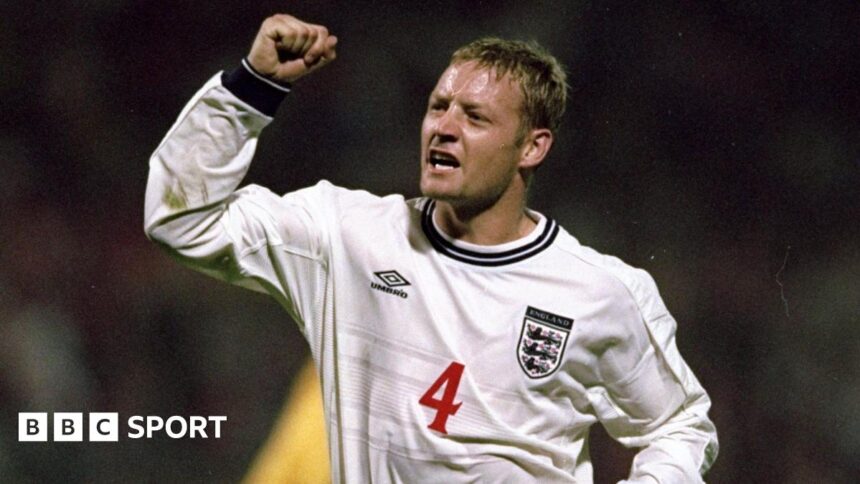
The Unmarked Man: The Enduring Mystery of David Batty’s Disappearing Act
In the modern era of football, where every training session is a social media post and every holiday a curated Instagram story, true anonymity is a relic. For the elite player, it’s a currency long spent. Yet, one man, a Premier League title-winner and an England international with 42 caps, has achieved the impossible: he has vanished. Last month, dozens of phones buzzed across the globe. Rio Ferdinand, Mark Viduka, Jason Wilcox, even former manager David O’Leary were among those alerted to new messages in their Leeds United WhatsApp group. It was David Batty’s 57th birthday. The digital chorus of “happy birthday” and raised emoji pints went unanswered. The stark, unifying truth for that band of brothers was this: nobody who shared a dressing room with the ex-midfielder had the slightest idea where he was. Not a clue. In a world of perpetual connection, David Batty remains football’s ultimate unmarked man.
The Engine Room Enigma: Batty’s On-Field Persona
To understand the intrigue of Batty’s absence, you must first recall the unyielding presence of his playing days. He was not a flashy playmaker or a goal-scoring hero. David Batty was the defensive midfield anchor, the human vacuum cleaner who broke up play with a ferocious, uncompromising efficiency. At Leeds United, he was the snarling heartbeat of Howard Wilkinson’s 1992 title-winning side. At Blackburn Rovers, he partnered Tim Sherwood to provide the steel for Alan Shearer’s fire, clinching another Premier League crown in 1995. For England, his 42 caps were a testament to a reliability so few could provide.
His style was defined by a ruthless simplicity. He never sought the spotlight; his job was to ensure others could shine. He was the player you hated to play against but loved to have on your team. This was a man of few words on the pitch, and even fewer off it. His infamous penalty in the 1998 World Cup shootout against Argentina—a casual, almost dismissive chip that rattled the bar—was a rare, fleeting moment of audacity that somehow perfectly encapsulated his contrarian nature. He walked away from that monumental pressure without a flicker of emotion. Why would retirement be any different?
The Conscious Uncoupling: A Life Beyond the Game
David Batty’s retreat from public life is not a disappearance born of scandal or bitterness. It is, by all accounts, a deliberate and contented choice. Unlike many contemporaries who transition into punditry, coaching, or ambassadorial roles, Batty executed what can only be called a clean break. After hanging up his boots in 2004 following a second stint at Leeds, he simply went home.
Reports from the rare sightings paint a picture of a man thoroughly at peace. He is said to split his time between his Yorkshire roots and a quiet life in the Scottish borders, immersed in the countryside he always preferred to the glitz of city life. His passions are refreshingly normal:
- Family life with his wife and children, fiercely guarded from public view.
- A deep love for the countryside, involving walking, farming, and the outdoors.
- A complete avoidance of the football media circus, including reunions and anniversary events.
This is not a recluse in the traditional sense, but a private citizen who has successfully demarcated his past career from his present life. As former teammate Gary McAllister once noted, “He’s just a private person. He’s not one for the fanfare.” In an age where “fanfare” is the default setting, Batty’s silence is deafening.
The WhatsApp Void: What Batty’s Silence Says About Modern Football
The birthday episode in the Leeds WhatsApp group is more than just an anecdote; it is a profound symbol of Batty’s unique stance. That digital space, buzzing with banter, business ventures, and nostalgia, represents the permanent interconnectedness of the modern football fraternity. It is a net that has caught almost everyone. Except him.
Batty’s absence from this realm highlights a vanishing archetype: the player whose identity was not consumed by the sport. He worked as a footballer; he was not a “brand.” His legacy is sealed in trophies and the respect of peers, not in follower counts or media profiles. In refusing to engage, he has, ironically, preserved the mystique of the 90s football hardman in its purest form. There is no diluted version of Batty on Twitter, no softening of his image on a podcast. He remains, in the public consciousness, exactly as he was: tough, uncompromising, and entirely on his own terms.
This stands in stark contrast to today’s athletes, for whom post-career personal branding is often a second career. Batty’s path asks a compelling question: when the final whistle blows, who owns your narrative? His answer was to take it back completely.
The Final Whistle: Will We Ever See Batty Again?
Predicting any return to the public eye for David Batty is a fool’s errand. All evidence points to a man who has found exactly what he was looking for. However, football has a long memory and a sentimental heart. There are milestones that could, perhaps, tempt a sighting:
- A significant Leeds United anniversary for the 1992 title-winning squad, perhaps a decade from now.
- An event deeply connected to his family or local community, rather than the global football industry.
But the overwhelming likelihood is that we won’t. And that should be celebrated, not lamented. In a culture obsessed with access, Batty’s choice is a powerful statement of autonomy. He gave football everything he had on the pitch for nearly two decades. He owes it nothing more.
His former teammates, those left puzzled in the WhatsApp group, likely understand this better than anyone. They knew the man. They remember the steely focus, the dry wit, the lack of pretense. Their confusion over his whereabouts isn’t born of worry, but of a knowing respect. David Batty is not lost. He is exactly where he wants to be.
The enduring mystery of David Batty is not a mystery to him. It is a masterclass in defining success on one’s own terms. He was the midfielder nobody could get hold of on the pitch. In retirement, he has perfected the art. While the football world continues to buzz and chatter, one of its toughest sons is finally, and happily, at peace in the quiet. And that, perhaps, is the greatest victory of all.
Source: Based on news from BBC Sport.