Premier League Panel Backs Officials in Controversial Amad Diallo Penalty Decision
The line between a foul and a fair challenge in the Premier League’s penalty area is often microscopically thin, a frontier where games, seasons, and even careers are decided. In the aftermath of Manchester United’s chaotic 2-2 draw with Bournemouth last month, that line was drawn squarely through the incident involving Amad Diallo and Adrien Truffert. While pundits cried foul, the league’s own arbiters have now delivered a definitive verdict: the officials got it right. The Premier League’s Key Match Incidents Panel has ruled that neither referee Stuart Attwell nor the VAR were wrong to deny Amad’s dramatic penalty appeal, a decision that sparked immediate controversy and a devastating Bournemouth counter-attack goal.
The Incident: A Moment of Chaos at the Vitality Stadium
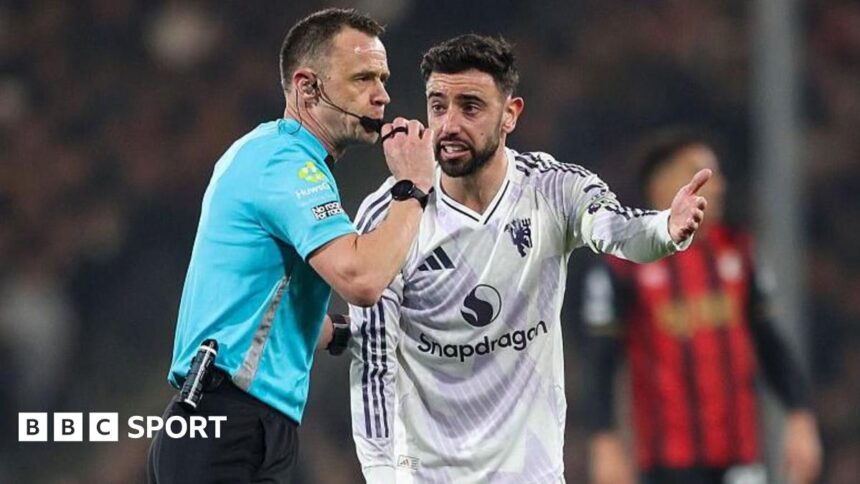
The flashpoint occurred in the 67th minute with the score delicately poised at 1-1. Manchester United’s Ivorian winger, Amad Diallo, received the ball on the right side of Bournemouth’s box. As he attempted to shift the ball onto his left foot, Bournemouth defender Adrien Truffert closed in. The crucial sequence saw Truffert place both hands on Amad’s back. The contact was undeniable, but its nature and consequence became the subject of fierce debate. Amad went to ground, his arms flung out in appeal. Referee Stuart Attwell, positioned nearby, immediately waved play on, judging the contact to be insufficient for a penalty.
The ramifications were instantaneous and severe. As United’s players protested, Bournemouth launched a blistering counter-attack. The play swept upfield, culminating in Ryan Christie firing the Cherries into a 2-1 lead. The swing in momentum—from a potential United penalty to a Bournemouth goal—was a brutal two-goal psychological shift encapsulated in mere seconds. The incident became the defining moment of the match, overshadowing the eventual 2-2 draw and fueling post-match analysis for weeks.
Pundits vs. Panel: The Great VAR Debate Reignited
In the immediate aftermath, the reaction from television studios was largely critical of the on-field decision. The phrase ‘The referee got it wrong’ echoed from pundits who argued that any two-handed push in the box, however slight, constitutes a foul. Their case rested on a fundamental principle: such contact is illegal and impedes the attacker’s ability to play the ball. From this perspective, the VAR’s failure to intervene was a failure of the system’s primary purpose—to correct clear and obvious errors.
However, the Key Match Incidents Panel operates on a different, more nuanced set of criteria. This independent group, comprised of former players, managers, and refereeing experts, reviews major decisions in the cold light of day. Their 5-0 ruling in favor of the officials reveals a critical distinction in modern officiating:
- Contact vs. Consequence: The panel acknowledged contact but deemed it not enough to warrant a penalty. Amad was not denied a clear scoring opportunity by the hands on his back.
- Attacker’s Responsibility: There is a growing emphasis on whether the attacker is genuinely seeking to play the ball or is initiating contact to “buy” a penalty. The panel likely felt Amad’s fall was exaggerated relative to the force applied.
- Clear and Obvious Threshold: For VAR to overturn Attwell’s real-time decision, the error must be undeniable. The panel concluded the on-field call was a valid judgment, thus making it immune to VAR intervention.
This ruling highlights the perennial disconnect between the instantaneous, emotional analysis of a game and the deliberate, technical process of officiating review.
Expert Analysis: The Shifting Sands of Penalty Interpretations
This decision is not an isolated case but part of a broader, deliberate trend in Premier League officiating. Experts note a conscious effort to raise the threshold for penalty awards, particularly for incidents involving minimal contact in the box. The directive aims to preserve the flow of the game and reduce the incentive for attackers to go to ground easily.
“What we are seeing is a recalibration,” explains a former top-flight referee. “The question is no longer simply ‘Was there contact?’ It is now a more complex equation: ‘Was the contact sufficient to foul the player? Did the attacker use the contact as a reason to go down?’ The panel’s support of Attwell suggests they felt Truffert’s actions were more about balance and proximity than a forceful, foul-inducing push.”
For managers and players, this creates a challenging landscape. Defenders are given slightly more leeway to be physical, while attackers must now demonstrate not just contact, but genuine impairment. This incident, backed by the panel’s ruling, serves as a benchmark. It signals to players that not every touch will be penalized and to fans that the era of “soft penalties” is being actively challenged by the authorities.
Predictions and Ramifications for the Premier League Run-In
The panel’s validation of this call will have ripple effects for the remainder of the season and beyond.
- Clarity for Referees: On-field officials will feel emboldened to let similar, physical moments play on, knowing the panel supports a higher threshold. We may see fewer penalties awarded for similar two-handed incidents.
- Adaptation from Attackers: Smart forwards will need to adjust. Staying on their feet through minor contact, even if it compromises a shot, may become more valuable than seeking the penalty, as the reward is no longer guaranteed.
- Increased Fan and Pundit Frustration: The dissonance between real-time perception and post-hoc analysis will continue. As this standard solidifies, we can expect more heated debates when similar non-calls occur in high-stakes matches.
- Tactical Implications: Defenders may test these limits more aggressively, especially against tricky wingers in the box, knowing the benefit of the doubt is shifting slightly in their favor.
Conclusion: A Landmark Decision in the Quest for Consistency
The Premier League’s Key Match Incidents Panel has done more than just rule on a single moment in a April fixture. By unequivocally backing Stuart Attwell and the VAR, they have drawn a clear line in the sand regarding penalty box contact. This decision champions the authority of the on-field referee’s instantaneous judgment and reinforces a sterner, less forgiving interpretation for attackers seeking penalties from minimal contact.
While the roar of disagreement from pundits and fans proves that controversy will never be eliminated from football, the pursuit of consistency demands such definitive stances. The Amad Diallo incident at the Vitality Stadium is no longer just a controversial flashpoint; it is a landmark case study in the evolving philosophy of Premier League officiating. It underscores a fundamental message: not all contact is a foul, and the game’s dramatic, often heartbreaking, swings in fortune—like the immediate concession of a goal—will sometimes be upheld as a fair, if brutal, consequence of play.
Source: Based on news from BBC Sport.