Coco Gauff’s Powerful Serve: Champion Speaks Out on U.S. Turmoil from Dubai
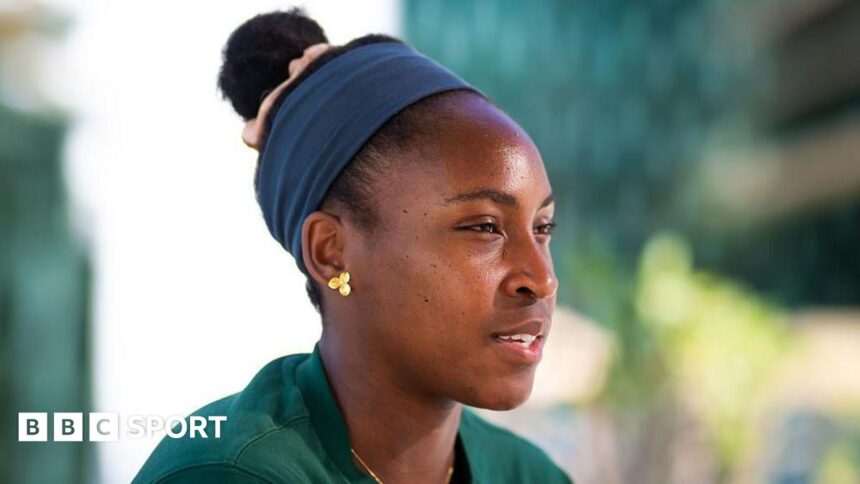
From the sun-baked hard courts of Melbourne to the gleaming stadiums of Dubai, Coco Gauff carries more than her tennis gear. The 21-year-old phenom, a two-time Grand Slam champion and one of the most recognizable faces in global sports, carries the weight of a nation’s strife. As she prepares to compete at the Dubai Tennis Championships, Gauff’s powerful voice is cutting through the usual pre-match chatter, addressing a far more profound struggle happening thousands of miles away. Her message, distilled from grief and conviction, is a stark indictment: “People shouldn’t be dying just for existing.”
A Champion’s Awakening: Tragedy Viewed from Afar
For elite athletes like Gauff, the perpetual global tour creates a unique duality. They represent their country on the world stage while often witnessing its most difficult chapters from a disconnected, satellite feed distance. This was Gauff’s reality during the Australian Open, where she was competing for tennis’s highest honors. It was there, between training sessions and media commitments, that she learned of the deaths of Renee Good and Alex Pretti in Minneapolis. The two individuals were killed last month during an operation by Immigration and Customs Enforcement (ICE) agents, sparking a fresh wave of protests across the United States.
“It’s tough to wake up and see what’s happening back home,” Gauff confessed, her words reflecting the helplessness felt by many abroad. This incident is not an isolated one in her consciousness. Gauff has been among the most vocal American athletes regarding social justice, using her platform to speak against systemic inequality and, specifically, the policies of former President Donald Trump, including his administration’s immigration crackdown. For her, these are not political abstractions but human tragedies.
- Global Platform, Local Pain: Gauff’s international profile amplifies her commentary, bringing domestic U.S. issues to a worldwide audience.
- Athlete Activism Legacy: She stands in a growing lineage of American sports figures, from Muhammad Ali to the WNBA, who leverage fame for advocacy.
- The Weight of Witness: Learning of traumatic events from afar adds a layer of complex emotion for athletes representing their country.
More Than a Backhand: The Evolution of Gauff’s Advocacy
Coco Gauff’s activism is not a recent development. It is woven into the fabric of her career. As a 16-year-old at the 2020 US Open, she delivered an eloquent speech on racial injustice, asking, “We need to have more conversations… How can I use my voice to make a change?” Since that moment, her voice has only grown more assured. Her criticism of Trump-era policies places her squarely within a movement of athletes who see civic engagement as a responsibility of their station.
This stance requires significant courage. The world of professional sports, particularly individual sports like tennis, often pressures athletes to remain “apolitical” to avoid alienating sponsors or segments of the fanbase. Yet, Gauff, now ranked world number five, continues to defy this unspoken rule. Her analysis is rooted in a clear moral framework: the fundamental right to safety and dignity. “Just for existing,” she stated—a phrase that underscores a perceived breakdown in the basic social contract, where life itself is seen as endangered by systemic forces.
Expert analysis suggests Gauff represents a new generation of athlete who views their platform as inherently political. “They don’t separate the person from the player,” says Dr. Amira Davis, a sports historian. “For Gauff, speaking on ICE actions or police brutality is as integral to her identity as her forehand. She’s competing for titles while simultaneously advocating for the soul of her home country.”
The Game Ahead: Predictions for Impact and Backlash
As Gauff takes to the court in Dubai, the question becomes: what is the tangible impact of an athlete’s voice from overseas, and what challenges will she face?
Prediction 1: Amplification of the Issue. Gauff’s comments will inject the stories of Good and Pretti, and the broader debate around ICE enforcement, into international sports headlines. This globalizes a domestic issue, potentially galvanizing diaspora communities and international human rights groups to apply external pressure.
Prediction 2: Intensified Scrutiny and Polarized Reactions. Gauff will likely face heightened criticism from certain political quarters and media outlets that believe athletes should “stick to sports.” Her endorsements and public perception in the U.S. may become more polarized, reflecting the nation’s own divisions. However, this also strengthens her credibility with a vast segment of the public, particularly younger fans, who expect authenticity and social awareness from their icons.
Prediction 3: Inspiring a Wave in the WTA Locker Room. Gauff’s stance may empower other tennis players, on the WTA and ATP tours, to speak more openly about social and political issues in their own countries. The locker room has long been a cosmopolitan space for quiet discussion; Gauff’s public courage could bring more of those conversations to the podium.
The immediate test, however, is in Dubai. Can she compartmentalize the emotional weight of her advocacy to deliver championship-level tennis? History suggests she can. At the 2020 French Open, played amid a global pandemic and a summer of racial reckoning, Gauff navigated similar pressures with grace and power, proving her mental fortitude is as formidable as her physical game.
Love Means Nothing? A Conclusion on Tennis and Truth
In tennis, “love” means zero. But for Coco Gauff, love for her community and country means everything—and it compels her to speak a difficult truth. Her journey from teen sensation to Grand Slam singles champion has run parallel to her evolution into a mature, unflinching advocate. Competing in Dubai, she embodies a modern paradox: the athlete as both national ambassador and national critic.
Her statement, “People shouldn’t be dying just for existing,” is a profound, minimalist manifesto. It cuts through political rhetoric to center on humanity and the value of life. As protests continue in American cities and the debate over immigration and enforcement rages, the voice of a young Black woman at the pinnacle of her sport carries unique resonance. She is not just playing for ranking points or trophies; she is playing—and speaking—for a principle. Coco Gauff’s most powerful serve may not be delivered with a racquet, but with a microphone, challenging a nation to live up to its ideals, one courageous statement at a time.
Source: Based on news from BBC Sport.