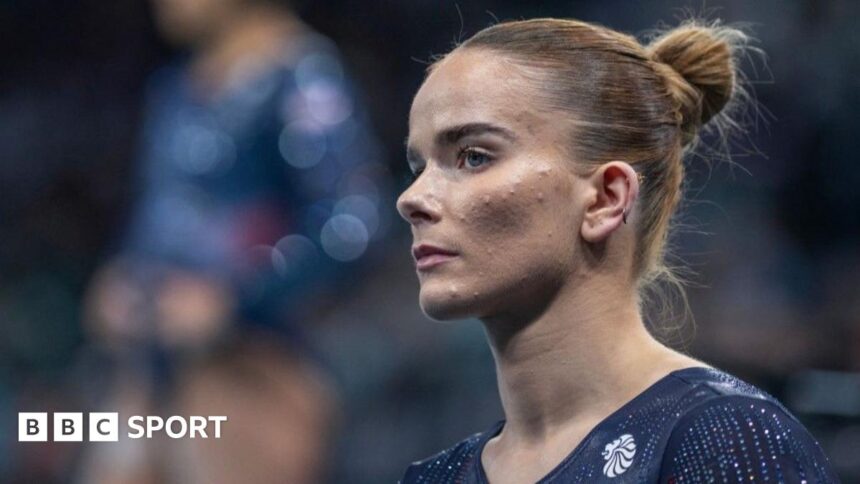
Alice Kinsella: The Pioneer Defying Time and Tradition in Gymnastics’ Postpartum Comeback
The air in the high-performance gym at Lilleshall National Sports Centre is thick with the scent of chalk and ambition. Elite athletes flip and fly in a symphony of controlled power. But when Alice Kinsella enters, the focus of the room shifts. Coaches and world-class gymnasts don’t rush to discuss her latest vault. Instead, they flock to the tiny, wriggling center of her universe: her son, Parker, beaming in his Christmas babygrow. This simple, heartwarming scene is the most radical act in elite gymnastics today. Alice Kinsella isn’t just training for the Paris Olympics; she is authoring a blueprint for motherhood at the pinnacle of a sport that has long considered the two mutually exclusive.
More Than a Comeback: A Groundbreaking Case Study
What Alice Kinsella is attempting is so statistically rare, so precedent-defying, that her journey has become the subject of an academic research paper. In the brutal chronology of women’s artistic gymnastics, where peak performance often coincides with late adolescence, a return to elite competition after childbirth is virtually uncharted territory. We celebrate “comebacks” from injury, but a comeback from pregnancy and childbirth involves a physiological and psychological transformation with no established playbook. Kinsella, a team bronze medalist at the Tokyo Olympics and a European champion, is writing it in real time, repointing the sport’s compass on what is possible for an athlete’s lifespan.
“When I first found out I was pregnant, I didn’t know if this was even an option,” Kinsella has admitted. The path was foggy, littered with unanswered questions about pelvic floor health, joint stability, and the sheer logistics of training with an infant. Her decision to return transforms her from Olympian to pioneer, challenging the ingrained notion that elite gymnastics and motherhood exist on opposite ends of a spectrum.
The Unseen Hurdles: Retraining Body and Mind
The physical journey back is a meticulous deconstruction and rebuild. Pregnancy hormones like relaxin, which loosens ligaments to accommodate childbirth, don’t simply switch off. This means returning to a sport that demands explosive power and precise landings on a body that is fundamentally different.
- Core Re-engineering: It’s not about “getting a six-pack back.” It’s about rehabilitating the deep core system, including the transverse abdominis, which has been stretched and separated. Every skill, from a simple handstand to a complex tumbling pass, originates from this restabilized core.
- Impact Management: Returning to pounding vault runs and floor landings requires a gradual, scientifically monitored approach to protect the pelvic floor and joints. It’s a careful balance between rebuilding strength and listening to a body that is giving new feedback.
- The Mental Shift: Perhaps the most profound change is psychological. Training is no longer a singular pursuit. It exists in 90-minute windows between feeds and naps. “Your priorities completely change,” Kinsella notes. This can, paradoxically, become a strength—a newfound perspective where the gym becomes a sanctuary of personal pursuit, and the pressure is filtered through the lens of being a role model for her son.
Her training is now a masterclass in efficiency and purpose, a stark contrast to the endless hours often associated with elite gymnastics. Every minute in the gym is intentional.
Changing the Game: The “Parker Effect” on Team Culture
The presence of baby Parker in Lilleshall is more than a cute sidebar; it’s a cultural shift. Gymnastics halls are traditionally spaces of singular, often solitary, ambition. By bringing her whole self—athlete and mother—into that environment, Kinsella is subtly reshaping team dynamics. The emotional support and shared joy Parker brings create a more holistic, human atmosphere.
This “Parker Effect” offers a powerful counter-narrative to the win-at-all-costs mentality that has plagued the sport. It showcases balance, resilience, and a broader definition of success. For younger gymnasts on the team, it visually normalizes a future where a family doesn’t have to mean the end of a career. Kinsella is not just training alongside them; she is showing them a potential roadmap for their own futures, expanding their horizons beyond the next quadrennium.
Paris and Beyond: What Success Looks Like for a Pioneer
Measuring Kinsella’s success purely by a podium finish in Paris misses the monumental point of her journey. Her victory is already in progress. Qualification for the British team would be a historic achievement in itself, sending a seismic message to federations and athletes worldwide. However, her impact transcends medals.
Expert analysis suggests her greatest contribution will be the data and narrative she generates. The university research following her journey will provide invaluable insights for sports scientists, physiotherapists, and coaches, creating a safer, more informed pathway for the athletes who will inevitably follow her. She is building the institutional knowledge that gymnastics has lacked.
Predictions for Paris must be tempered with realism; the field is fierce, and her training timeline is compressed. Yet, Kinsella’s experience and refined artistry, particularly on beam and floor, could be potent weapons. A spot in a final would be a spectacular triumph. But the stronger prediction is this: Alice Kinsella will inspire a generation. She will make the once-unthinkable thinkable. Gymnasts watching her will now know that asking “what if I want a family?” doesn’t have to be a career-ending question.
A Legacy Forged in Love and Chalk
As Alice Kinsella chalked up for her first major competition since becoming a mother, the roars from the crowd carried a deeper resonance. They were cheering not just for the gymnast, but for the pioneer; not just for the difficulty of her routines, but for the profound difficulty of her path. Her story is a powerful rebuke to the outdated calendar that has governed women’s gymnastics.
When she walks into the arena in Paris, or any gym thereafter, she carries the hopes of every athlete who has dared to envision a longer, fuller career. And while the world may watch her soaring twists and turns, the most revolutionary image remains the one back in Lilleshall: a champion with chalk on her hands, picking up her smiling son, seamlessly blending two worlds that were never meant to be apart. Alice Kinsella’s greatest routine isn’t on the floor—it’s the beautiful, groundbreaking balance she is mastering every single day.
Source: Based on news from BBC Sport.