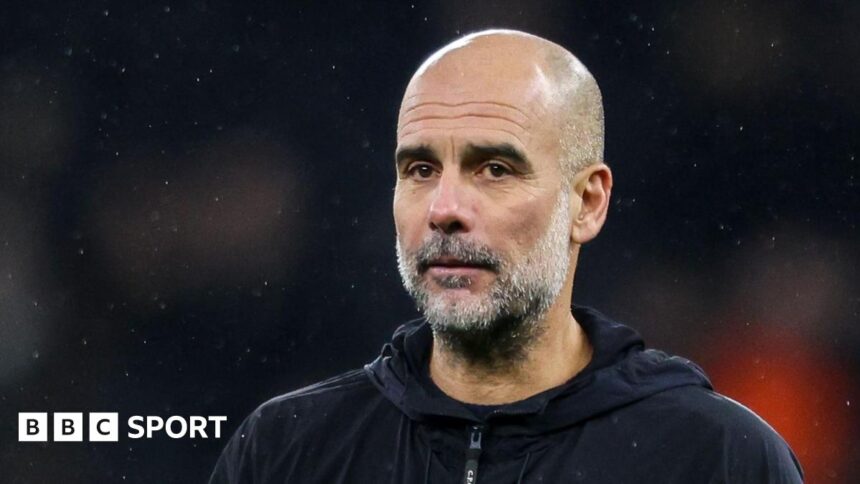
Guardiola’s ‘Pure Logic’ Plea: The Case for a Carabao Cup Rule Revolution
The Carabao Cup, often celebrated for its unpredictability and platform for emerging talent, finds itself at the center of a high-stakes philosophical debate. As Manchester City secured their passage to a sixth final under Pep Guardiola, the narrative swiftly shifted from another dominant semi-final performance to a pointed critique of the competition’s regulations. The catalyst? A £50m defender sitting in the stands, ineligible to feature at Wembley. Guardiola’s call for a rule change to allow Marc Guehi to play in the final is more than a manager lobbying for his player; it’s a clash between rigid bureaucracy and the evolving reality of modern football.
The Ineligibility Conundrum: A Rule Born from a Different Era
Manchester City’s 5-1 aggregate dismantling of Newcastle United was a testament to their depth and quality. Yet, post-match, Guardiola’s focus was on an absent figure. Marc Guehi, signed from Crystal Palace in a major January move, was a spectator. The reason lies in the Carabao Cup’s specific eligibility rules, which state a player must be registered “prior to the closure of the Winter transfer window, or the first leg of the semi-final (whichever is sooner).”
City played their first leg against Newcastle on January 13th, winning 2-0. The winter transfer window closed on February 1st. Guehi’s signing was confirmed after both dates, rendering him cup-tied for the remainder of the competition, including the final against Arsenal on March 22nd. From the EFL’s perspective, the rule is clear and intended to maintain competitive integrity, preventing teams from stacking their squad specifically for the latter stages of a knockout tournament.
However, Guardiola’s argument cuts to the heart of a modern incongruity. “The rule is the rule,” he conceded, before adding, “but maybe for the future, for the fairness, for the players and managers, they could think about it. It is not fair for him. He could play in the final. It is pure logic.” His point is compelling: why should a player, now fully integrated into his squad, be barred from the showpiece event of a competition his new club is in, simply because of administrative timing?
Guardiola’s “Pure Logic” vs. The Spirit of the Rule
Guardiola’s stance is rooted in a manager’s desire for optimal selection and a fundamental sense of fairness towards the athlete. Let’s break down his core arguments:
- Player Welfare and Fairness: Guehi is fit, registered, and a key part of Guardiola’s plans. Denying him a Wembley final, a pinnacle of the domestic season, feels like an unjust punishment for a timing technicality.
- The “Final” as a Unique Event: Guardiola implicitly distinguishes between earlier rounds and the final. The semi-final rule prevents tactical window-shopping for a specific two-legged tie, but the final is a one-off event, a separate entity in the football calendar.
- Modern Squad Dynamics: Transfers are complex, multi-faceted operations. A deal of Guehi’s magnitude often involves protracted negotiations, medicals, and personal terms. Punishing a club and player for a deal concluding a few weeks after a semi-final first leg seems anachronistic.
Conversely, the EFL’s rule is designed to uphold a core principle: competition continuity. It ensures the squad that navigates the early and middle rounds is largely the one that contests the final, preserving the traditional narrative arc of a cup competition. Changing the rule could, in theory, open the door for elite clubs with financial muscle to make targeted “final-only” signings, potentially undermining the spirit of the tournament.
Historical Precedent and the Potential for Change
This is not the first time such an issue has arisen. The precedent often cited is the 2012 FIFA Club World Cup rule, which allowed new signings to play if they were registered before the tournament began, regardless of domestic cup ties. More recently, UEFA’s rules for the Champions League knockout stages are different, allowing a club to register three new eligible players without restrictions after the group stage, irrespective of previous competitions.
Guardiola’s public lobbying places the EFL in a delicate position. As a governing body often keen to demonstrate flexibility and modern thinking—evident in their early adoption of VAR in the final and allowing five substitutes—this presents a clear test. A potential compromise could involve:
- Amending the “sooner” clause: Shifting the cutoff to the date of the final itself, or perhaps the day before the final, for players signed during the winter window.
- A “one-player” exception: Allowing a single player registered after the semi-final first leg to be eligible for the final, provided they were not cup-tied to another club in the competition.
- Alignment with UEFA model: Adopting a squad list amendment system for the final, similar to European competitions.
Any change would need careful drafting to avoid unintended consequences, but Guardiola has ignited the debate. The Carabao Cup’s identity is at stake: does it cling to its traditional regulations, or does it adapt to reflect the fluid nature of the contemporary transfer market and squad management?
Final Forecast: Impact on City, Arsenal, and the Wembley Showdown
While the rule change debate rages, the immediate reality is that Marc Guehi will not feature at Wembley. This has tangible implications for the final. For Manchester City, it means Guardiola cannot deploy his preferred new defensive cornerstone. Instead, he will likely rely on the established partnership of Ruben Dias and John Stones, or call upon Nathan Ake or Manuel Akanji. While this is hardly a crisis for a squad of City’s depth, it does remove a tactical option and the potential boost of a new, high-quality addition.
For Arsenal, it is a minor but undeniable psychological and tactical reprieve. Mikel Arteta will not have to plan for Guehi’s specific attributes. Instead, he prepares for a City defensive unit he knows intimately. The absence could be most keenly felt in a tight, tense match where one moment of unfamiliarity or a fresh defensive dynamism might have made the difference.
Prediction for the Final: City, even without Guehi, remain slight favorites due to their immense experience in these occasions. However, Arsenal’s hunger and improved big-game mentality under Arteta make this the most finely poised Carabao Cup final in years. The scoreline may ultimately be decided by a moment of individual brilliance from a Kevin De Bruyne or a Bukayo Saka, rather than a missing defender. Yet, Guehi’s absence will linger as a subplot—a “what if” that fuels Guardiola’s campaign for change.
Conclusion: A Catalyst for Modernization
Pep Guardiola’s intervention regarding Marc Guehi’s Carabao Cup final ineligibility transcends self-interest. It highlights a growing dissonance between football’s archaic regulatory frameworks and its modern operational rhythms. While the EFL’s rules are well-intentioned, they risk appearing punitive and out-of-step. Guardiola’s “pure logic” is difficult to refute: a player legally transferred and registered to a club should be available for the biggest games that club plays.
The Carabao Cup has an opportunity here. By reviewing and potentially amending this rule, the EFL can demonstrate it is a forward-thinking competition, one that prioritizes fairness to players and reflects the realities of the 21st-century game. Whether the change comes too late for Marc Guehi is secondary. The goal should be to ensure no player or manager has to voice this same, frustratingly logical complaint again. The final at Wembley will crown a champion, but the conversation Guardiola has started may be the contest’s most lasting legacy.
Source: Based on news from BBC Sport.