Rashford’s Redemption? How Amorim’s Exit Opens a Surprising Manchester United Pathway
The winds of change are blowing through Old Trafford once more, but this time, they carry a whisper from the past. The recent, and somewhat abrupt, dismissal of manager Ruben Amorim has done more than just reset the dugout; it has subtly shifted the tectonic plates beneath the feet of Manchester United’s entire squad. In this new seismic landscape, a fascinating possibility has emerged from the rubble: a potential lifeline for Marcus Rashford, the academy graduate whose United future seemed, until very recently, to be written in another club’s colours.
The Amorim Era: A Stark Mismatch of Philosophy and Instinct
To understand the significance of this shift, one must first revisit the brief, turbulent tenure of Ruben Amorim. Appointed to instil a rigorous, system-first discipline, Amorim’s vision for United was one of collective automatism over individual flair. His demands for relentless defensive work-rate and strict positional adherence created an environment where natural, instinctive attackers could often feel stifled.
Marcus Rashford, a player whose greatest strengths are his explosive pace, direct running, and instinct for goal, never truly fit the schematic puzzle. Amorim’s public comments, while diplomatically framed, were a damning indictment of this mismatch. By stating Rashford had to “change” to be welcomed, Amorim highlighted a fundamental professional divide. It was a coach’s system versus a player’s identity. The subsequent loan to Aston Villa in February was a clear consequence, a pragmatic solution for a player whose talent was undeniable but whose fit was problematic.
Key points of friction under Amorim:
- System Over Star: Amorim’s tactical rigidity left little room for the freelance attacking style that Rashford has honed since his teenage debut.
- Public Ultimatum: The manager’s comments, though not personal, placed the burden of adaptation solely on the player, creating an untenable public pressure.
- The Loan as Exile: The move to Villa, despite being productive, was widely interpreted as the first step toward a permanent separation.
A Spanish Sojourn and the Unfinished Business in England
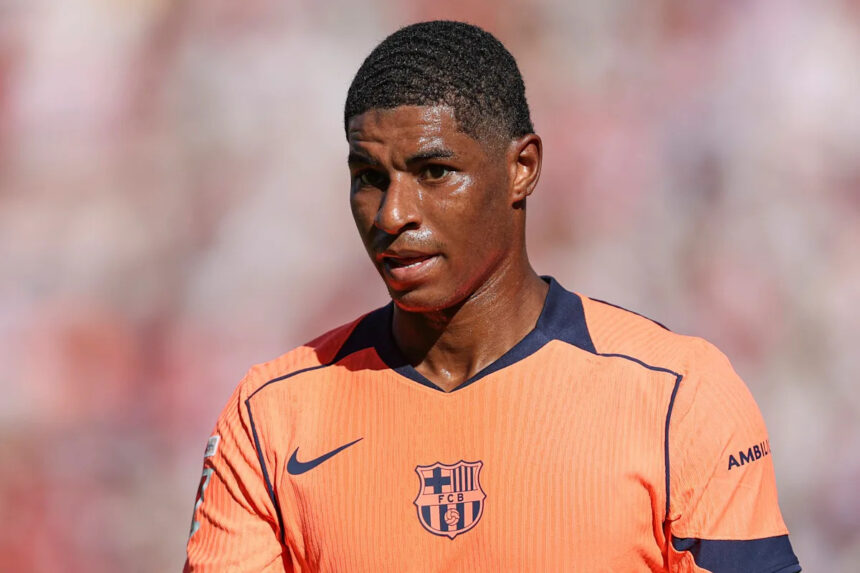
Rashford’s loan spell at Aston Villa was a classic case of “what if.” In 17 appearances, he racked up 10 goal contributions, a timely reminder of the devastating forward he can be when deployed in a system that harnesses his strengths. Villa’s more transitional, counter-attacking style suited him, proving he was far from a spent force. Yet, that momentum stalled. A permanent deal didn’t materialize, leading to a surprising summer loan to Barcelona—a move that felt more like a glamorous holding pattern than a long-term project.
At Barcelona, the narrative has been one of fits and starts. While showing flashes of his quality, consistency within their intricate possession model has been elusive. This has left Rashford in a curious limbo: a Manchester United player under contract until 2028, performing on loan for European giants, yet with his heart and most resonant successes tied to Old Trafford. His “voice suggesting clarity elsewhere” now speaks with a different accent, but the sentence remains unfinished.
The Post-Amorim Reset: A Clean Slate and a New Calculus
The sacking of Ruben Amorim changes everything and nothing. It changes everything because the primary architect of Rashford’s exile is gone. The philosophical roadblock has been removed. A new manager—whoever that may be—will arrive with their own ideas, unburdened by the previous regime’s public assessments and tactical prejudices. For Rashford’s representatives, this is an undeniable opportunity to repitch their client as a solution, not a problem.
Yet, it changes nothing because the core questions remain. Can Rashford adapt to a top-level manager’s demands, which will inevitably include defensive responsibility? Does his purported desire for “clarity elsewhere” still hold true after a nomadic year? Most importantly, does the new manager see value in reintegrating a 26-year-old homegrown star as a cornerstone of a new project, or will they view him as an asset to be monetized for their own rebuild?
The new manager’s in-tray will feature a critical Rashford dossier:
- Proven Premier League Pedigree: Over 100 United goals and a history of decisive moments in big games.
- Marketability & Connection: A local icon whose resurgence would be a powerful story for the club brand.
- Tactical Flexibility: Can he be molded, or is his style too defined? His Villa form suggests the former is possible.
- Financial Consideration: With a long contract, United hold significant value, making a sale lucrative but a revival potentially priceless.
Predictions: The Likely Scenarios for Rashford’s Crossroads Summer
As the season concludes and the new footballing hierarchy settles at Carrington, Rashford’s future will become a bellwether for the club’s direction. Several paths are now plausible.
Scenario 1: The Romantic Return (Most Likely)
A new manager, keen to unite the fanbase and build on positive foundations, sees Rashford as a reclamation project. A strong pre-season showing for United (if he returns early) or a blistering end to his Barcelona loan could force a rethink. He returns as a motivated, experienced player with a point to prove, slotting into a left-wing role in a more attack-minded setup. This is the storybook ending that now seems possible post-Amorim.
Scenario 2: The Premium Sale (Financially Tempting)
Despite the managerial change, the club decides the reset is total. Rashford is sold to the highest bidder—potentially Barcelona making his loan permanent, or a Premier League rival—with the substantial fee reinvested into multiple signings that better fit the new manager’s specific blueprint. Amorim’s exit merely removes a personal friction, not a strategic decision to refresh the attack.
Scenario 3: The Extended Loan (The Compromise)
Uncertainty prevails. The new manager wants a full assessment period. Rashford spends another season on loan, perhaps at Barcelona or elsewhere, with his United future evaluated again in 2025. This kicks the can down the road but maintains control and asset value for United.
Conclusion: A Door Reopened, But Passage is Not Guaranteed
The dismissal of Ruben Amorim has performed a simple but profound act: it has reopened a door at Manchester United that seemed firmly shut to Marcus Rashford. It has reintroduced hope where there was only resignation. The geometry of the club has altered, creating an angle of approach that didn’t exist just weeks ago.
However, a door opened is not an invitation walked through. Rashford’s future now hinges on a cold, professional calculus that will be made by a manager not yet in place. His talent is undeniable, his connection to the club is unique, and his recent history proves he can still perform at the highest level. The Amorim obstacle is gone, but the challenge of reinvention remains. The coming months will determine if Marcus Rashford’s return is a sentimental footnote or the defining second act of a United career reborn. The power, once again, is in his feet.
Source: Based on news from Yahoo Sports.