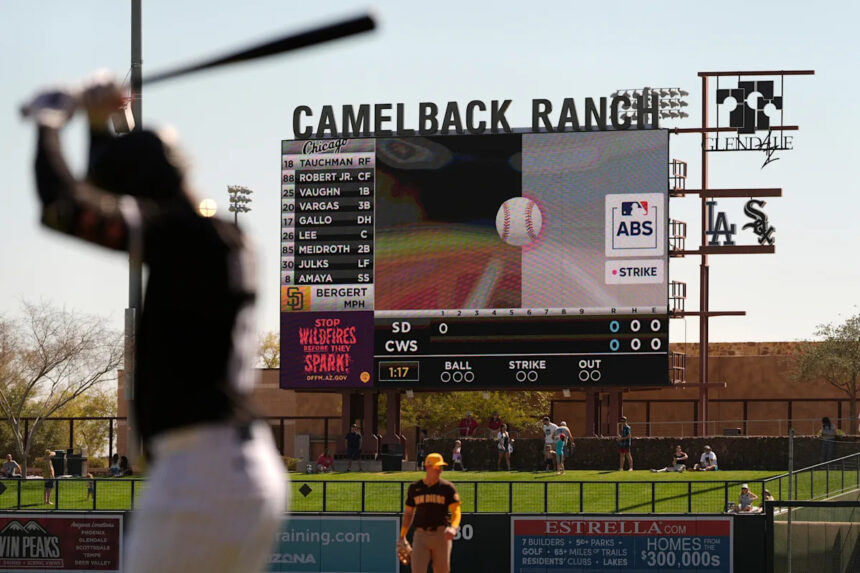
The Robo-Ump Era Begins: Which MLB Stars Will Thrive and Which Will Struggle Under ABS?
The most profound technological shift in Major League Baseball history is no longer a minor league experiment. As the Automated Ball-Strike System (ABS) makes its regular-season debut this week, it doesn’t just replace an umpire’s judgment with pixel-perfect precision. It rewrites a decade of established reputation, strategy, and psychology. For pitchers like Kevin Gausman, who built careers on bending the rulebook, and hitters who learned to live with its inconsistencies, the game they know is over. A new one, defined by an unblinking, digital eye, is beginning.
The Art of the Illusion: Pitchers Who Mastered the “Human” Zone
For generations, pitching was as much about theater as it was about physics. The ability to “steal” a strike on a pitch an inch off the plate could define an at-bat, a game, even a career. The data from the past decade, courtesy of MLB Statcast, reveals the masters of this craft. These are the pitchers who benefited most from the generous, or perhaps fooled, human eye.
Kyle Hendricks, the Chicago Cubs’ control artist, stands alone at the top. Over the last ten years, he earned a staggering 777 called strikes on pitches that, according to the precise electronic zone, were actually balls. He is the undisputed king of the phantom strike. Close behind are aces like Aaron Nola (747) and Kevin Gausman (709), whose elite movement and deception consistently expanded the zone.
- Kyle Hendricks: 777 called strikes on balls
- Aaron Nola: 747 called strikes on balls
- Kevin Gausman: 709 called strikes on balls
- Zach Davies: 709 called strikes on balls
- Kyle Gibson: 697 called strikes on balls
These pitchers developed a symbiotic relationship with umpires. Their command and the late movement of their pitches—particularly splitters, changeups, and two-seamers that dive off the plate—created an optical illusion. “I guess that’s a good thing because you make balls look like strikes,” Nola told the AP. That skill, once a superpower, is now being recalibrated. As Gausman admitted, “The book is kind of still out. We’ll see what happens and how we have to adjust.”
Winners and Losers in the New ABS Reality
The implementation of the Automated Ball-Strike System is not merely an upgrade; it’s a market correction. It will create immediate, tangible winners and losers, reshaping value and approach across the league.
The Likely Winners:
- High-Discipline Hitters: Batters like Juan Soto, Alex Bregman, and Steven Kwan, who have legendary eyes and refuse to chase, will see their patience rewarded absolutely. Pitches that once nipped the black for a called strike three will now be correctly labeled ball four.
- Power Pitchers with Control Issues: Flamethrowers who struggle with command but have “effectively wild” stuff may benefit. The robot zone eliminates the need to “paint the corners.” They can attack more directly, knowing a pitch clearly over the plate will be a strike, and one clearly off won’t be gifted.
- Catchers’ Bats: The defensive skill of “pitch framing”—the art of subtly receiving a pitch to make it look like a strike—is instantly obsolete. Catchers like Austin Hedges, valued almost solely for their glovework, may see their roles diminished, while offensive-minded backstops gain relative value.
The Likely Losers:
- The “Shadow” Pitchers: The Hendricks, Gausman, and Nola types face the biggest adjustment. Their margin for error shrinks. The pitch that was a called strike for a decade is now ball one. Their entire sequencing and approach must evolve.
- Aggressive Free-Swingers: Hitters who relied on umpires expanding the zone for them to force pitchers into hitter’s counts may find themselves in deeper holes. The zone is now immutable; they can’t wait for a mistaken gift.
- The “Framing” Specialists: This is the most direct casualty. A multi-million dollar defensive skill has been rendered moot by technology. Teams that invested heavily in catchers for this trait alone face a sunk cost.
Beyond the Box Score: The Psychological Game Changes
The impact of ABS extends far beyond the raw count of balls and strikes. It fundamentally alters the psychological warfare between pitcher and hitter. The “pitcher’s count” of 1-2, once a license to expand the zone with a waste pitch, loses some potency. The hitter knows that chase pitch will not be called a strike. Conversely, the 3-1 “hitter’s count” becomes even more advantageous for the batter, who can confidently take a pitch on the edge, knowing it won’t be incorrectly rung up.
This removes a layer of gamesmanship and argument, but also a layer of unpredictability that many in the game consider part of its fabric. As Nola noted, there is a trade-off: “There’s going to be some maybe good and bad to it, but I think the good parts and the big situations and big games, I think that’s going to help out a lot. We’ve seen over the years our side lose games on a bad call.” The quest for fairness, however, comes at the cost of a certain human drama.
Furthermore, the Hawk-Eye technology—with its 12 cameras and accuracy to within one-sixth of an inch—does not account for a hitter’s stance. A player who crouches deeply, like Jose Altuve, will have a different zone than a tall, upright hitter like Aaron Judge. The system uses a pre-programmed, batter-specific zone. This standardization is the point, but it also means the zone is no longer a dynamic interaction between the pitcher, the hitter’s physicality, and the umpire’s perspective.
The Future of the Game: Predictions for the ABS Era
As the robo-ump era dawns, several predictions seem almost inevitable. The initial adjustment period will be rocky, with pitchers on the “losers” list seeing their walk rates climb and ERAs inflate as they relearn their craft. Hitters may see a league-wide increase in on-base percentage, at least initially, as the zone tightens.
Long-term, however, the game will adapt. Pitching coaches will develop new strategies, emphasizing command *within* the electronic zone rather than manipulation just outside it. We may see a resurgence of high-velocity, high-spin fastballs at the top of the zone, a pitch that plays well in the ABS rectangle. The art of pitching will not die; it will evolve from illusion to pinpoint execution.
Perhaps the most significant prediction is the final death of the “human element” debate for balls and strikes. The quest for perfect accuracy, long resisted by traditionalists, will have been achieved. The conversation will shift from “Did the ump miss it?” to “How is the zone defined?”—debating the dimensions of the rectangle itself rather than its enforcement.
Conclusion: A More Perfect, Yet Less Human, Game
The debut of the Automated Ball-Strike System marks the end of baseball’s last great bastion of subjective officiating. For pitchers like Kyle Hendricks and Kevin Gausman, it closes a chapter where their craftiness was a measurable asset. For hitters with eagle eyes, it opens an era of justified reward. The trade-off is stark: perfect accuracy for imperfect humanity.
The winners and losers created by this shift are not just players, but philosophies. The data-driven pursuit of fairness and consistency has triumphed over the romantic, if frustrating, acceptance of human error as part of the drama. The game will be more fair. It will also be different. As the Hawk-Eye system makes its call on Wednesday night, it won’t just be signaling ball or strike. It will be sounding the starting bell for baseball’s newest, and most precise, era.
Source: Based on news from Yahoo Sports.