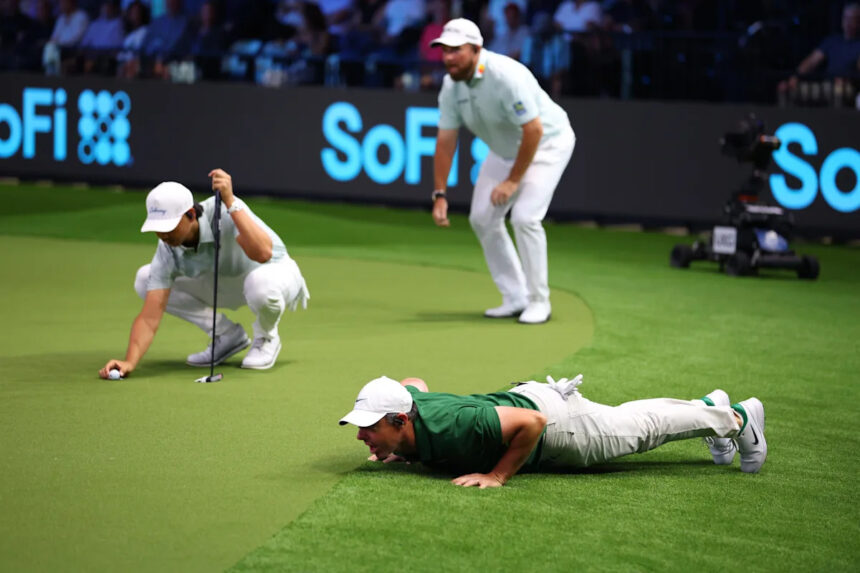
Rory McIlroy Sees a Shift: Could Koepka’s PGA Tour Return Spark a LIV Golf Exodus?
PALM BEACH GARDENS — In the ever-evolving saga of professional golf’s great schism, a single defection can feel like a seismic event. The news of Brooks Koepka leaving the lucrative confines of LIV Golf to stage a full-time return to the PGA Tour has sent shockwaves beyond the perfectly manicured fairways. While Koepka’s move is a personal career recalibration, his former Ryder Cup teammate, Rory McIlroy, sees it as a potential harbinger of a larger trend. In the wake of his own TGL victory, McIlroy didn’t just welcome Koepka back; he framed the five-time major winner’s decision as a crack in LIV’s once-impenetrable armor, suggesting other stars may soon be looking for the exit.
The McIlroy Perspective: A League “Stagnating” and Buyers’ Remorse
Rory McIlroy has transitioned from LIV Golf’s most vocal critic to a more strategic observer. His recent comments, however, cut to the core of the current perception surrounding the Saudi-backed series. After leading his Boston Common Golf team to a dominant 9-1 win in the tech-infused TGL on January 26th, McIlroy shifted focus to the broader landscape. He pinpointed a sense of disillusionment among some who made the jump.
“It seems like some of those guys are maybe starting to realize they’re not getting everything they wanted out of going over there,” McIlroy stated. The key phrase, delivered with the insight of a player deeply embedded in the sport’s governance, is “starting to realize.” It implies a delayed reaction, a gap between the promise and the reality of LIV’s project. McIlroy doubled down, labeling the league as in a state of “stagnation,” a powerful indictment suggesting a lack of competitive momentum, narrative growth, or cultural impact.
This analysis isn’t merely partisan. Observers note LIV’s ongoing challenges:
- Media Rights Deal: The continued absence of a significant, mainstream U.S. television contract limits reach and commercial legitimacy.
- Event Format: The team and individual hybrid model, while novel, has struggled to capture the casual fan’s imagination in a crowded sports landscape.
- World Ranking Points: The failure to secure Official World Golf Ranking accreditation has crippled the career trajectories of many LIV players, effectively making them invisible in the traditional meritocracy of the sport.
For players who joined seeking legacy alongside lucre, this stagnation creates a professional purgatory.
Koepka as Catalyst: Why His Return Resonates
Brooks Koepka is not just any golfer. He is a alpha competitor defined by his performance on the grandest stages. His defection to LIV in 2022 was a major coup for the league, symbolizing its appeal to top-tier, major-winning talent. His return, therefore, is equally symbolic. Koepka’s brand is built on winning majors. The path to those majors runs through the PGA Tour’s ecosystem of competitive reps, FedExCup points, and automatic qualifications.
Koepka’s move signals that for the absolute pinnacle of the sport, the PGA Tour remains the essential proving ground. It reinforces McIlroy’s subtle point: the initial “everything they wanted” – vast guaranteed money, less grueling schedule – may have come at a hidden cost to competitive relevance. Other LIV stars with major ambitions, particularly those in their prime, will be watching Koepka’s reintegration closely. If he successfully contends and returns to world No. 1 contention, the blueprint is drawn.
The Psychology of the Locker Room: PGA Tour Players Will Fuel the Narrative
McIlroy astutely noted that PGA Tour players “certainly will bring up the possibility at every opportunity.” This is a crucial, often overlooked, psychological element. Golf is a sport fueled by chatter, camaraderie, and subtle needling. In practice rounds, locker rooms, and player dining areas, the question will hang in the air: “Who’s next?”
This constant, low-grade social pressure serves multiple purposes:
- It normalizes the idea of a return, making it less of a betrayal and more of a smart career move.
- It keeps the narrative alive in the media, applying external pressure on LIV’s stability.
- It potentially sows doubt among LIV players who may already feel isolated from the sport’s historical fabric and biggest events.
The PGA Tour’s social and competitive ecosystem is a powerful draw. The chance to compete for historic titles at Quail Hollow, Riviera, and Bay Hill, against a fully ranked field, holds an intangible value that a 54-hole no-cut event cannot replicate. Tour pros understand this intimately, and they will use that understanding as a recruiting tool.
Predictions: Who Could Follow and What Are the Barriers?
Speculating on a potential exodus requires examining player profiles. The most likely candidates are not the aging legends who secured generational wealth, but players in their competitive prime who value legacy.
Potential Candidates to Watch:
- Cameron Smith: The Open Champion’s game is built for classic PGA Tour setups. His competitive fire seems better suited for a weekly grind than a exhibition series.
- Joaquin Niemann: The young Chilean has been vocal about his OWGR plight. His recent extra-major exploits show a desperate desire to qualify for majors, a path far easier on Tour.
- Bryson DeChambeau: A complex figure, but his scientific approach is geared toward conquering traditional majors. The Captaincy of his Crushers GC team may be his only tether.
Significant Barriers Remain:
- Contractual Obligations: LIV contracts are rumored to be ironclad with massive clawbacks for early departure.
- PGA Tour Sanctions: While a path back is being negotiated, returning players would likely face suspensions and mandatory play commitments.
- Pride and Principle: Some players are fully invested in the LIV “project” and would view a return as an admission of failure.
Conclusion: A Tipping Point, Not a Floodgate
Rory McIlroy’s comments are less a prediction of an imminent mass departure and more an identification of a critical tipping point in perception. The Koepka move shatters the illusion of LIV’s inevitability and exposes it as a choice with significant competitive consequences. For LIV, it is a stark challenge: it must accelerate its growth, secure key partnerships, and deliver on its promised “evolution” to retain its top talent. Stagnation, as McIlroy labeled it, is the greatest threat to its survival.
For the PGA Tour, Koepka’s return is a massive morale and strategic victory, validating its ongoing structural changes and the enduring value of its competitive product. The coming months will be a delicate dance of negotiation, public posturing, and private persuasion. One thing is certain: the golf civil war is entering a new, more nuanced phase. It is no longer about who is leaving, but about who might be coming back. And as McIlroy knows, in the game of high-stakes golf politics, perception is often the first step toward reality.
Source: Based on news from Yahoo Sports.