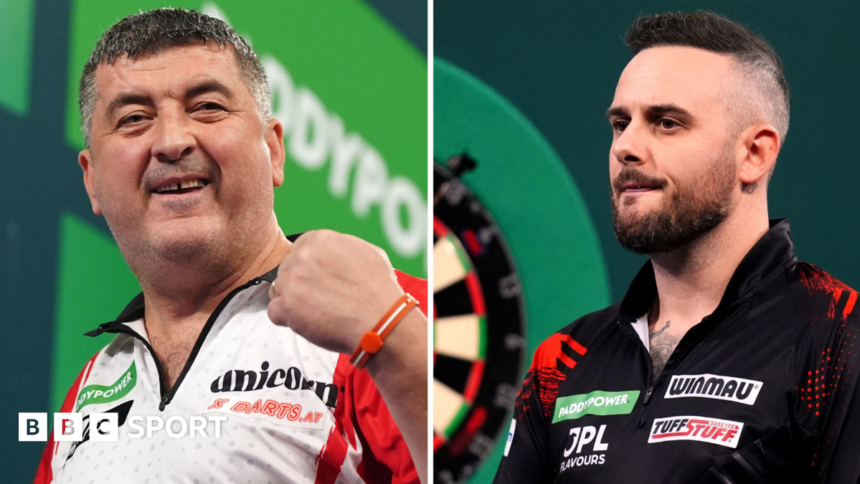
Suljovic Denies Cullen’s ‘Cheating’ Claim: A Clash of Tempo and Temperament at the World Darts Championship
The PDC World Darts Championship is a theater of pressure, precision, and personality. In its latest dramatic act, a second-round clash between Joe Cullen and Mensur Suljovic ignited a fiery debate that cuts to the very heart of sportsmanship and strategy. After a 3-1 defeat, an aggrieved Joe Cullen labeled Suljovic’s notoriously deliberate pace of play as akin to “cheating.” The Austrian veteran, “The Gentle,” offered a heartfelt denial and an apology, setting the stage for a controversy that transcends the oche. This wasn’t just a match lost on doubles; it was a collision of two contrasting philosophies of the game.
The Anatomy of an Accusation: Cullen’s Frustration Boils Over
On paper, 11th seed Joe Cullen entered his match against 32nd seed Mensur Suljovic as the clear favorite. The “Rockstar” started strong, taking the first set with the fluid, rhythmic throwing that has defined his rise. However, the match’s momentum shifted not with a sudden burst of 180s, but with a palpable deceleration in tempo. Suljovic, known for one of the most unique and methodical routines in the sport, began to impose his natural rhythm.
Cullen’s rhythm disintegrated. He lost the next two sets and, most painfully, squandered a 2-1 lead in the decisive fourth set. The frustration was visible. In his post-match interview, Cullen did not mince words. He argued that Suljovic’s extreme slowness crossed a line from personal habit into gamesmanship. The implication was clear: Cullen felt the delay was a tactical ploy designed to disrupt his flow, break his concentration, and unfairly manipulate the match’s psychological battlefield. For a player of Cullen’s explosive talent, being forced out of his groove is a significant tactical disadvantage.
“Love You Man”: Suljovic’s Heartfelt Rebuttal
Mensur Suljovic’s response was as characteristically gentle as his throwing action is slow. There was no counter-accusation, no anger. Instead, he offered a sincere and emotional defense of his craft. “I never ever do this as a provocation,” Suljovic stated, directly addressing the core of Cullen’s accusation. He framed his pace not as a weapon against his opponent, but as a necessary tool for himself.
For Suljovic, the meticulous routine—the careful positioning, the multiple practice throws, the deep breath before release—is the scaffolding that holds his game together. At 53 years old, with a unique throwing style, this process is non-negotiable. His closing remark, “Sorry Joe, I never do this – love you man,” was a poignant attempt to separate the personal from the professional. It was a denial of malicious intent, an affirmation of respect for his opponent, but also a steadfast refusal to apologize for the style that has brought him a major title and a prolonged career at the sport’s summit.
Expert Analysis: Gamesmanship or Genuine Style?
This incident opens a complex debate in darts and across sports: where does personal style end and gamesmanship begin? Darts, uniquely, has no shot clock, placing the onus of pace on a player’s conscience and the referee’s discretion to enforce the “rule of reason.”
- The Case for Gamesmanship: Critics point to history. Slowing down a faster opponent is a timeless tactic in individual sports like tennis or boxing. The prolonged pauses before critical doubles can magnify pressure. When a player’s natural action becomes exceptionally slow, it can objectively disrupt the natural ebb and flow of a match, giving the slower player disproportionate control over the match’s tempo.
- The Case for Authentic Style: Suljovic’s defenders, and indeed the rules, support his right to his routine. His style is not a new trick; it’s his career-long identity. Asking him to speed up is akin to asking a power hitter in baseball to bunt—it negates their fundamental skill set. His success hinges on his meticulous process, and forcing a change mid-tournament could be seen as equally unfair.
The key distinction lies in intent. Suljovic’s consistent history and emotional denial suggest his pace is intrinsic, not situational. He doesn’t suddenly slow down against fast players; he is always slow. This consistency strengthens his argument that it is style, not strategy.
Broader Implications and Predictions for the Sport
The Suljovic-Cullen fallout has immediate and long-term ramifications for the PDC World Darts Championship and the sport at large.
Immediate Impact: For Joe Cullen, this is a bitterly early exit that will sting. The challenge is to channel this frustration, ensuring a fiery match narrative doesn’t become a mental block against methodical opponents. For Mensur Suljovic, the victory is marred by controversy. He advances, but with his style under a harsher spotlight, potentially facing increased scrutiny from crowds and officials in his next match.
Long-Term Predictions: This incident will inevitably reignite the discussion around a shot clock in all championship matches. While the Premier League and some stage events employ one, the World Championship does not, valuing tradition and player variance. This clash may tip the scales. We predict:
- Increased referee vigilance in invoking the “rule of reason” against extreme delays.
- Mounting pressure on the PDC to consider a standardized shot clock for all televised majors to ensure consistency and remove subjectivity.
- A potential stylistic evolution, where new players may be less inclined to develop ultra-slow routines if a clock is anticipated.
Ultimately, the sport must balance preserving unique player personalities with ensuring a fair and consistent pace of play. The absence of a clock is part of the World Championship’s unique pressure, but as the game grows, so does the need for unambiguous rules.
Conclusion: A Clash of Rhythms with No Easy Answers
The clash between Joe Cullen and Mensur Suljovic was more than a second-round match; it was a profound sporting dilemma played out on the Ally Pally stage. Cullen’s accusation of “cheating” speaks to the visceral frustration of an athlete feeling robbed of his best performance by an external tempo. Suljovic’s pained denial speaks to the integrity of an athlete whose unique method is inseparable from his ability.
There are no villains in this piece, only two professionals operating at the edges of the sport’s unwritten code. The real takeaway is that darts has outgrown ambiguity. As the sport continues its global ascent, the PDC World Darts Championship must address this tempo tension. Whether through a formal shot clock or stricter, clearer enforcement, the goal must be to protect both the Joe Cullens, who thrive on flow, and the Mensur Suljovics, who rely on ritual—ensuring that matches are decided solely by the darts thrown, not the time taken between them. Until then, this debate will continue to simmer, flaring up whenever the sport’s contrasting rhythms collide.
Source: Based on news from BBC Sport.