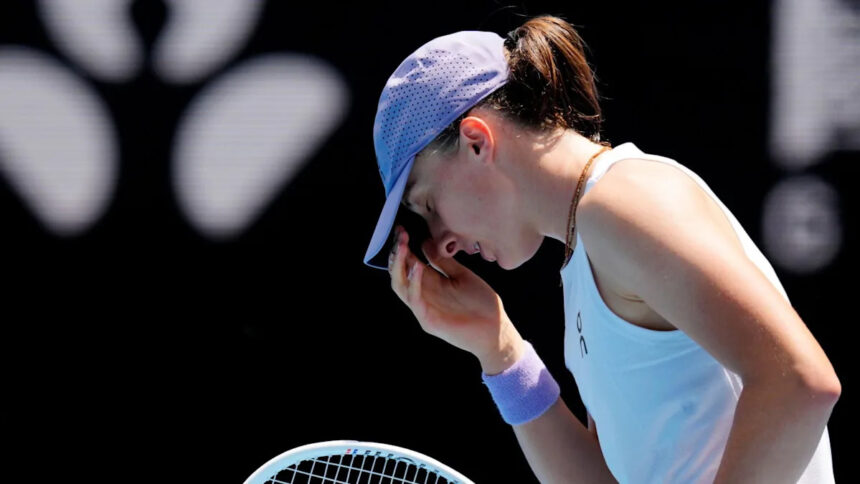
Swiatek’s Australian Open Dream Dashed: Rybakina Halts Career Grand Slam Bid in Ruthless Fashion
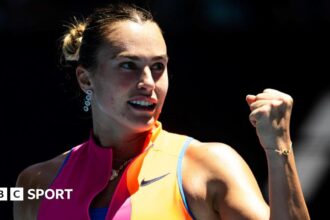
The air of inevitability that so often surrounds Iga Swiatek was conspicuously absent in Melbourne. For two weeks, the world number one had navigated the draw, but her progress lacked the imperious, steamrolling certainty that defines her at Roland Garros. A sense lingered that she was surviving, not dominating. That lingering doubt crystallized into stark reality on a sun-baked Rod Laver Arena, where Elena Rybakina, with the cold precision of a diamond cutter, ended Swiatek’s quest for a career Grand Slam with a commanding 7-5, 6-1 quarter-final victory.
This was not a collapse under the weight of history. It was a systematic dismantling by a player built for these conditions. Swiatek’s bid to join the sport’s most exclusive club—players with all four major titles—was not merely paused; it was emphatically shut down by a rival whose power game on fast courts presents a recurring, and so far, unsolved puzzle for the Polish superstar.
A Flaw Exposed: The Serve That Never Found Its Rhythm
Throughout the tournament, the most telling statistic for Swiatek was not her winner count, but her vulnerability on serve. It was the tournament’s worst-kept secret. Despite a much-discussed service technique change in the off-season, designed to add power and variety, the new motion failed to hold up under the intense pressure of a major quarter-final and against one of the game’s premier returners.
The numbers were damning evidence of a foundational crack:
- Fewest service games won among all quarter-finalists.
- Broken the most times alongside Coco Gauff, a staggering 21 times before the Rybakina match.
- A first-serve percentage that consistently dipped below 60%, inviting Rybakina to attack the second delivery.
“You could see the lack of confidence in that shot from the first round,” noted former champion Jim Courier in commentary. “Against most players, her supreme groundstrokes can cover for it. Against Rybakina, it’s a target. And today, Elena aimed right for it.” Every second serve became a sitting duck, met with a crushing return that immediately shifted the point onto Rybakina’s terms.
Rybakina’s Blueprint: Power, Pressure, and Poise
If Swiatek’s serve was the problem, Elena Rybakina was the perfect opponent to provide the punishing exam. The 2022 Wimbledon champion executed a masterclass in aggressive, first-strike tennis. Her game plan was simple, brutal, and devastatingly effective: neutralize Swiatek’s heavy topspin with flat, penetrating drives and use her own monumental serve as both a shield and a sword.
Rybakina’s big forehand and bigger serve were the defining weapons of the match. She fired 9 aces and 25 winners, many of them coming in clusters at critical moments. At 5-5 in a tense first set, it was Rybakina who elevated, holding to love with two aces and a forehand winner before breaking Swiatek’s spirit and serve to seize the set. The momentum shift was tectonic.
“This is the matchup issue for Iga on hard courts,” analyzed sports psychologist Dr. Laila Stein. “Rybakina doesn’t allow her to construct points or use her legendary movement. She takes time away, which compresses Swiatek’s decision-making and forces errors. It’s a historical struggle against aggressive opponents in Melbourne made manifest by its most capable executor.” The second set was a procession, a 6-1 statement that underscored Rybakina’s growing belief as a giant-killer at majors.
Crossroads for the World No. 1: What Comes Next for Swiatek?
This loss raises immediate and profound questions for Iga Swiatek. The career Grand Slam remains the ultimate goal, but the Australian Open now looms as her most complex challenge. The combination of fast courts and a draw littered with power players like Rybakina, Sabalenka, and Zheng creates a unique obstacle course.
The primary focus will undoubtedly return to her serve. Was the technical change a misstep, or simply a work in progress that needs more time? Does she revert to a more reliable motion for the upcoming hard-court swing, or double down on the changes for long-term gain? Her team faces a delicate balancing act between immediate results and future development.
Furthermore, she must find a new tactical key for these matchups. Swiatek’s coach, Tomasz Wiktorowski, must devise a plan to blunt the power of players like Rybakina—perhaps through more varied slice, smarter serving patterns, or even a more aggressive net approach to shorten points on her own terms.
The Road Ahead: Predictions for the Rivalry and the Season
This result recalibrates the WTA landscape at the start of 2025. Rybakina, now into another major semi-final, reaffirms her status as the tour’s premier big-match power player. For Swiatek, the season is long, and her dominance on clay is almost a foregone conclusion. But the path back to the top in Melbourne has become clearer and more daunting.
We predict:
- The Swiatek-Rybakina rivalry will become the defining hard-court duel of the next two seasons, with Rybakina holding a significant mental and tactical edge on faster surfaces.
- Swiatek will likely dominate the European clay and swing, but her team will prioritize hard-court adjustments throughout the summer, targeting the US Open.
- The quest for the career Grand Slam will now carry an even heavier psychological weight in Australia, a test of adaptation as much as skill.
For Rybakina, this victory is another step toward shedding the “passive champion” label. She is actively hunting the biggest names on the biggest stages. “I know I can beat anyone if I play my game,” she stated coolly after the match. In Melbourne, her game was nearly unplayable.
Conclusion: A Dream Deferred, Not Denied
Iga Swiatek’s career Grand Slam dream remains on hold, deferred by a force of nature named Elena Rybakina. This loss was a stark reminder that even the most dominant champions have kryptonite. In Melbourne, it is the confluence of court speed and sheer, uncompromising power—a confluence Rybakina embodies perfectly.
For Swiatek, this is not an end, but a critical data point. The greatest champions are defined not by their supremacy alone, but by their response to being solved. The 2025 Australian Open exposed a flaw. The true measure of Swiatek’s legendary resolve will be how she, and her team, choose to fix it. The journey to complete the set continues, but the road through Melbourne just got a lot more complicated.
Source: Based on news from Yahoo Sports.