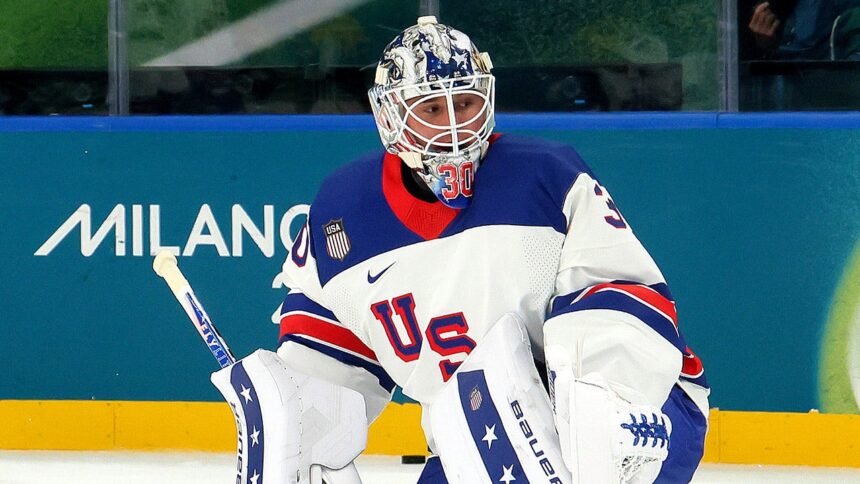
Jake Oettinger Breaks Silence: Team USA Goalie Addresses Trump’s Locker Room Comments on Women’s Hockey
The scene was one of pure, unadulterated triumph. The United States men’s Olympic hockey team, fresh off a heart-stopping gold medal victory over Canada at the 2026 Milan-Cortina games, stood in the House chamber receiving a thunderous standing ovation during President Donald Trump’s State of the Union address. It was a moment of national recognition for athletic excellence. Yet, the path to that moment was suddenly clouded by a viral controversy stemming from the locker room celebration itself, pulling star goaltender Jake Oettinger into a political and cultural maelstrom he never saw coming.
- The Viral Phone Call: Celebration, Politics, and an Unexpected Quip
- Oettinger’s Calculated Response: Navigating the High-Stakes Media Spotlight
- Expert Analysis: The Impossible Position of the Modern Athlete
- Legacy and Fallout: What This Means for USA Hockey’s Future
- Conclusion: A Save More Important Than Any on Ice
The Viral Phone Call: Celebration, Politics, and an Unexpected Quip
In the raw, champagne-soaked euphoria of the gold medal locker room, President Trump called to congratulate the Team USA men’s hockey team. The call, intended as a celebratory gesture, took a turn that would soon dominate sports headlines. After inviting the men to the State of the Union, Trump referenced the U.S. women’s hockey team, who had also won a historic gold medal in their tournament.
“I’d have to invite the women, too,” Trump said, as heard in widely circulated audio. “Otherwise, I probably would be impeached.” The comment was met with laughter from the assembled players. While seemingly intended as a light-hearted, off-the-cuff remark in the context of a boisterous celebration, the clip quickly escaped the locker room walls. It sparked immediate backlash from fans and commentators who viewed the statement as diminishing the women’s monumental achievement and injecting partisan politics into a moment of pure sporting pride.
The men’s hockey team reaction—specifically the laughter—became a secondary point of scrutiny. Were they laughing at the joke, at the awkwardness of the moment, or simply caught up in the giddy haze of a life-altering win? As the criticism mounted, one player found himself directly in the line of questioning: Dallas Stars netminder and team pillar, Jake Oettinger.
Oettinger’s Calculated Response: Navigating the High-Stakes Media Spotlight
Known for his calm demeanor under a barrage of pucks, Oettinger was now facing a different kind of pressure. Asked by reporters to give his thoughts on the now-infamous phone call, the goaltender delivered a response that was as measured as a perfectly executed glove save.
“That was an incredible moment for us, right after the final buzzer,” Oettinger began, carefully framing his answer around the team’s experience. “The President calling was a surprise, and the whole thing was just a whirlwind. Our focus, and my focus, was entirely on what our team and the women’s team accomplished on the ice. Winning a gold medal for your country is the dream, and both teams lived it.”
Oettinger’s statement was notable for what it did and did not do:
- Acknowledged the context: He did not dismiss the controversy but rooted the moment in the disorienting joy of victory.
- Shifted focus to performance: He deliberately and repeatedly pivoted the narrative back to the athletic achievements of both national teams.
- Avoided political entanglement: He declined to analyze or interpret the President’s specific words, refusing to be drawn into a political debate.
- United the teams: He consistently paired the men’s and women’s successes, presenting them as equal pillars of American hockey glory.
This was not a fiery defense nor a blunt condemnation. It was a strategic, diplomatic play from an athlete who understood the magnitude of the platform. In doing so, Oettinger protected his team’s moment while showing implicit respect for the women’s program—a tightrope walk of modern sports media relations.
Expert Analysis: The Impossible Position of the Modern Athlete
Sports sociologists and media analysts see the Oettinger situation as a textbook case of the new pressures facing elite athletes. “The locker room is no longer a private space, and a celebratory phone call from any world leader is now a public performance,” notes Dr. Alisha Fernandez, a professor of Sports Media and Culture. “Oettinger was put in an nearly impossible position: comment on a politically charged remark made in what felt like a private moment, or risk appearing complicit by saying nothing.”
His response, experts argue, was a masterclass in athlete media training. By refusing to engage directly with the contentious element and instead redirecting to the universal value of Olympic achievement, he:
- Protected his and his team’s brand from lasting political association.
- Affirmed the stature of the women’s team without needing to explicitly critique the remarks.
- Maintained his personal reputation as a focused, team-first athlete.
“The laughter from the room is the most human element here,” adds Fernandez. “It’s a classic, nervous reaction in an unfamiliar, high-pressure social situation. To parse it as a deliberate political endorsement is to misunderstand the psychology of the moment. Oettinger’s later, sober reflection is the more meaningful indicator of his—and likely the team’s—true stance.”
Legacy and Fallout: What This Means for USA Hockey’s Future
The immediate fan criticism highlighted a passionate and growing segment of the sports audience that demands equality and respect across genders, and views any perceived slight as significant. The incident, however brief, casts a shadow over what should have been an unambiguously celebratory period for USA Hockey.
Looking ahead, several predictions and consequences seem likely:
- Increased Scrutiny on Interactions: Future communications between political figures and national teams will be heavily vetted and likely more formal, robbing athletes of some spontaneous joy but minimizing risk.
- A Unified Front: Expect to see more joint appearances and statements from the men’s and women’s national teams in the future, consciously projecting unity to overcome this narrative.
- Oettinger’s Leadership Role: How Oettinger handled this will likely cement his role as a leader not just in the locker room, but as a public-facing diplomat for the sport. His poised response under fire demonstrates a maturity that transcends the crease.
- Focus on the Ice: The ultimate outcome will be determined by performance. If both teams continue to dominate on the world stage, this incident becomes a footnote. Any struggle, however, will see this controversy resurrected as a potential distraction.
Conclusion: A Save More Important Than Any on Ice
The 2026 Olympic gold medals won by the U.S. men’s and women’s hockey teams are permanent, historic achievements. The controversy sparked by a phone call quip is, in the grand sweep of sports history, fleeting. Yet, it provided a critical moment of reflection. It tested the mettle of athletes like Jake Oettinger not against a shooter on a breakaway, but against the complex, often divisive currents of modern public life.
Oettinger’s response—focused on sport, respectful of both teams, and diplomatically neutral—may be remembered as one of the most important plays of his career. It was a save that preserved the integrity of his team’s moment, honored the parallel triumph of their female counterparts, and navigated a political thicket with impressive grace. In the end, the story should return to where it began: with two hockey teams standing atop the Olympic podium, having achieved the pinnacle of their sport. Thanks to Oettinger’s steady hand, that is precisely where it is now poised to go.
Source: Based on news from Fox Sports.