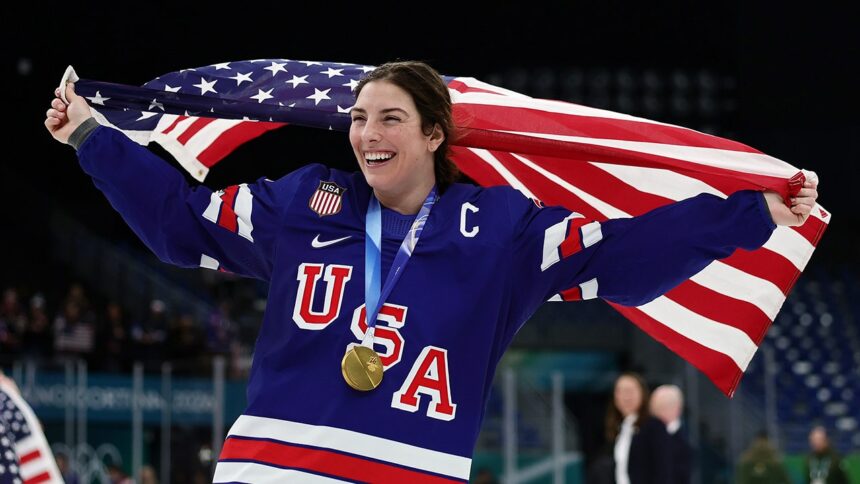
Hilary Knight’s Grace Under Fire: A Captain’s Response to Political Noise
In the world of elite sports, the pinnacle of achievement is often followed by a whirlwind of celebration, media appearances, and ceremonial honors. For the U.S. Women’s National Hockey Team, their hard-fought gold medal victory over Canada was a moment of pure, unadulterated triumph. Yet, in the subsequent days, the narrative surrounding their historic win encountered an unexpected and politically-charged cross-check. The focus shifted from their athletic dominance to a presidential quip, forcing captain Hilary Knight to navigate a media landscape far more complex than any power play. Her response, a masterclass in poise and principle, highlighted the ongoing tension between celebrating female athletes and the political spectacles that sometimes seek to co-opt them.
- The “Distasteful Joke” That Overshadowed a Golden Moment
- Contrasting Reactions: The Fox News Analysis and a Captain’s Quiet Dismissal
- Expert Analysis: The Unenviable Position of the Modern Female Athlete
- Predictions: Knight’s Legacy and the Future of Women’s Sports Narratives
- Conclusion: A Golden Standard for Handling Distraction
The “Distasteful Joke” That Overshadowed a Golden Moment
Following the U.S. men’s hockey team’s gold medal victory, President Donald Trump placed a congratulatory call. During that conversation, he turned his attention to the women’s team, stating, “By the way, the women also won. We’ll have to invite them. Otherwise, I probably would be impeached.” The remark, intended as off-the-cuff humor, quickly circulated beyond the locker room call. For Hilary Knight, the team’s legendary captain and all-time leading scorer, the comment was no laughing matter. Appearing on ESPN’s SportsCenter, Knight addressed it head-on, labeling it a “distasteful joke” that had regrettably “overshadowed” her team’s monumental success on the ice.
Knight’s choice of words was precise and powerful. By calling the remark “distasteful,” she passed a value judgment on its tone and timing, separating the team’s achievement from the political context. More critically, her assertion that it “overshadowed” their victory cut to the heart of a perennial frustration for women’s sports: the struggle to own their narrative. Instead of analysis of their flawless defensive structure or game-winning plays, the headlines pivoted to presidential politics.
- Hilary Knight’s leadership was tested not by a Canadian forecheck, but by a media maelstrom.
- The U.S. women’s hockey team’s gold medal victory, a testament to years of sacrifice, risked being reduced to a political footnote.
- Knight’s stance was clear: the spotlight belonged on her team’s skill and perseverance, not on ancillary commentary.
Contrasting Reactions: The Fox News Analysis and a Captain’s Quiet Dismissal
The fallout played out across predictable media fault lines. On Fox & Friends, contributors like Marc Thiessen and Ari Fleischer dissected the media’s reaction to the men’s team’s White House visit and State of the Union appearance, often framing the scrutiny as partisan overreach. Their analysis typified a perspective that views such athletic-political intersections through a lens of cultural contention, where every reaction is scrutinized for partisan allegiance.
Into this charged arena stepped Hilary Knight. Her response was notably different from the heated, opinion-driven discourse on cable news. She did not engage in partisan counter-punching or elaborate on her personal politics. Instead, she performed a deft defensive play, brushing off the remark by recentering the conversation on what truly mattered: the team. This was not an evasion, but a reclamation. She effectively dismissed the “men’s reaction” and the ensuing media chatter as irrelevant noise, unworthy of derailing the celebration of a lifetime. In doing so, she demonstrated a form of athlete media training at its highest level—addressing the issue without being defined by it, and steering the narrative back to the sport itself.
Expert Analysis: The Unenviable Position of the Modern Female Athlete
Sports journalists and sociologists have long noted the disproportionate burden placed on female athletes to be ambassadors not just for their sport, but for broader social issues. “Hilary Knight’s situation is a textbook case of the double bind facing women in sports today,” says Dr. Lena Michaels, a professor of sports sociology. “They are expected to be grateful for any recognition, yet are often thrust into political arenas without their consent. Their victories are framed as national triumphs, but the commentary surrounding them can quickly become divisive. Knight’s response was a strategic effort to reclaim agency. By labeling the joke ‘distasteful’ and noting its overshadowing effect, she established a boundary while maintaining the high ground.”
This episode underscores the delicate dance Olympic athletes, particularly women, must perform. Their moment of global triumph is instantly monetized and politicized by various entities. The State of the Union appearance invitation, typically an honor, becomes a potential political litmus test. Knight’s maneuver was to sidestep the test entirely, refusing to let her team’s legacy be framed by a single remark or the predictable reactions it spawned from pundits on either side.
Predictions: Knight’s Legacy and the Future of Women’s Sports Narratives
Looking ahead, Hilary Knight’s handling of this incident will likely be seen as a watershed moment in how elite female athletes manage external noise. We can predict several lasting impacts:
- Hilary Knight’s legacy will be bolstered not just by her on-ice records, but by her captaincy in the press room. She has set a precedent for future captains in women’s sports to prioritize their team’s story above all else.
- Media training for Olympians will increasingly focus on navigating politically adjacent questions, equipping athletes with tools to gracefully pivot back to their athletic achievements.
- The public appetite for women’s hockey coverage that focuses solely on the sport’s brilliance—its speed, skill, and rivalry—will grow, as fans grow weary of extraneous political drama overshadowing the games.
- This incident may make future administrations more circumspect in their comments toward women’s teams, understanding that the athletes themselves have a powerful platform and are unafraid to redirect the conversation.
Conclusion: A Golden Standard for Handling Distraction
In the final analysis, Hilary Knight provided an object lesson in leadership that extends far beyond the hockey rink. Faced with a situation that could have splintered her team’s focus or entangled them in a wearying political debate, she made a clear, principled, and unifying choice. She acknowledged the remark without amplifying it, expressed its impact without dwelling in victimhood, and forcefully redirected the world’s attention to where it always should have been: on the ice. In brushing off the men’s reactions and the media frenzy, Knight didn’t just defend her team’s accomplishment; she defined it on her own terms. The true legacy of the 2023 U.S. Women’s Hockey Team is not just a gold medal, but the golden standard their captain set for owning a moment, proving that the most powerful response to a distasteful joke is the enduring taste of victory, spoken about on one’s own terms.
Source: Based on news from Fox Sports.