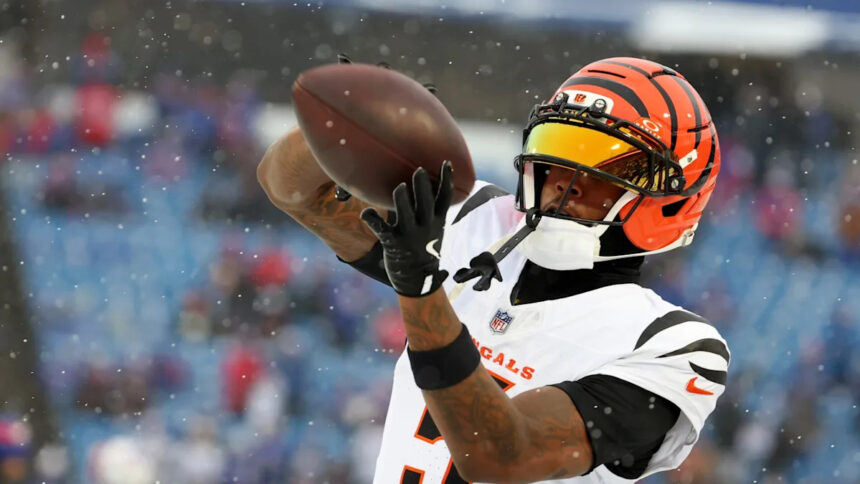
Tee Higgins’ Concussion Protocol Absence Raises Alarms for Bengals’ Playoff Push
The Cincinnati Bengals’ precarious path to the postseason hit another potential roadblock on Friday, as star wide receiver Tee Higgins was notably absent from practice. This development, reported by ESPN’s Ben Baby, casts a significant shadow over the team’s critical Week 15 matchup and raises urgent questions about the long-term health of one of their offensive cornerstones. After a brief return to action, Higgins’ absence suggests a possible setback in his recovery from a concussion, his second in as many weeks, throwing the Bengals’ offensive blueprint into disarray at the worst possible time.
A Troubling Pattern: Higgins’ History with Head Injuries
The situation surrounding Tee Higgins is concerning not just for its immediate impact, but for the pattern it reveals. Higgins first entered the NFL’s concussion protocol following the Bengals’ Week 12 game, causing him to miss their pivotal Week 13 victory over the Baltimore Ravens. He was cleared in time for Week 14 against the Buffalo Bills, but that game may have proven disastrous for his health. Close analysis of the game film shows multiple, jarring instances where Higgins’ head struck the frozen turf at Paycor Stadium. While he finished the contest, the cumulative effect of those impacts appears to have triggered the protocol once again.
This week’s practice reports now tell a worrying story:
- Wednesday: Higgins listed as a limited participant.
- Thursday: Again listed as limited, a sign his progress was stagnant.
- Friday: Not on the practice field at all, a clear indicator of a regression in his status.
For a player in the protocol, missing Friday’s practice is a near-definitive sign he will not play on Sunday. The NFL’s concussion protocol is a multi-step, non-linear process that requires a player to be symptom-free both at rest and after exertional exercises. A setback at this stage is a serious medical matter, prioritizing long-term neurological health over short-term competitive gain.
The On-Field Void: Analyzing Higgins’ Impact on the Bengals’ Offense
Losing Tee Higgins is not merely about subtracting one player; it fundamentally alters how defenses can attack the Cincinnati Bengals. While Ja’Marr Chase rightfully commands the spotlight as a top-tier NFL wideout, Higgins’ role as the primary “X” receiver and elite possession target is irreplaceable. His 6’4″, 219-pound frame and contested-catch prowess have been a security blanket for quarterback Jake Browning, especially on critical third downs and in the red zone.
His 2023 statistics, while hampered by earlier injuries, underscore his scoring importance:
- 46 Receptions for 667 yards.
- A team-leading 9 Touchdowns in just 12 games.
- A proven, clutch performer in high-leverage situations.
Without Higgins, defenses can allocate more safety help over the top to shadow Ja’Marr Chase, daring other receivers to win one-on-one matchups. It also diminishes the effectiveness of play-action and limits the playbook in the red zone, where Higgins’ size is a premier asset. For an offense now led by a backup quarterback in Jake Browning, the margin for error was already thin. Removing Higgins shrinks that margin exponentially and places an immense burden on Chase and the running game.
Looking Ahead: Predictions for the Bengals’ Offensive Adjustments
With Tee Higgins likely sidelined, the Bengals’ coaching staff must engineer a new offensive identity on the fly. The immediate beneficiary in terms of snap count will be Trenton Irwin, a savvy and reliable route-runner who has made big plays in spot duty before. However, expecting Irwin to fully replicate Higgins’ role is unrealistic. Instead, look for a multi-faceted adjustment strategy from head coach Zac Taylor and offensive coordinator Brian Callahan.
First, increased involvement for the tight ends is a near certainty. Irv Smith Jr. and Drew Sample will be called upon to work the intermediate middle of the field and provide check-down options for Browning. Second, the team may leverage more “11” personnel (1 RB, 1 TE) with three wide receivers, inserting rookie speedster Charlie Jones into the slot to stretch defenses horizontally. Most critically, the game plan will likely center on establishing Joe Mixon and the running game early to control tempo and create more manageable play-action opportunities for Browning.
The long-term prediction is murkier. A second concussion in quick succession invites serious questions about Higgins’ availability for the remainder of the season. The Bengals, while in the playoff hunt, have a medical and ethical obligation to prioritize the player’s health. If symptoms persist, the organization must be prepared for the possibility that Higgins’ 2023 campaign could be over.
A Critical Crossroads for Player and Franchise
The absence of Tee Higgins from Friday’s practice is a sobering moment for the Cincinnati Bengals. It transcends the typical week-to-week injury report and touches on the ever-present dangers of a violent sport. For Higgins, this is a personal health journey that must be handled with extreme caution, regardless of the playoff stakes. For the franchise, it is a stark test of their depth and strategic adaptability.
As they prepare for a must-win game, the Bengals’ identity is once again in flux. Can Jake Browning elevate a depleted receiving corps? Can the defense shoulder more responsibility? The answers to these questions will define their season. But the larger, more important question hangs over it all: ensuring the long-term well-being of a young star whose recent history with head trauma has become a troubling, and unavoidable, narrative. The hope for Sunday is a Bengals victory; the hope for Tee Higgins is a full and complete recovery, on a timeline dictated solely by medicine, not by urgency.
Source: Based on news from Yahoo Sports.