From Europa League Glory to Gallery Walls: The Unlikely Second Act of Alfie Whiteman
There is a photograph inside a Grade II listed art gallery at the Tottenham Hotspur Stadium that captures Alfie Whiteman sitting completely naked on a jetty, staring out over the still, grey waters of Sweden’s Lake Mockeln. In another, he is hanging out of a tumble dryer, a surreal grin plastered across his face. A third shows him celebrating a birthday alone in a dense, silent forest.
“There was no intention of anyone ever seeing these pictures,” Whiteman laughs, scanning the self-portraits that now hang in a space where he once walked the tunnel to the pitch. “But that also just reflects how I was living before—I kind of split my life in two.”
Less than a year ago, the split was simple. One half of Whiteman’s life was a professional footballer sitting on the bench as Tottenham Hotspur defeated Manchester United in Bilbao to win the Europa League. The other half was a quiet, introspective artist who documented his own loneliness and curiosity through a lens. Now, at just 26, the halves have merged. Whiteman has retired from football, traded the pitch for the darkroom, and is launching himself into a dizzying new career as a director, actor, DJ, and photographer.
The Weight of the Trophy and the Silence of the Bench
To understand Whiteman’s radical pivot, you have to understand the peculiar tension of being a homegrown goalkeeper at a club like Tottenham. Whiteman joined the academy at age ten, having watched the 2008 League Cup triumph at Wembley with his father. For more than 15 years, he breathed the air of the club’s training ground, living the dream of every kid kicking a ball on the streets of north London.
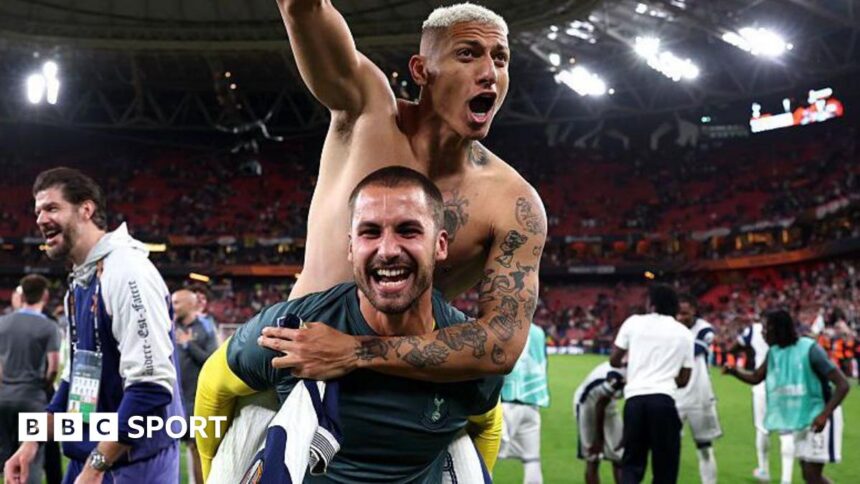
The pinnacle arrived in May 2024. In the cauldron of San Mamés in Bilbao, Tottenham edged past a resilient Manchester United side to lift the Europa League trophy. Whiteman was an unused substitute, a spectator in the most glorious sense. He watched the shootout from the bench, his heart pounding, knowing his role was to be ready but likely never called.
“That night in Bilbao was the greatest feeling of my life,” he says. “The parade through the streets of north London—the same streets I walked to school—was a full-circle moment I will never forget.”
Yet, even as confetti rained down on the open-top bus, Whiteman felt a quiet, nagging pull. The celebration was the culmination of his football life, but it was also a closing door. He had already been splitting his life in two. While teammates scrolled through match footage, Whiteman was editing photo series. While others analyzed set-pieces, he was selecting tracks for a DJ set.
Within months of that triumph, he made the decision that shocked the football world: retirement at 26. He walked away from a contract, from the prestige of being a Europa League winner, and from the only professional identity he had ever known.
Director, Actor, DJ, Photographer: The Four Pillars of a New Life
Whiteman’s post-football career is not a single hobby; it is a multi-platform empire built in fast-forward. He is currently directing a short film, acting in an independent British drama, curating DJ sets for underground London clubs, and—most prominently—mounting a gallery exhibition inside the very stadium where he once defended the goal.
His photography, which forms the core of the exhibition, is raw, vulnerable, and deliberately unpolished. The self-portraits are not glamorous. They are uncomfortable. The image of him naked on the jetty in Sweden is a meditation on isolation. The tumble dryer shot is a commentary on the absurdity of modern life. The birthday in the woods is a stark look at solitude during a career that is supposed to be all team, all the time.
“Football is a collective obsession,” Whiteman explains. “You are never alone. But I was always alone in my head. These pictures are the conversations I was having with myself when no one else was watching.”
His transition to director is a natural extension. He is drawn to stories of men who struggle with identity after their athletic prime—a theme he knows intimately. His acting debut, a small role in a gritty London drama, required him to play a version of himself: a young man adrift after a sudden career change.
“The acting was terrifying,” he admits. “I’ve faced penalty kicks, but standing in front of a camera with a script is a different kind of fear. It’s the fear of being seen for who you really are, not just the jersey.”
His DJ sets, meanwhile, are already gaining a cult following. He mixes deep house with obscure electronic tracks, often playing late-night sets in venues that are a world away from the sanitized hospitality suites of a football stadium. “Music was always my escape. On the bus to away games, I was the one with the headphones on, finding new sounds. Now I get to share that.”
Expert Analysis: Why Whiteman’s Career Pivot Works
From a sports journalism perspective, the story of a young athlete retiring at the peak of his club’s success is usually a cautionary tale. We have seen players burn out, lose motivation, or succumb to injury. But Whiteman’s case is different. He is not leaving football; he is recontextualizing it.
His exhibition inside the Tottenham Hotspur Stadium is a masterstroke of branding. By using the physical space of his former identity—the Grade II listed gallery within the concrete cathedral of modern football—he forces the audience to reconcile the athlete with the artist. The venue itself becomes part of the art.
Furthermore, Whiteman’s multi-hyphenate approach is perfectly aligned with the modern content economy. He is not just a photographer; he is a director who can tell stories, an actor who can embody them, and a DJ who can score them. This is the blueprint for the post-football career of the future—one where the athlete becomes a creator, not just a commentator or a coach.
Prediction: Within five years, Alfie Whiteman will be more famous for his art than his football. His Europa League medal will be a footnote in a biography that centers on his photography and film work. Look for him to direct a documentary about the mental health of young athletes—a subject he understands from the inside out.
His retirement at 26 is not the end of a story. It is the opening chapter of a far more interesting one.
What the Future Holds for the Artist-Goalkeeper
Whiteman stands in the gallery, looking at the portrait of himself hanging out of the tumble dryer. The cycle has turned. He is no longer a goalkeeper waiting for a call that never comes. He is a creator, calling the shots.
“People ask if I miss the pitch,” he says, turning away from the image. “I miss the dressing room banter. I miss the feeling of a clean sheet. But I don’t miss the split. I don’t miss hiding half of myself.”
His exhibition is open to the public, and the reviews have been surprisingly strong. Critics praise the honesty of his work, noting that it avoids the narcissism of many celebrity photo shows. Whiteman is not trying to be a famous photographer. He is trying to be a truthful one.
He also has plans for a documentary series that follows retired footballers as they transition into creative fields. “There are so many of us who feel lost after the final whistle. We are trained to be one thing, and then suddenly we are nothing. I want to show that there is life after the game—and it can be just as exciting.”
For the young fans who remember his name from the Europa League final, Alfie Whiteman will always be the man on the bench in Bilbao. But for a new audience—one that visits galleries, watches independent films, or dances to deep house in a basement club—he will be something else entirely.
He will be the artist who was brave enough to walk away from the trophy to chase the frame.
Conclusion: Alfie Whiteman’s journey is a testament to the fact that a career in football does not have to define a life. By retiring at 26, he has given himself the greatest gift: the time to become whoever he wants to be. The Europa League winner who now directs, acts, DJs, and photographs is not a cautionary tale. He is a pioneer. And his most important exhibition is the one he is still building—frame by frame, beat by beat, shot by shot.
Source: Based on news from BBC Sport.