Tiger Woods’ DUI Arrest: The One Big Question That Could Decide His Fate
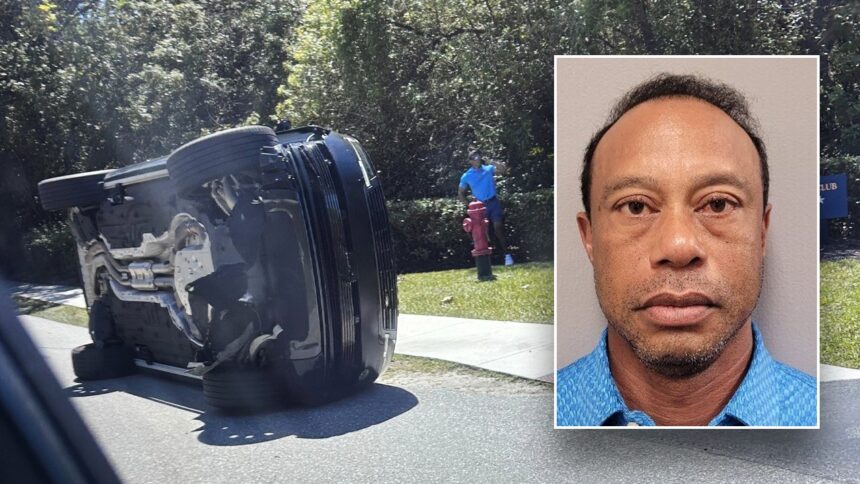
The flashing blue lights illuminated a scene far removed from the manicured greens of Augusta. In the pre-dawn hours of March 27, 2026, Tiger Woods, the most transcendent golfer of his generation, was arrested on a DUI charge following a single-car crash on Jupiter Island, Florida. While the sports world grapples with the jarring image of the 50-year-old icon standing beside his overturned vehicle, legal experts are dissecting a critical decision Woods made that morning—a refusal that may define the entire case against him.
The Arrest and the Pivotal Refusal
According to Martin County Sheriff John Budensiek, Woods was driving at “a high rate of speed” when he lost control of his vehicle. The initial on-scene breathalyzer test yielded a surprising result: “triple zeroes,” indicating no detectable alcohol. Yet, when authorities requested a urine sample for further chemical testing, Woods refused. This single act, legal analysts say, has shifted the entire landscape of the impending legal battle.
This refusal is not a simple act of defiance. Under Florida’s Implied Consent Law, drivers automatically consent to chemical testing by virtue of holding a license. Refusal triggers immediate administrative penalties, including a one-year license suspension. More critically, it deprives prosecutors of what could be the most damning evidence—or the most definitive proof of innocence.
- On-Scene Breathalyzer: Registered 0.000% Blood Alcohol Content (BAC).
- Urine Sample Request: Refused by Woods at the scene.
- Legal Ramification: Automatic 1-year driver’s license suspension for refusal.
- Evidence Void: No data on prescription medications, THC, or other substances.
Expert Analysis: The Prosecution’s Uphill Climb
Fox News contributor and renowned defense attorney Donna Rotunno provided sharp analysis on ‘Fox & Friends First,’ framing the central dilemma for the state. “The one big question prosecutors now face is how to prove impairment without the concrete, scientific evidence a urine or blood test would provide,” Rotunno explained.
She highlighted that Woods’ documented history of surgeries and past issues with prescription pain medication will inevitably become a focal point. “Prosecutors will look at his history. They will subpoena medical records, pharmacy records, and try to build a circumstantial case that he was under the influence of something that impaired his ability to drive,” Rotunno stated. However, she was quick to note the challenge: “History isn’t evidence of what was in his system that morning. Without the chemical test, they have to rely entirely on observational evidence.”
This observational evidence includes the officer’s account of Woods’ demeanor, the nature of the single-car crash at high speed, and any field sobriety exercises performed. Rotunno suggested the defense will aggressively attack this, arguing that a medical episode, distraction, or simple error could explain the crash. The “triple zero” breathalyzer, she noted, effectively removes the straightforward narrative of alcohol impairment, forcing the state into a more complex and difficult prosecution.
The Shadow of History and the Strategy Ahead
Woods’ 2017 arrest for DUI—an incident where he was found asleep at the wheel with a cocktail of prescription drugs in his system—looms large. Legal experts agree prosecutors will seek to introduce this history to establish a pattern, though such motions are often contested by defense teams as prejudicial.
The defense strategy is predicted to be two-fold:
- Challenge the Cause of the Crash: Attribute the accident to factors unrelated to impairment, such as fatigue, a medical issue related to his extensive past injuries, or road conditions.
- Attack the Probable Cause for the DUI Arrest: Question whether the officer had sufficient evidence of impairment, beyond the crash itself, to justify the DUI charge after the 0.000% breathalyzer result.
Woods’ refusal, while administratively punishing, may be viewed tactically as having robbed the prosecution of its most potent weapon. “He has handed himself a major administrative penalty, but he may have also handed his defense team a major strategic advantage in the criminal case,” one legal analyst not involved in the case observed.
Predictions and Potential Outcomes
The path forward is fraught with uncertainty. Several scenarios are now in play, each hinging on the strength of the state’s circumstantial case.
Scenario 1: The Case Proceeds to Trial. The state, lacking hard toxicology data, would present a mosaic of evidence: the high-speed crash, officer observations, pharmacy records showing valid prescriptions, and expert testimony on how those substances *could* cause impairment. The defense would counter with medical experts of their own, arguing alternative causes for the crash and highlighting the absence of proof. This becomes a high-stakes, public battle of experts and narratives.
Scenario 2: A Plea Deal is Reached. This is widely considered the most likely outcome. To avoid the spectacle and risk of a trial, the state may offer a reduced charge, such as reckless driving. Woods would likely accept, facing penalties like probation, fines, community service, and mandatory DUI education programs—while the administrative license suspension for his refusal remains in effect independently.
Scenario 3: Charges are Reduced or Dropped. If the state determines its case is too weak without chemical evidence, they may preemptively reduce the charge or, less likely, drop it altogether. The refusal penalty from the DMV would stand, but the criminal case would fade.
Conclusion: A Legacy Tested Off the Course
Tiger Woods’ legacy on the golf course is unassailable—a tale of peerless dominance, catastrophic injury, and a historic comeback that cemented his myth. His legacy off the course, however, remains a complex and often troubled narrative. This latest chapter is not about a relapse into alcohol, but about the profound legal and personal consequences of a single decision in a moment of crisis.
The “one big question” Donna Rotunno identified cuts to the core of the American legal system: proof beyond a reasonable doubt. By refusing the urine test, Tiger Woods did not make his legal problems disappear. He instead forced the prosecution to answer that question with one hand tied behind its back. The coming months will reveal whether the circumstantial evidence is enough to convict a global icon, or if the lack of a chemical test result creates the reasonable doubt that secures his freedom. Regardless of the courtroom outcome, the image of that overturned car and the subsequent refusal will remain a pivotal, and painful, moment in the Tiger Woods saga.
Source: Based on news from Fox Sports.