Tom Brady’s Raiders Ownership Throws a Hail Mary on NFL Comeback Dreams
The competitive fire of a seven-time Super Bowl champion is a force of nature, not easily extinguished by the simple declaration of retirement. For Tom Brady, the allure of the gridiron still flickers, but a new, significant obstacle has emerged on his hypothetical path back to the field: his own front office seat. In a revelation that blurs the lines between ownership and athlete, Brady confirmed he explored a potential comeback with the Las Vegas Raiders, only to be met with a firm, if unsurprising, league veto. The saga offers a fascinating glimpse into the NFL’s rigid structural boundaries and the unyielding competitive spirit of its greatest quarterback.
The Inquiry That Rocked the League Office
During a recent interview, Brady shed light on the tantalizing “what if” scenario that has lingered since he purchased a minority stake in the Raiders last year. The future Hall of Famer admitted he directly “inquired” with the NFL about the mechanics of a potential return to play while holding an ownership position. His conclusion was succinct: “They don’t like that idea very much.” This understatement underscores a monumental conflict of interest the league’s governance is simply not built to handle.
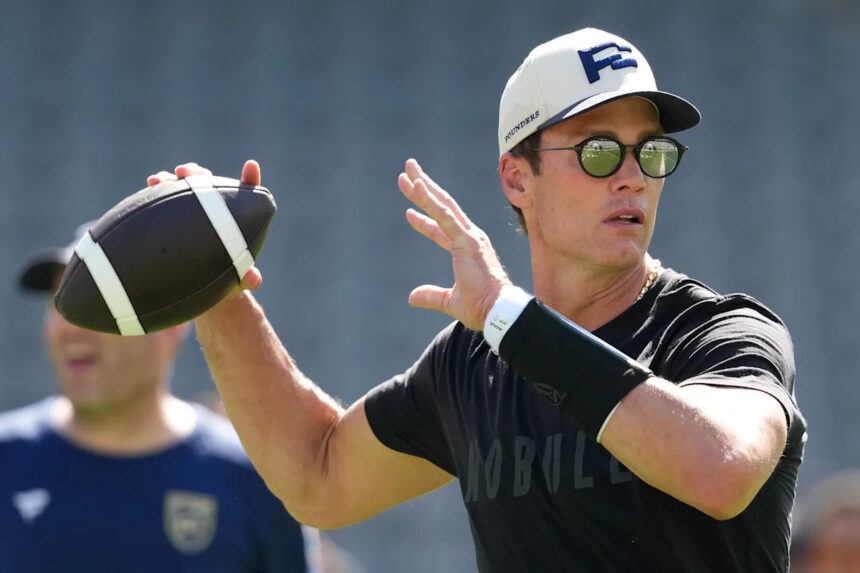
Brady’s exploration wasn’t born in a vacuum. It followed his participation in a recent Flag Football Classic, where, despite his team’s lopsided loss, the 48-year-old delivered a vintage moment—rolling to his right and launching a perfect 40-yard spiral. That single play, a flicker of the old magic, was enough to ignite the speculation machine. Could he still do it? The physical hint, combined with his own admitted curiosity, created a perfect storm of offseason intrigue. However, as Brady himself stated, he is “happily retired,” framing the inquiry as mere due diligence from a man accustomed to leaving no stone unturned.
Why the NFL’s “No” Was the Only Possible Answer
The league’s swift and definitive rejection of this hypothetical scenario is rooted in bedrock principles of competitive integrity and operational protocol. The idea of an owner-suitor presents a labyrinth of conflicts the NFL wants no part of navigating.
- Competitive Integrity and Fair Play: How could the league assure 31 other teams that in-game decisions, roster moves, or even practice squad elevations made by Brady-the-player weren’t influenced by Brady-the-part-owner? The mere perception of impropriety would be damaging.
- Salary Cap and Roster Manipulation: Could Brady play for a league-minimum contract, effectively creating a massive competitive advantage for the Raiders by having a star quarterback not count significantly against the cap? The potential for systemic abuse is obvious.
- The Precedent Problem: Allowing Brady to do this would open a Pandora’s Box. Would star players on the verge of retirement seek minority shares with the understanding they could return? The line between player and owner must remain distinct to preserve league structure.
- Collective Bargaining Agreement (CBA) Complications: Brady would be simultaneously a member of the NFL Players Association (NFLPA) and a member of management. This dual role creates an irreconcilable conflict under the current labor agreement.
Essentially, Brady’s question forced the league to confront a scenario its rulebook never anticipated because it seemed so far-fetched. The answer was a necessary safeguard for the league’s operational credibility.
Brady’s Unprecedented Career Crossroads
Tom Brady finds himself in a uniquely paradoxical position in sports history. He is actively trying to build a post-playing career as a franchise owner and executive while his legendary competitive instincts clearly still simmer. This tension defines his current chapter. His ownership stake in the Raiders and his upcoming role as Fox Sports’ lead analyst represent a deliberate pivot toward influence and legacy-building beyond the helmet and pads.
Yet, the flag football highlight and his own admission reveal that the transition from ultimate competitor to composed executive is not a clean switch. The man who built a career on defying age, odds, and logic was simply testing the boundaries one more time. This episode is less about a genuine comeback plan and more about Brady’s mindset: he is wired to seek every possible edge, understand every rule, and explore every avenue, even those that are ultimately dead ends. It is the same exhaustive processing that made him legendary in the two-minute drill.
What’s Next for Brady and the Raiders?
So, with the comeback door firmly shut (barring a divestment of his ownership stake, which seems highly unlikely), where does this leave all parties? The path forward is now clear and likely less dramatic, but no less impactful.
For Tom Brady, his focus will fully shift to the boardroom and the broadcast booth. His value to the Raiders will be in leveraging his unparalleled football IQ to advise on personnel, culture, and the elusive “winning formula.” His presence in the building is a resource most franchises can only dream of. On television, his deep understanding of quarterback play and high-stakes moments will be instantly valuable.
For the Las Vegas Raiders, the fantasy of Brady under center is over. The reality of his influence begins. The team must continue building around young quarterback Aidan O’Connell or a future draft pick, with Brady providing guidance from above. His competitive hunger, now channeled solely into ownership, could become a driving force in the franchise’s quest to return to relevance.
For the NFL, this incident may prompt a quiet review of ownership bylaws to further codify the separation between equity and eligibility. It served as a stress test on the league’s governance, one it passed by upholding long-standing principles.
The Final Whistle on a Legend’s Playing Days
Tom Brady’s exploratory question to the league office will go down as one of the most intriguing footnotes in a career full of headlines. It was a hypothetical hail mary, launched from the owner’s suite rather than the pocket. While the NFL’s defense held firm, the play call itself reminds us of what made Brady singular: an relentless, almost obsessive, desire to compete and a mind constantly probing for an advantage.
The ultimate conclusion is that the rules of the front office, unlike the rules of a football game, are not something even the GOAT can bend to his will. His playing career, for real this time, appears to have met its final, immovable defense. The legacy now evolves from quarterbacking dynasty to shaping one, proving that for athletes of a certain stature, the transition from legend to architect is the next, and perhaps greatest, challenge. The comeback chapter is closed, but the influence of Tom Brady on the National Football League is entering a powerful new phase.
Source: Based on news from Yahoo Sports.