Tom Brady’s Bold NFL Comeback Inquiry: Why the League Shut Down the Owner-Player Dream
The competitive fire of a seven-time Super Bowl champion is a force that retirement papers and a front-office title can scarcely contain. Tom Brady, the architect of the greatest career in NFL history, is officially a retired quarterback and a minority owner of the Las Vegas Raiders. Yet, in a revelation that sent shockwaves through the sports world, Brady admitted he recently explored the unprecedented idea of merging those two roles—suiting up for the Raiders while holding an ownership stake. The NFL’s response, according to Brady himself, was a swift and definitive veto. This isn’t just a quirky “what if” scenario; it’s a profound exploration of league power, competitive integrity, and the unyielding drive of a legend who still hears the call of the gridiron.
- The Flag Football Tease and the Owner’s Curiosity
- The NFL’s Immediate Rejection: Protecting the Sanctity of the Shield
- Expert Analysis: The Unprecedented Crossroads of Legacy and Protocol
- Predictions: What This Means for Brady, the Raiders, and the NFL
- Conclusion: The Legend Who Couldn’t Be Contained by a Title
The Flag Football Tease and the Owner’s Curiosity
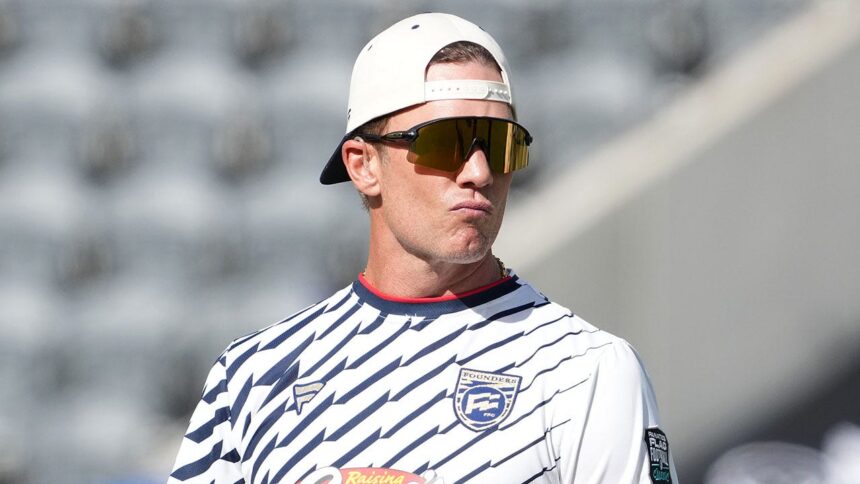
Just weeks before his stunning admission, fans were treated to a nostalgic glimpse of the old magic. At a flag football exhibition featuring NFL legends against Team USA, the 46-year-old Brady dropped back and launched a perfect touchdown pass to star receiver Stefon Diggs. He then connected with his longtime teammate, Rob Gronkowski, for a two-point conversion. The sequence was effortless, a haunting reminder of the precision that defined two decades of dominance. It was a controlled environment, but it proved the engine still hums.
This display of enduring skill coincided with Brady’s evolving role with the Las Vegas Raiders. Having purchased a minority stake in the franchise, his focus was presumed to be solely on boardrooms and long-term strategy. However, in an interview with CNBC, Brady peeled back the curtain on a far more tantalizing thought process. “I actually have inquired, and they don’t like that idea very much,” Brady stated, referring to the NFL league office. He added, “We explored a lot of different things, and I’m very happily retired. Let me just say that, too.” That final clause—the insistence on his happiness in retirement—felt like a necessary disclaimer after lobbing such a provocative grenade into the public discourse.
The NFL’s Immediate Rejection: Protecting the Sanctity of the Shield
The league’s instant dismissal of Brady’s hypothetical comeback as an owner-player is rooted in a bedrock of ethical and operational principles. The NFL’s governance model is built to prevent even the appearance of conflicts of interest, and a playing owner represents the ultimate breach. Imagine the potential scenarios that would plague the league and undermine its credibility:
- Competitive Integrity: Could an owner-player influence roster decisions, playing time, or coaching strategies for personal gain? The mere suspicion would taint every Raiders victory.
- Salary Cap Manipulation: How would Brady’s compensation be structured? Could ownership equity be used to circumvent the NFL salary cap, creating a monumental competitive imbalance?
- Player Safety and Leverage: As an owner, Brady would technically be part of management. This creates an untenable dynamic in a locker room and would complicate the NFL Players Association’s role in protecting its members.
- A Dangerous Precedent: Allowing one legend to bypass rules sets a precedent. Would the door then be open for other wealthy stars to seek similar hybrid roles?
The NFL’s rejection wasn’t about doubting Brady’s ability; it was about protecting the league’s foundational structure. The roles of labor and management, clearly defined for decades, cannot be blurred without risking the league’s entire ecosystem. As one league insider might phrase it, the “shield” must be protected from even the most glamorous of existential threats.
Expert Analysis: The Unprecedented Crossroads of Legacy and Protocol
From a sports business and legacy perspective, Brady’s inquiry is fascinating. It operates on two distinct levels: one personal, one professional. On a personal level, it confirms what many have long suspected—Brady’s retirement is a constant negotiation with his own legendary competitiveness. The inquiry wasn’t necessarily a serious plan, but more likely a probe to see if the universe of possibilities had any flexibility. It was Brady testing the boundaries, as he always has, even in retirement.
Professionally, this move can be seen as a savvy power play. By publicly revealing the league’s rejection, Brady positions himself as the ultimate competitor, silenced not by age or skill, but by bureaucracy. It burnishes his mythos as the guy who would still play if they’d only let him. Furthermore, it highlights the unique and somewhat awkward position of a minority owner who is also the most famous athlete in the sport’s history. His presence in the Raiders facility, even in a suit, inherently challenges traditional owner-player dynamics.
Football purists and analysts are united on the league’s decision. “The NFL made the only call it could,” says a veteran NFL columnist. “This isn’t the NBA, where Michael Jordan returned as a Wizard while owning part of the team. The NFL’s parity model is its golden goose. Introducing an owner, especially one of Brady’s stature, into the lineup would have been a Pandora’s box the league could never close.”
Predictions: What This Means for Brady, the Raiders, and the NFL
While the comeback door is firmly shut by league decree, the fallout from this episode will shape several narratives moving forward.
For Tom Brady: His playing career is definitively over. This inquiry was the final, formal exploration. He will now channel his competitive energy into ownership, broadcasting for Fox Sports, and building his business empire. However, his comments ensure that any Raiders struggle, particularly at quarterback, will be met with a chorus of “what if” from fans and media, adding a layer of pressure to the franchise he now helps lead.
For the Las Vegas Raiders: The organization gains an owner with an unparalleled football IQ, but also one whose shadow looms large. His relationship with the team’s general manager, head coach, and starting quarterback will be scrutinized like no other minority owner in history. Every piece of advice or sideline observation will be parsed for deeper meaning.
For the NFL: The league will likely review and potentially formalize rules regarding owner involvement in football operations to prevent future gray areas. Brady’s probe, though rebuffed, exposed a hypothetical loophole that the league will now seek to permanently cement shut. It also sets a clear boundary for any future legend-investor who might entertain similar thoughts.
Conclusion: The Legend Who Couldn’t Be Contained by a Title
Tom Brady’s failed attempt to become the NFL’s first owner-player is the perfect capstone to a career defined by pushing limits. He pushed his body, his teammates, and the rules of the game to their absolute extremes, securing a legacy of victory that may never be matched. In retirement, he has now tested the limits of the league’s constitution itself. The NFL, guardian of its own parity and integrity, pushed back. Brady’s admission is a testament to an addiction to competition that ownership alone cannot satisfy. It confirms that for athletes like Brady, retirement is not an off-switch, but a dial they are constantly trying to turn back up. While we will never see him take a snap as a Las Vegas Raider owner, the mere fact that he asked the question ensures that the legend of Tom Brady—the competitor who never quit asking “what if?”—will continue to grow long after his final pass.
Source: Based on news from Fox Sports.