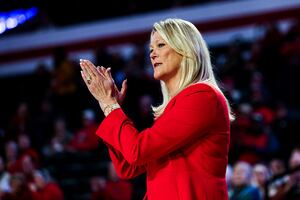
UGA Women’s Basketball Enters New Era as Katie Abrahamson-Henderson Departs
In a move that reverberates through the landscape of SEC basketball, the University of Georgia and head women’s basketball coach Katie Abrahamson-Henderson have mutually agreed to part ways. The announcement, made official by the athletic department on Saturday, concludes a four-season tenure marked by moments of promise but ultimately falling short of the storied program’s championship aspirations. The departure of “Coach ABE” sends the Lady Bulldogs into a pivotal offseason search, igniting immediate speculation about the future of one of the nation’s most tradition-rich programs. This decision underscores a clear message from Athens: the standard for Georgia women’s basketball is a return to national prominence.
A Tenure of Transition: The Coach ABE Era in Review
Katie Abrahamson-Henderson arrived in Athens in 2022 with a formidable reputation as a program builder, having orchestrated remarkable turnarounds at UCF and Albany. Her task was clear: restore the luster to a Georgia program that had seen inconsistent results in the years following the legendary Hall of Fame coach Andy Landers. Her tenure, resulting in a 69-59 overall record, was a study in contrasts.
On one hand, Coach ABE secured two NCAA Tournament appearances, a baseline expectation in Athens. She navigated the program through the turbulent waters of conference realignment and the transfer portal era, consistently fielding competitive, defensively-minded teams. Her teams were known for their toughness and resilience, hallmarks of her coaching philosophy.
However, the trajectory failed to show the upward climb many hoped for. The Lady Bulldogs struggled to break through in the gauntlet of the SEC conference, often finishing in the middle of the pack. A lack of deep postseason runs—with no trips to the tournament’s second weekend—and occasional high-profile transfers out of the program created a sense of stagnation. While the record was above .500, the gap between Georgia and the SEC’s elite programs like South Carolina, LSU, and Tennessee appeared to widen, not narrow.
Decoding the Decision: Why a “Mutual” Parting Now?
The term “mutually agreed to part ways” is common in coaching change lexicon, but it often hints at a shared recognition that a plateau has been reached. For UGA Athletic Director Josh Brooks, the statement is telling. By immediately emphasizing a commitment to “building on the proud tradition” and providing “necessary resources for future success,” Brooks signals that this decision is proactive, not reactive. It is a declaration that mere tournament appearances are not the ultimate goal.
Several factors likely converged:
- Recruiting Momentum: While Coach ABE landed talent, the fierce competition for top-tier recruits in the SEC and nationally proved challenging. A change in leadership can reinvigorate a program’s recruiting narrative.
- Competitive Benchmark: The meteoric rise of other SEC programs has reset expectations. Fans and administrators see rivals winning national championships and making Final Fours, raising the bar for what is possible.
- Program Identity: After four seasons, the program’s identity under ABE was firmly set. The administration may have believed a new vision was required to reconnect with the program’s past glory and attract a new generation of stars.
This was not a dismissal for failure, but a strategic divergence in vision for how to achieve top-tier success.
The Georgia Job: A Premier Opportunity in a New Landscape
Despite recent challenges, the Georgia Lady Bulldogs basketball head coaching position remains one of the most attractive in the country. Any candidate will be presented with a compelling sales pitch from Josh Brooks and the search committee.
Key selling points for the next head coach include:
- Unwavering Institutional Support: Brooks’s statement directly addresses resources. UGA has the financial capability, facilities (including the recently renovated Stegeman Coliseum), and NIL collective strength to compete at the highest level.
- Fertile Recruiting Ground: The state of Georgia is a hotbed for high school girls’ basketball talent. The right coach with deep regional ties can build a powerhouse by keeping the best players home.
- Proud Tradition and Fan Base: The legacy of Final Fours and elite players under Andy Landers is not forgotten. A passionate, albeit hungry, fan base is ready to rally behind a winner.
- The SEC Platform: Coaching in the SEC means maximum exposure, television deals, and the chance to compete against the best nightly—a major draw for competitive coaches.
The question now becomes: what profile will UGA target? Will they seek a proven, sitting head coach from a mid-major looking for a power-conference leap? Will they pursue a top assistant from a championship-caliber program? Or will they make a splash with a established, big-name coach?
Predictions and Potential Candidates for the Lady Bulldogs
The search to lead the UGA women’s basketball program will be one of the most watched in the offseason. Expect Athletic Director Josh Brooks to move swiftly but thoroughly. Here are some potential candidate profiles and names that will likely surface in speculation:
The Proven Program Builder: A coach with a track record of taking a team to the NCAA Tournament and winning games once there. Think of coaches at strong mid-major or lower-power conference programs who have consistently overachieved.
The SEC or Power Conference Insider: An associate head coach or top assistant from a program like South Carolina, LSU, or Stanford. This candidate would bring immediate recruiting connections, familiarity with the league’s brutality, and experience in a championship culture.
The Homecoming Narrative: A coach with deep ties to Georgia or the Southeast. This could include former UGA standouts now in coaching or coaches who have deep recruiting roots in the Atlanta area. The emotional pull of “coming home” can be powerful for fans and recruits alike.
The High-Risk, High-Reward Splash: While perhaps less likely, Georgia has the resources to make a run at a currently employed, highly successful coach from another power conference. This would be a statement hire that would instantly energize the fanbase and send shockwaves through the recruiting world.
Regardless of the direction, the hire must be a unifier—someone who can articulate a clear vision, embrace the program’s history while forging a new path, and, most critically, recruit at an elite level in the modern NIL and transfer portal era.
Conclusion: A Pivotal Crossroads for a Storied Program
The mutual parting with Katie Abrahamson-Henderson represents more than a simple coaching change; it is a strategic recalibration for Georgia women’s basketball. The Coach ABE era provided stability and postseason bids, but the administration’s decisive move confirms that stability alone is insufficient. The standard in Athens, built over decades, is to contend for SEC titles and make deep runs in March.
This moment is a critical crossroads for the Lady Bulldogs. The pressure now shifts squarely onto the shoulders of Josh Brooks to deliver a hire that matches the ambition of his own statements. The next coach will inherit a program with every tool needed to succeed: resources, tradition, and location. The task will be to synthesize those elements into a team that can not only reach the NCAA Tournament but dominate once there.
For the players, fans, and recruits watching closely, the message from Saturday’s announcement is clear: the Georgia women’s basketball program is open for business and aiming for the summit. The foundational work of the past four seasons is over. The build toward a championship future begins now. The eyes of the college basketball world will be on Athens to see who leads that charge.
Source: Based on news from Yahoo Sports.